
Painter and sculptor
Constant Nieuwenhuys
Dutch, 1920 – 2005
Stay up to date with this artist
Leave your email to receive updates on newly available works and news about this artist.
Works by Constant Nieuwenhuys
1 work

Constant Nieuwenhuys
Constant Nieuwenhuys (Amsterdam, 1920 – Utrecht, 2005), known artistically as Constant, was a Dutch painter, sculptor, theorist, and designer. A co-founder of the CoBrA movement, he developed an artistic practice spanning Expressionist painting, architectural experimentation, and reflection on contemporary society. His most famous project, New Babylon, envisions a future city in which automation frees people from repetitive work, allowing creativity and play to flourish. Through…
Read the full biographyClose the biography
Constant Nieuwenhuys (Amsterdam, 1920 – Utrecht, 2005), known artistically as Constant, was a Dutch painter, sculptor, theorist, and designer. A co-founder of the CoBrA movement, he developed an artistic practice spanning Expressionist painting, architectural experimentation, and reflection on contemporary society. His most famous project, New Babylon, envisions a future city in which automation frees people from repetitive work, allowing creativity and play to flourish. Through paintings, drawings, models, collages, and writings, Constant transformed art into a means of reflecting on the relationship between individuals and their environment. After a long period devoted to experimental urban planning, he returned to painting, exploring themes related to the human condition.
Training in Amsterdam
Constant Anton Nieuwenhuys was born in Amsterdam on July 21, 1920. From a young age, he showed an interest in drawing and music. He attended the school of applied arts in Amsterdam. He later studied at the Rijksakademie van Beeldende Kunsten. His education unfolded during a period marked by Europe’s political and cultural transformations. Constant gradually became interested in the expressive possibilities of modern painting.
The War Years
During the Second World War, Constant continued to paint. The conflict had a profound influence on his conception of art. Destruction and social transformations contributed to the development of an artistic practice that assigned a fundamental role to creativity. After the war, the artist sought a language capable of going beyond academic conventions.
L'The meeting with Asger Jorn
In 1946, Constant met Asger Jorn in Paris. The encounter marked a decisive moment. The two artists shared an interest in free, spontaneous painting capable of expressing emotions. Their exchange contributed to the birth of a new artistic direction. The avant-garde tradition was reinterpreted through a particular focus on instinctive creativity.
The Dutch Experimental Group
In 1948, Constant took part in founding the Dutch Experimental Group. Key figures included Karel Appel and Corneille. The group published the magazine Reflex. L'The aim was to develop an artistic language free from traditional conventions. Painting was considered a means of immediate expression.
The Birth of CoBrA
In 1948, Constant took part in founding the CoBrA movement. The name derives from the initials of Copenhagen, Brussels, and Amsterdam. The group brought together artists and writers from various European countries. Key figures included Karel Appel, Corneille, Asger Jorn, Christian Dotremont, and Joseph Noiret. The movement placed particular importance on spontaneity. Its references included children's drawings, folk art, and non-academic forms of expression.
CoBrA painting
During the CoBrA period, Constant created artworks characterized by intense colors and expressive forms. Figures may appear distorted. The mark takes on an energetic character. The composition does not necessarily follow the rules of traditional representation. L'the artist seeks a language capable of expressing emotions and tensions.
The social significance of art
For Constant, artistic research is not concerned only with formal problems. L'art can contribute to the transformation of society. Creativity is considered a fundamental possibility of human experience. This conception would accompany all his work. After CoBrA disbanded in 1951, his interest in the relationship between the individual and society became even more evident.
Moving beyond painting
During the 1950s, Constant developed a growing interest in architecture and urban planning. Painting no longer seemed sufficient to him for addressing certain social issues. L'the artist began to imagine environments capable of fostering new ways of life. His research gradually shifted toward habitable space.
L'unitary urbanism
Constant engages with the research of the Situationist International. The concept of unitary urbanism proposes transforming the urban environment by integrating architecture, art, and everyday life. The city should not be organized solely around production and circulation. It can become a space for experience and creativity. These ideas contribute to the creation of the New Babylon project.
New Babylon
New Babylon represents Constant's most famous project. Developed between the second half of the 1950s and 1974, it envisions a future city characterized by modifiable structures. L'automation makes it possible to reduce the labor required for production. Individuals can devote more time to creativity. L'the urban environment becomes flexible. Spaces are transformed according to the needs of their inhabitants.
L'Homo Ludens
The New Babylon project is linked to the concept of Homo Ludens, developed by the historian Johan Huizinga. Lhuman being is also understood in terms of the capacity to play and create. Constant imagines a society in which play is not merely a recreational activity. It becomes a fundamental dimension of life. The city must therefore offer opportunities for continual transformation.
Architectural models
For New Babylon, Constant created numerous three-dimensional models. The structures were built using different materials. The models make it possible to visualize suspended environments, connections, and complex spaces. The design does not correspond to an urban plan intended for immediate implementation. It constitutes a utopian reflection on the possibilities of future society.
Drawings, collages, and graphic art
The project also includes drawings, collages, photographs, and graphic artworks. The images make it possible to represent imaginary structures and environments. Graphic art becomes a tool for design and communication. The prints play a fundamental role in building New Babylon's visual universe.
The return to painting
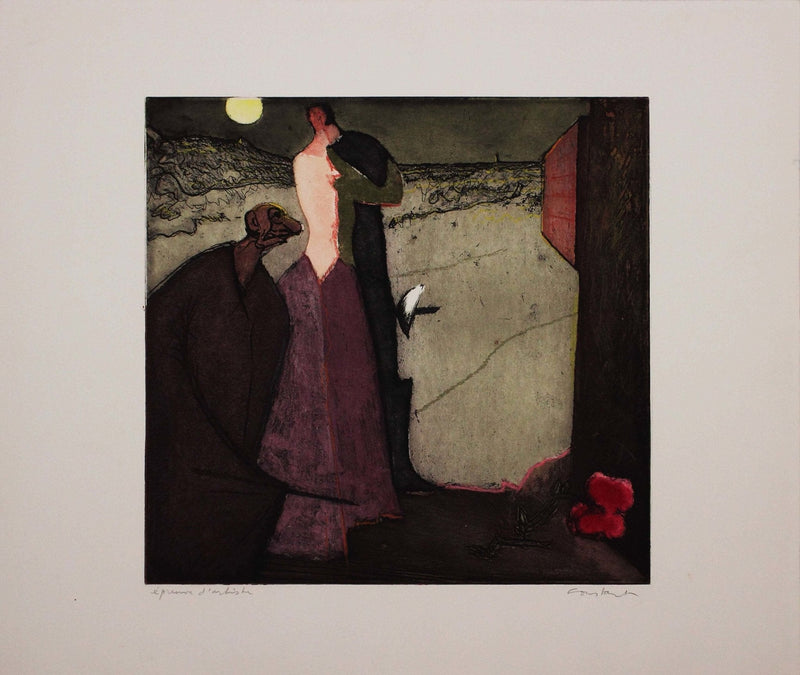
In 1974, Constant concluded the main period devoted to New Babylon and returned to painting. His work once again focused on the human figure. The artworks often explore themes related to social conditions and contemporary contradictions. The color and composition retain a strong expressive intensity.
Late work
During the final decades of his life, Constant continued to paint. His images may feature figures and situations marked by psychological tension. His artistic inquiry retained a critical dimension. L’artista continued to question the relationship between the individual and society.
International recognition
Constant's artworks are held in major European museums. The Kunstmuseum Den Haag holds one of the most important collections dedicated to New Babylon. His work is studied in the context of the history of the avant-garde and experimental urban planning.
L's artistic legacy
Constant dies in Utrecht on August 1, 2005. His research represents a fundamental contribution to the history of European art in the second half of the twentieth century. Through CoBrA and New Babylon, he explored the relationship between creativity and social transformation. His work shows how art can become a tool for imagining new forms of life and spatial organization.
Do you like Constant Nieuwenhuys?
Leave your email to receive updates on newly available works and news about this artist.
Constant Nieuwenhuys
Art that lives in your spaces
Choosing a work by Constant Nieuwenhuys means making room for an individual artistic language. The works gathered here suggest combinations and perspectives to bring into your own surroundings, letting art guide your gaze.

DISCOVER THE ARTIST
Frequently asked questions
Answers to common questions about Constant Nieuwenhuys, the artist’s life, works and value on the art market.
Who was Constant Nieuwenhuys?
Constant Anton Nieuwenhuys (1920–2005), known as Constant, was a Dutch artist active in painting, sculpture and experimental design. He participated in the CoBrA group and subsequently developed New Babylon, a utopian project dedicated to new ways of inhabiting the city.
What was the CoBrA movement and what role did Constant play?
CoBrA was an international avant-garde movement founded in 1948, whose name derives from Copenhagen, Brussels and Amsterdam. Constant was among the protagonists of its birth; the group valued spontaneity, experimentation and non-academic forms of expression.
What is New Babylon by Constant?
New Babylon is a project developed by Constant starting from the late 1950s: it imagines a transformable urban environment, destined for a society in which play and creativity have a central role. It is expressed through models, drawings, maps and texts, not as a truly built city.
How does Constant's painting change after CoBrA?
Constant's production goes through different phases. After the expressive works associated with CoBrA, his interest in space, architecture and social transformation orients his work towards New Babylon; later he also returns to different pictorial solutions. To describe a work it is essential to place it in its period.
How to identify an original graphic work by Constant?
It is necessary to check the printing technique, support, possible numbering and signature, publisher, date and origin. An original lithograph or screenprint in print run is not the same as a photomechanical reproduction; the simple appearance of the image is not enough to establish this.