
Painter
Achille Perilli
Italy, 1927–2021
Stay up to date with this artist
Leave your email to receive updates on newly available artworks and news about this artist.
Artworks by Achille Perilli
1 artwork

Biography of Achille Perilli
Achille Perilli (Rome, 1927 – Orvieto, 2021) was a central figure of post-war Italian abstraction and one of the artists who most radically questioned traditional geometry. His compositions are populated by inclined structures, impossible volumes, joints and chromatic backgrounds that seem to defy the rules of perspective. Behind the apparent visual game lies rigorous research on the relationship between order and invention, rule and imagination.
Read the full biographyClose the biography
Achille Perilli (Rome, 1927 – Orvieto, 2021) was a central figure of post-war Italian abstraction and one of the artists who most radically questioned traditional geometry. His compositions are populated by inclined structures, impossible volumes, joints and chromatic backgrounds that seem to defy the rules of perspective. Behind the apparent visual game lies rigorous research on the relationship between order and invention, rule and imagination.
Form 1 and the defense of abstraction
In 1947 Perilli participated in the founding of the Forma 1 group, together with artists including Carla Accardi, Piero Dorazio, Pietro Consagra, Giulio Turcato and other protagonists of the new Roman generation. The manifesto claimed the value of abstract art in a cultural context characterized by the comparison between figuration, political commitment and experimentation. Perilli thus contributed to a period in which formal research was understood as a cultural choice and as an affirmation of freedom.
His interest was not limited to painting. The magazines, the theoretical debate and the collaboration with poets and intellectuals had a significant impact on his career. With Gastone Novelli he directed The modern experience and was among the promoters of Grammatica, editorial experiences that testify to the attention to the relationship between image, writing and language.
The birth of Forma 1 took place in the post-war period in which the relationship between art and society was the subject of heated discussions. Claiming abstraction meant affirming that cultural commitment should not necessarily coincide with the recognizable representation of a subject. Perilli participated in this choice with a strong attention to language: shape, rhythm and color could constitute autonomous tools of knowledge.
The comparison with poets and writers strengthened this belief. An abstract composition can be read as a sequence of visual events, in which one element recalls the next without having to illustrate a story. The page and the painting then share a problem: how to organize signs and pauses so that they produce a significant experience. This sensitivity to the relationships between languages remained present even in his mature artworks.
From graphic narration to irrational geometry
In the early stages of the research, Perilli's surfaces host sequences of signs and abstract shapes that seem to allude to a story without recognizable characters. The composition proceeds through rhythms, intervals and variations, almost as if it were a writing to be followed with the eyes. Subsequently, the artist delves into the construction of an imaginary space, in which geometry ceases to guarantee stability and becomes a tool for producing surprise.
From the 1970s onwards, machineries emerged particularly clearly: structures that resemble geometric solids, machines or architecture, but present deliberately incongruent spatial relationships. Planes and edges seem to meet in ways incompatible with the usual perspective. The colour, often bright and contrasting, accentuates this instability, while the image retains an almost planning precision.
The apparent paradox of Perilli's structures consists in their executive rigor. The lines can be clear, the surfaces carefully delimited and the colors distributed according to a recognizable order; however, when the gaze tries to reconstruct the object in space, it encounters impossible passages. A face seems to belong to two different volumes, a direction is reversed and an element appears simultaneously in front of and behind another.
The result is not a simple optical trick. Perilli questions the confidence with which we interpret images as representations of a coherent space. The viewer seeks a solution, but the artwork continues to elude a definitive reading. Color contributes to this experience, because it can reinforce an apparent depth and immediately contradict it. Geometry becomes a territory of imaginative freedom.
Imagination as a method
In the Manifesto of the crazy image in imaginary space of 1971 and in the subsequent reflection on the geometric irrational, Perilli claimed the possibility of building images that did not obey ordinary logic. His is not a rejection of discipline: it is rather the conscious use of rules to open up an unpredictable dimension. Painting thus becomes a laboratory in which visual thought can proceed beyond what appears possible.
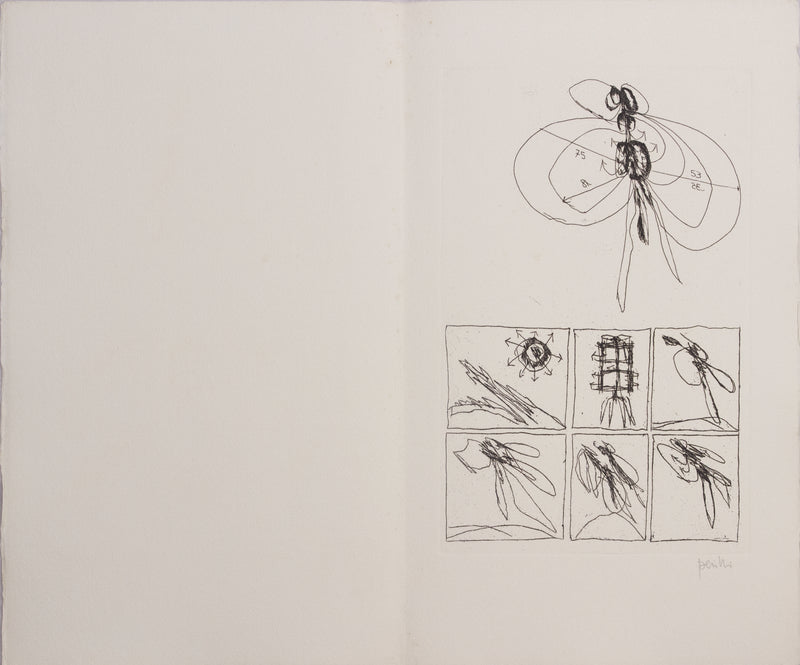
Perilli also worked with scenography, drawings and graphic artworks. In the prints, the relationship between lines, backgrounds and chromatic superimpositions allows us to grasp the construction of his images with particular clarity. Screen printing, lithography, engraving and reproduction must not, however, be considered interchangeable: for each artwork it is necessary to verify the actual process, the print run and any editorial data.
Present in important exhibitions, including the Venice Biennale, Perilli has left a recognizable language for audacity and coherence. His artworks show that geometry is not only a measure of real space: it can also become a grammar of the absurd, capable of generating images that are both exact and impossible.
This research dialogues with a broad conception of the avant-garde, in which painting, writing and theater can undermine consolidated perceptive habits. The scenography, in particular, allows you to experiment with relationships between forms and physical space, transforming the intuitions of the canvas into environments crossed by bodies and movement. The graphic artwork instead allows you to focus attention on the precision of the lines and the balance of the backgrounds.
To understand an artwork by Perilli it is useful to observe the relationship between overall structure and details. From a distance a composition may appear to be a unitary solid; up close, discontinuities and contradictions emerge. The same image thus requires two ways of looking. In paper editions this effect also depends on the quality of the print and the fidelity of the color relationships: therefore it is important to distinguish a graphic original conceived by the artist from a subsequent reproduction.
The value of his research lies in having transformed a discipline traditionally associated with measurement into a language capable of generating wonder. The irrational does not eliminate form: it arises from its conscious organization and the possibility of imagining spaces that do not exist in everyday reality.
Do you like Achille Perilli?
Leave your email to receive updates on newly available artworks and news about this artist.
Achille Perilli
Art that lives in your spaces
Marks, rhythms and forms: artworks by Achille Perilli bring a new sense of balance to a space. Understated furnishings give the composition room to breathe and invite you to rediscover it every day from a different perspective.
DISCOVER THE ARTIST
Frequently asked questions
Answers to common questions about Achille Perilli, the artist’s life, artworks and value on the art market.
Who was Achille Perilli?
Achille Perilli (1927–2021) was an Italian painter who was a protagonist of post-war abstraction. His research is known for geometric structures, intense colors and shapes that seem to question traditional perspective.
Was Achille Perilli part of the Forma 1 group?
Yes. Perilli was among the founders of Forma 1, a group born in Rome in 1947 which supported abstract research in a moment of intense debate on the relationship between art and society.
Why do Achille Perilli's geometries seem impossible?
The artist combines planes and volumes according to ambiguous spatial relationships. The eye attempts to reconstruct a three-dimensional object, but the shapes often contradict the rules of conventional perspective.
What graphic techniques did Achille Perilli use?
Alongside painting, Perilli has created artworks on paper and original graphics. To identify the technique of a specific example it is necessary to consult the artwork sheet, distinguishing lithography, silk-screen printing and other procedures.
How to recognize and evaluate a screenprint by Achille Perilli?
Check signature, numbering, print run, format, possible publisher and condition of the sheet. The evaluation also depends on the quality of the image and comparisons with copies of the same edition.