
Painter, printmaker and writer
Leonardo Castellani
Italy, 1896–1984
Stay up to date with this artist
Leave your email to receive updates on newly available artworks and news about this artist.
Artworks by Leonardo Castellani
2 artworks

Biography of Leonardo Castellani
Leonardo Castellani (Faenza, 1896 – Urbino, 1984) was one of the greatest Italian printmakers of the 20th century, as well as a painter, writer, and teacher. His graphic oeuvre is distinguished by his mastery of etching and his ability to transform landscapes, architecture, and everyday subjects into images of intense poetic sensibility. After an early interest in Futurism and ceramics, he developed a personal style…
Read the full biographyClose the biography
Leonardo Castellani (Faenza, 1896 – Urbino, 1984) was one of the greatest Italian printmakers of the 20th century, as well as a painter, writer, and teacher. His graphic oeuvre is distinguished by his mastery of etching and his ability to transform landscapes, architecture, and everyday subjects into images of intense poetic sensibility. After an early interest in Futurism and ceramics, he developed a personal style rooted in observing nature and constructing tonal values. From 1930, he taught intaglio at the Urbino School of Book Arts, helping train numerous artists. His body of work includes more than fifteen hundred engraved plates and represents a fundamental chapter in the history of Italian printmaking.
Education in Faenza
Leonardo Castellani is born in Faenza on October 19, 1896. He comes from a family of cabinetmakers. L'ambiente familiare encourages him to engage with materials and artisanal techniques. From a young age, he shows an interest in drawing and the visual arts. Between 1914 and 1915, he attends the sculpture program at the Academy of Fine Arts in Florence. During this period, he also meets Osvaldo Licini.
The War and Futurism
Between 1915 and 1920, he serves in the military. In the following years, he comes into contact with the ideas of Futurism. He meets Filippo Tommaso Marinetti and Giacomo Balla. His engagement with the avant-garde broadens his artistic education. L'interest in Futurism focuses above all on the possibility of moving beyond the conventions of traditional representation.
Ceramics
During the 1920s, Castellani also devotes himself to ceramics. In Cesena, he establishes an artistic ceramics workshop. L'experience allows him to explore the relationship between form, surface, and decoration in greater depth. His knowledge of materials contributes to his later engraving practice. Ceramics represent an important phase of experimentation.
Early exhibitions
In the 1920s, Castellani takes part in important art events. He exhibits at the Venice Biennale and other national exhibitions. In 1927, he holds one of his first solo exhibitions. His oeuvre still includes painting, sculpture, and ceramics. Gradually, however, printmaking takes on an increasingly central role.
Discovering intaglio
Castellani approaches intaglio as a self-taught artist. The process requires an in-depth knowledge of the plate and printing techniques. L'artista experiments with different engraving methods. The mark becomes a tool for constructing images through light and shadow. Printmaking becomes the main focus of his research.
The Urbino School of Book Arts
In 1930 Castellani was appointed to teach intaglio at the Institute for Book Illustration and Decoration in Urbino. He held the chair for thirty-eight years. L teaching activity contributed to the training of numerous printmakers, including Nunzio Gulino, Arnoldo Ciarrocchi, and Walter Piacesi. The School of the Book became an important center of Italian graphic art. Castellani played a fundamental role in sustaining the printmaking tradition.
L etching
L etching is the principal language of Castellani's oeuvre. The technique makes it possible to construct images through lines incised on a metal plate. The varying density of the mark helps define tonal values. Castellani uses the process with great sensitivity. The compositions may feature dense surfaces or broad areas of light. The mark serves not only a descriptive function. It helps create the atmosphere of the image.
L aquatint and drypoint
Alongside etching, Castellani also uses aquatint and drypoint. L aquatint makes it possible to create tonal surfaces. Drypoint produces lines characterized by a particular softness. The techniques are used according to the needs of the composition. Knowledge of intaglio processes allows the artist to construct remarkably complex images.
The landscape
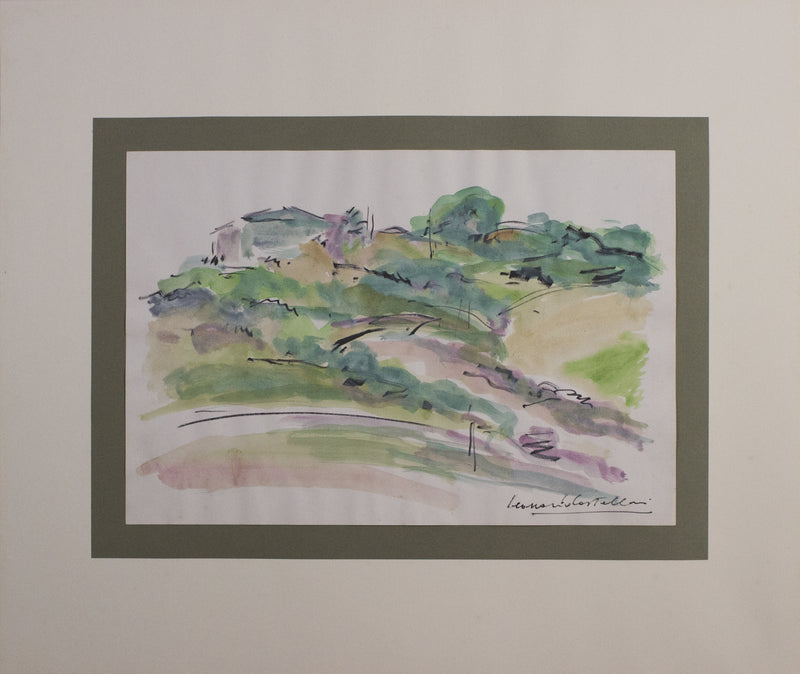
The landscape is one of the fundamental subjects. Castellani observes hills, trees, roads, and architecture. The depiction maintains a direct relationship with nature. L artist, however, does not seek a purely topographical description. He is interested above all in light and atmosphere. The views become images in which time seems to slow down.
Urbino and the Marche region
His stay in Urbino had a profound influence on his oeuvre. The city and the surrounding area offer a repertoire of architectural and natural forms. Hills, roads, and buildings are interpreted through the engraved mark. The Marche landscape becomes a constant presence. The relationship between environment and memory contributes to the poetic dimension of the artworks.
Light and tonal values
One of the most important aspects of Castellani's research is the relationship between light and shadow. The construction of the image depends on the density and distribution of the marks. Light areas can suggest depth and atmosphere. Darker parts accentuate the structure. Line engraving makes it possible to achieve effects of great delicacy.
More than fifteen hundred plates
During his career, Castellani created more than fifteen hundred engraved plates. The scale of his output attests to an exceptional dedication to printmaking. The artworks explore different subjects while maintaining a strong stylistic coherence. L'artista continued to experiment with the possibilities of the mark even after achieving full technical maturity.
Writing
Castellani also pursued an important literary career. His major publications include Pagine senza cornice (1946), Quaderni di un calcografo (1955), Vivere nel tuo paese (1964) and Carte sotto stampa (1974). His writing attests to an ongoing reflection on art and everyday experience. The relationship between printmaking and literature contributes to the complexity of his oeuvre.
The magazine Valbona
Between 1957 and 1961, Castellani founded and directed the magazine Valbona. The publishing project provided another forum for cultural exchange. L'artista also contributed to the magazine Il Mondo. His writing and editorial work accompanied his visual art.
The exhibitions
Castellani took part in numerous Italian and international exhibitions. He repeatedly exhibited at the Venice Biennale. In 1956, he presented a solo exhibition. The National Print Room in Rome and other institutions have devoted exhibitions to his oeuvre. Subsequent retrospectives have helped document the variety of his output.
L's artistic legacy
Leonardo Castellani died in Urbino on November 20, 1984. His oeuvre represents one of the most important contributions to the history of twentieth-century Italian printmaking. His mastery of etching, aquatint and drypoint is combined with a personal poetic sensibility. Through landscapes and everyday objects, he demonstrated how an engraved mark can transform the observation of reality into an experience of light and memory.
Do you like Leonardo Castellani?
Leave your email to receive updates on newly available artworks and news about this artist.
Leonardo Castellani
Art that lives in your spaces
Choosing an artwork by Leonardo Castellani means making room for an individual artistic language. The artworks gathered here suggest combinations and perspectives to bring into your own surroundings, letting art guide your gaze.

DISCOVER THE ARTIST
Frequently asked questions
Answers to common questions about Leonardo Castellani, the artist’s life, artworks and value on the art market.
Who was Leonardo Castellani?
Leonardo Castellani (1896–1984) was an Italian engraver, painter and poet, particularly appreciated for his research in etching. His oeuvre is linked to the careful observation of the landscape, architecture and everyday objects, translated into images of great precision and tonal sensitivity.
Why is Leonardo Castellani important in the history of etching?
Castellani dedicated a central part of his activity to intaglio engraving, developing a sign recognizable for balance, technical control and atmospheric quality. In his prints the light comes from the relationship between lines, bites and whites of the paper, not from the application of colour.
What subjects appear in Leonardo Castellani's engravings?
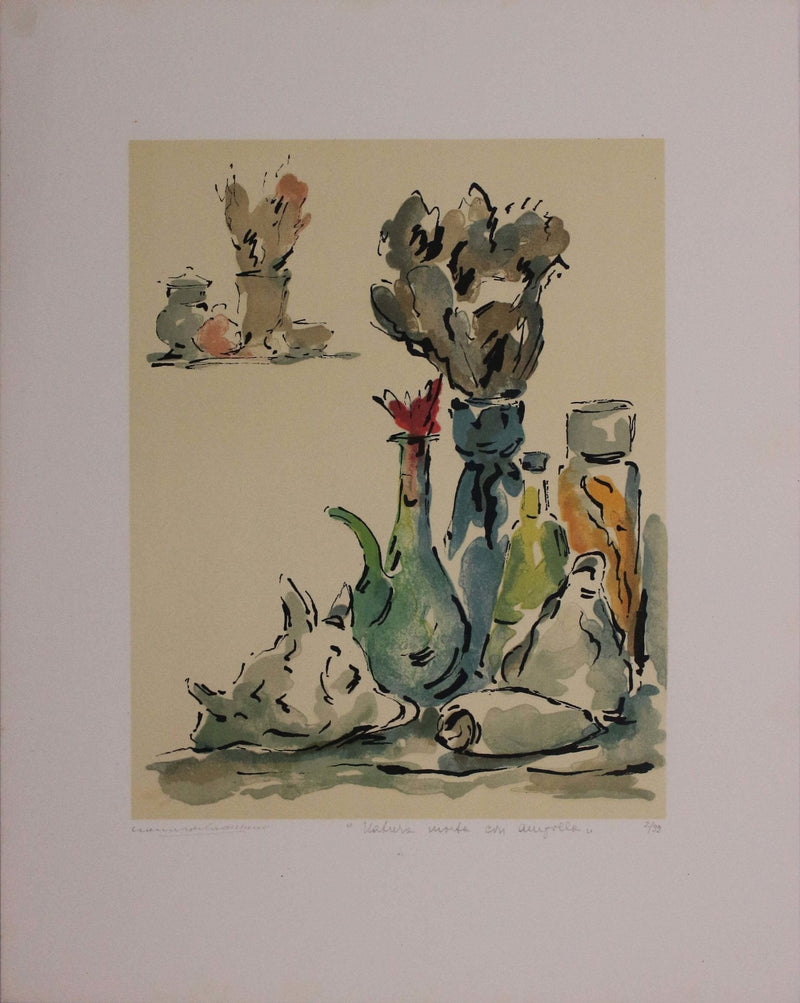
Landscapes, hills, trees, houses, interiors and still lifes are frequent subjects. Often the interest lies not in the event represented, but in the variations in light and the structure of space. The choice of apparently simple motifs allows us to focus attention on the quality of the engraved sign.
How to distinguish an original etching by Leonardo Castellani from a reproduction?
An original etching derives from the printing of an engraved matrix, while a reproduction photographically repeats a pre-existing image. It is useful to examine the paper, impression, possible plate strike, signature, numbering and provenance. No single clue is decisive without an overall examination of the specimen.
What influences the value of Leonardo Castellani's engravings?
The subject, quality of the impression, condition of the plate, possible print run, signature, conservation and provenance are relevant. Stains, foxing or restorations may affect the price. To compare two engravings it is necessary to verify that they belong to the same composition and, when known, to the same state of printing.