
Painter
Michele Cascella
Italy, 1892–1989
Stay up to date with this artist
Leave your email to receive updates on newly available artworks and news about this artist.
Artworks by Michele Cascella
2 artworks

Biography of Michele Cascella
Michele Cascella (Ortona, 1892 – Milan, 1989) was an Italian painter and graphic artist, best known for his luminous landscapes, seascapes and floral compositions. The son of painter and ceramicist Basilio Cascella, he trained within a family deeply devoted to the visual arts. His painting is distinguished by its sensitivity to color and its ability to transform landscapes and natural subjects into evocative images. Active…
Read the full biographyClose the biography
Michele Cascella (Ortona, 1892 – Milan, 1989) was an Italian painter and graphic artist, best known for his luminous landscapes, seascapes and floral compositions. The son of painter and ceramicist Basilio Cascella, he trained within a family deeply devoted to the visual arts. His painting is distinguished by its sensitivity to color and its ability to transform landscapes and natural subjects into evocative images. Active for much of the twentieth century, he exhibited in Italy and abroad, earning important recognition. Alongside oil painting and watercolor, he created numerous artworks in printmaking, including lithographs devoted to the characteristic themes of his oeuvre.
The Cascella family
Michele Cascella was born in Ortona, Abruzzo, in 1892. He was the son of Basilio Cascella, a painter, ceramicist, and leading figure in Abruzzo’s artistic culture. The family provided a particularly favorable environment for artistic development. Michele grew up surrounded by drawings, paintings, materials, and tools. His father encouraged him to pursue art, recognizing his abilities at an early age. His training took place primarily through direct observation and practice.
The early paintings
From a very young age, Cascella showed a particular interest in landscape. Views of Abruzzo became key subjects. L’artista observed the light, atmospheric variations, and relationships between colors. His painting soon stood out for its spontaneous, luminous sensibility. Color became his primary means of expression.
His exhibition debut
In 1907, Michele Cascella exhibited in Milan. L’esperienza represents an important recognition for an artist who was still very young. During his stay, he came into contact with figures from Italian culture, including the poet Clemente Rebora and the writer Sibilla Aleramo. Between 1909 and 1910, he also exhibited his own artworks in Paris. These early successes helped shape a career destined to develop internationally.
The First World War
During the First World War, Cascella created drawings devoted to military life. The artworks document experiences and settings related to the conflict. In 1917, he presented these artworks in Milan. In 1919, he exhibited them in Genoa. This body of work demonstrates the artist’s ability to engage with subjects different from the luminous landscapes that would characterize much of his career.
Landscape as a subject
Landscape is the central theme of Cascella’s oeuvre. The views may include hills, countryside, coasts, and cities. L’artista is not seeking a strictly photographic representation. He is interested above all in the perception of light and color. Forms are built through brushstrokes that suggest atmosphere and movement. Nature becomes a space for emotional experience.
Color and light
Cascella's painting is distinguished by its use of luminous tones. Color contributes more to the construction of the image than analytical drawing. Surfaces can be organized through vivid areas of color. Light seems to pass through the landscape, altering the perception of forms. This sensibility brings some artworks close to Post-Impressionist approaches, while retaining a personal style.
Seascapes
Seascapes are among his most recognizable subjects. The sea is depicted in different conditions of light and atmosphere. Coastlines, boats, and architectural elements contribute to the compositions. The relationship between sky and water allows for broad expanses of color. The painting seeks to convey the sense of place through light.
Flowers and Floral Compositions
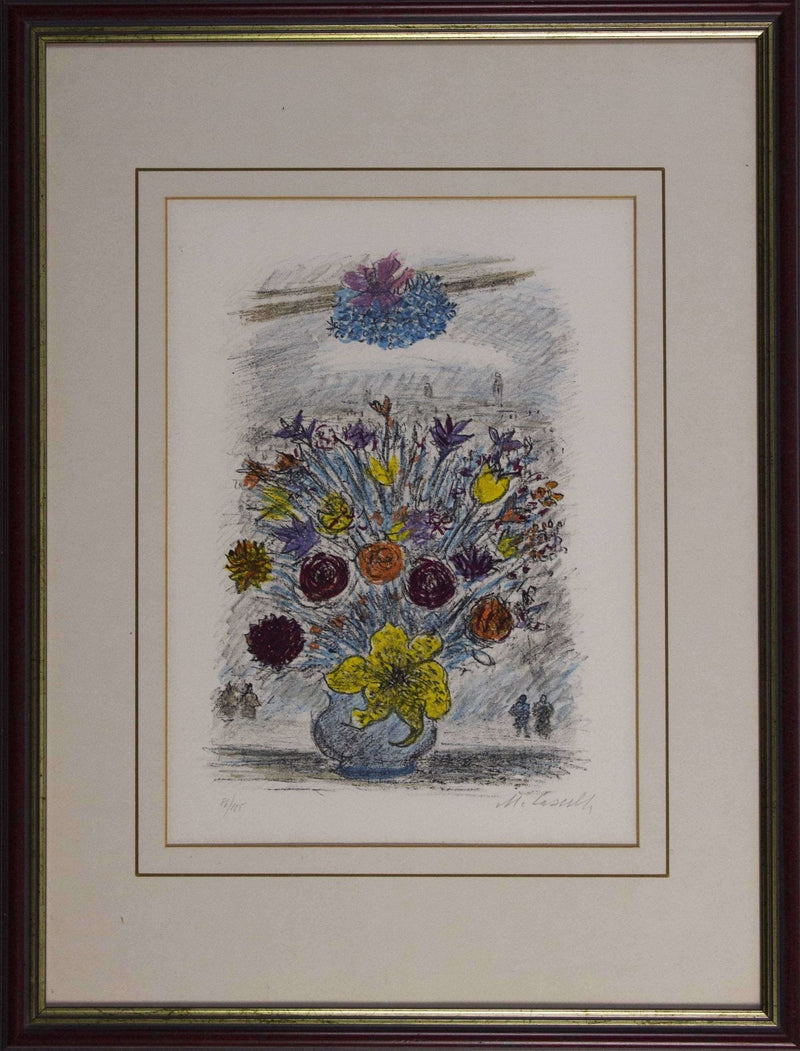
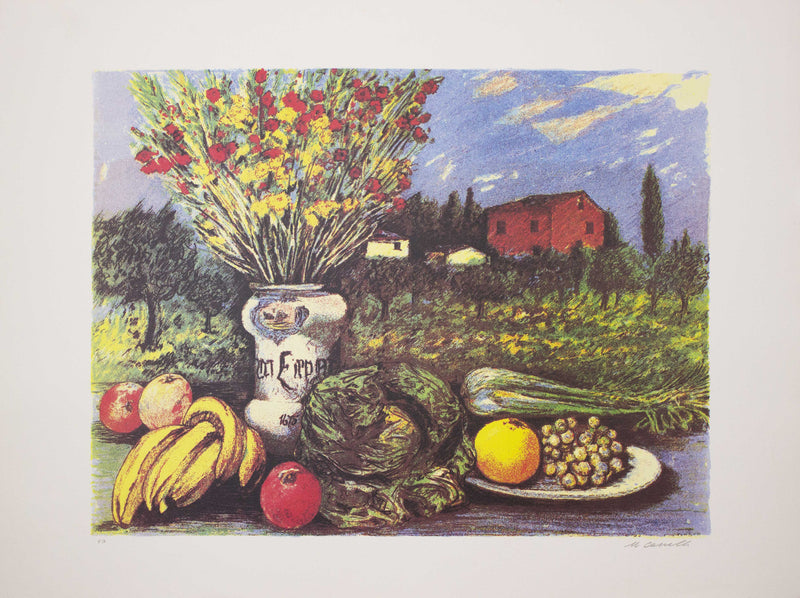
Alongside landscapes, Cascella devotes numerous artworks to flowers. Floral compositions allow him to explore the relationship between color and form. The petals are rendered with free brushstrokes. The depiction retains a particular freshness. Light helps define the volumes. These subjects become especially popular for their chromatic intensity.
L'watercolor
L'watercolor holds an important place in Cascella's oeuvre. The technique makes it possible to achieve transparency and delicate color transitions. The relationship between pigment, water, and paper is particularly suited to depicting light. Cascella uses these possibilities to develop landscapes and views with great immediacy. The speed of the process encourages a style of painting able to capture atmospheric changes.
Original Lithographs
Cascella also produces numerous lithographs, often devoted to landscapes, seascapes, and floral compositions. Lithography makes it possible to translate the painterly gesture into a printed image. In color artworks, the relationship between the different plates contributes to the composition. Original prints represent a significant part of his output. To catalog the artworks correctly, it is important to distinguish original lithographs from photomechanical reproductions of paintings. The presence of a signature or numbering must be verified directly on the print.
The Venice Biennale
Michele Cascella participates in the Venice Biennale in several editions between 1928 and 1942. His presence at the event confirms the recognition he has achieved in the Italian art scene. His artworks are also presented in numerous international exhibitions.
International Recognition
During his career, Cascella exhibited in Brussels, London, Johannesburg, and Paris. In 1937, he received a gold medal at the Paris International Exhibition. After World War II, he spent long periods in California. His stays in the United States helped broaden his repertoire of landscapes. His painting continues to be appreciated for its luminosity and color sensitivity.
Monumental artworks
In 1939, Cascella worked with his father Basilio and brother Tommaso to create the cartoons for the mosaic at the Messina Maritime Station. L's experience demonstrates his ability to engage with a format different from easel painting. The project is part of the family tradition of collaboration between the visual and decorative arts.
Later Years
In his later decades, Cascella spent time in California, Tuscany, Liguria, and Abruzzo. His painting remained rooted in observation of the landscape. Color and light continued to be its fundamental elements. His long career is a testament to remarkable stylistic continuity.
L's artistic legacy
Michele Cascella died in Milan in 1989. His oeuvre represents an important contribution to twentieth-century Italian landscape painting. Through oils, watercolors, and lithographs, he developed a language based on luminosity and color sensitivity. Seascapes, landscapes, and flowers are the main subjects of an artistic practice that combines observation with poetic interpretation.
Do you like Michele Cascella?
Leave your email to receive updates on newly available artworks and news about this artist.
Michele Cascella
Art that lives in your spaces
Choosing an artwork by Michele Cascella means making room for an individual artistic language. The artworks gathered here suggest combinations and perspectives to bring into your own surroundings, letting art guide your gaze.

DISCOVER THE ARTIST
Frequently asked questions
Answers to common questions about Michele Cascella, the artist’s life, artworks and value on the art market.
Who was Michele Cascella?
Michele Cascella was an Italian painter known above all for landscapes, views and floral compositions characterized by bright colors. He worked with different techniques, including painting, watercolor and graphics, maintaining a strong focus on light and nature.
Why did Michele Cascella often paint flowers and landscapes?
Flowers, gardens and landscapes allowed Cascella to explore light, atmosphere and color variations. They are central subjects in his public image, but the production is complex: the value and interest of an artwork also depend on the phase and technique.
How do you recognize a watercolor by Michele Cascella?
Watercolor uses pigments diluted in water, often allowing the paper support to shine through. In the artworks attributed to Cascella it is necessary to distinguish an original watercolor from a print that reproduces its appearance. Check technical description, surface, signature and provenance.
What is the difference between a painting and a silkscreen by Cascella?
A painting is generally a unique example, while a serigraph is a print made using a matrix process and can belong to a print run. Both may have collector's interest, but must be evaluated with different parameters, especially in terms of rarity and technique.
How much are Michele Cascella's artworks worth?
The prices change significantly between oils, watercolours, drawings and graphics. Size, period, subject, conservation, signature and provenance also matter. Before comparing prices it is necessary to verify that the artworks have truly comparable characteristics.
Discover more artists
Explore more leading figures in modern and contemporary art


