

Painter
Gianbecchina
1909 – 2001
Stay up to date with this artist
Leave your email to receive updates on newly available works and news about this artist.
Works by Gianbecchina
1 work

Gianbecchina
The Sicily of Gianbecchina, the pseudonym of Giovanni Becchina, is not a picturesque backdrop constructed for the gaze of those who come from elsewhere. It is a land experienced and observed through the seasons of work and everyday gestures, in sun-drenched countryside and in the figures of those who inhabit it. Landscapes, farmers, villages, and still lifes become the subjects of a painting that entrusts…
Read the full biographyClose the biography
The Sicily of Gianbecchina, the pseudonym of Giovanni Becchina, is not a picturesque backdrop constructed for the gaze of those who come from elsewhere. It is a land experienced and observed through the seasons of work and everyday gestures, in sun-drenched countryside and in the figures of those who inhabit it. Landscapes, farmers, villages, and still lifes become the subjects of a painting that entrusts color with the task of making visible not only the appearance of places, but also the memories and feelings that accompany them. His connection to Sicily runs throughout his entire body of work and constitutes its most recognizable core.
Origins and Artistic Training
Giovanni Becchina was born in 1909 in Sambuca di Sicilia, then called Sambuca Zabut. From childhood, he showed an interest in drawing and closely observed the work of decorators active in the village’s homes. His contact with Gaetano Grippi gave him an early opportunity to engage directly with painting, before embarking on more formal studies. In 1926, he moved to Palermo, where he attended the Free School of the Nude at the Academy of Fine Arts and studied with Archimede Campini. His academic training deepened his relationship with drawing and the human figure, but his sensibility continued to focus above all on the world he knew firsthand.
The pseudonym Gianbecchina, formed from his first and last names, becomes the identity under which the artist presents himself in the Italian art world. The earliest artworks already reveal his interest in everyday life, the landscape, and ordinary people. This choice takes on particular significance in a century marked by great social transformations: depicting work in the fields, homes, and everyday gestures means recognizing the dignity and presence of a world often marginalized in comparison with the subjects celebrated by the artistic tradition.
The Sicilian landscape and the peasant world
The Sicilian countryside is at the center of his painting, but it is never reduced to a simple geographical description. Hills, cultivated fields, and villages are interpreted through intense color relationships, in which Mediterranean light plays a decisive role. Warm colors, areas of shadow, and luminous fields of color shape the image’s atmosphere and convey the sense of a land that changes with the hours and the seasons. The landscape thus becomes a place of memory, where observation and personal involvement overlap.
At the same time, Gianbecchina devotes great attention to the peasant world. The workers are not decorative figures inserted to enliven a view: they represent the human heart of the story. Agricultural gestures, hard work, and moments of community life offer the artist an opportunity to reflect on the relationship between people and their land. This sensibility brings him close to the currents of Italian Realism, without reducing the meaning of his painting to a formula of protest or social documentation. The observed reality is transformed through composition and color, which retain an autonomous and intensely expressive function.
His interest in human figures is particularly evident in their presence and their belonging to a recognizable environment. The painting does not necessarily seek descriptive detail, but rather a balance that conveys the character of a situation. The still lifes also reveal this attention: simple objects and forms become opportunities to study the relationship between light, volume and tone, while maintaining a sensitivity to color consistent with that of the landscapes.
Painting, graphic artworks and exhibitions
Over the years, Gianbecchina established a recognizable presence in Italian artistic life. He held a solo exhibition in Palermo in 1941 and took part in the Venice Biennale in 1942; he subsequently continued exhibiting and combined painting with teaching at the Academy of Fine Arts in Palermo. His teaching did not interrupt his engagement with the themes of his artistic research: landscape, the human figure and work remained the main means through which he interpreted his experience of the world.
Alongside the paintings, experiences in printmaking and graphic arts are also documented. Working on paper makes it possible to approach subjects through line and develop a different relationship between figure and surface. However, generic technical attributions should be avoided: a graphic work cannot automatically be defined as a lithograph, screenprint or etching without information about the actual process. In descriptions intended for collectors, the support, documented technique, any edition size and the characteristics of the individual print all matter. The distinction between an original print and a reproduction of a painting is essential, even when both feature the same image.
Gianbecchina's mature painting continues to return to the places and subjects of his beginnings, without this fidelity necessarily becoming repetition. The landscape increasingly becomes a repository of memories, while color takes on the task of evoking atmospheres and human connections. Having died in Palermo in 2001, Gianbecchina leaves an important testament to twentieth-century Sicilian figurative culture: his work portrays a region not through exoticism or superficial nostalgia, but through a constant attention to the lives of those who inhabit it.
Do you like Gianbecchina?
Leave your email to receive updates on newly available works and news about this artist.
Gianbecchina
Art that lives in your spaces
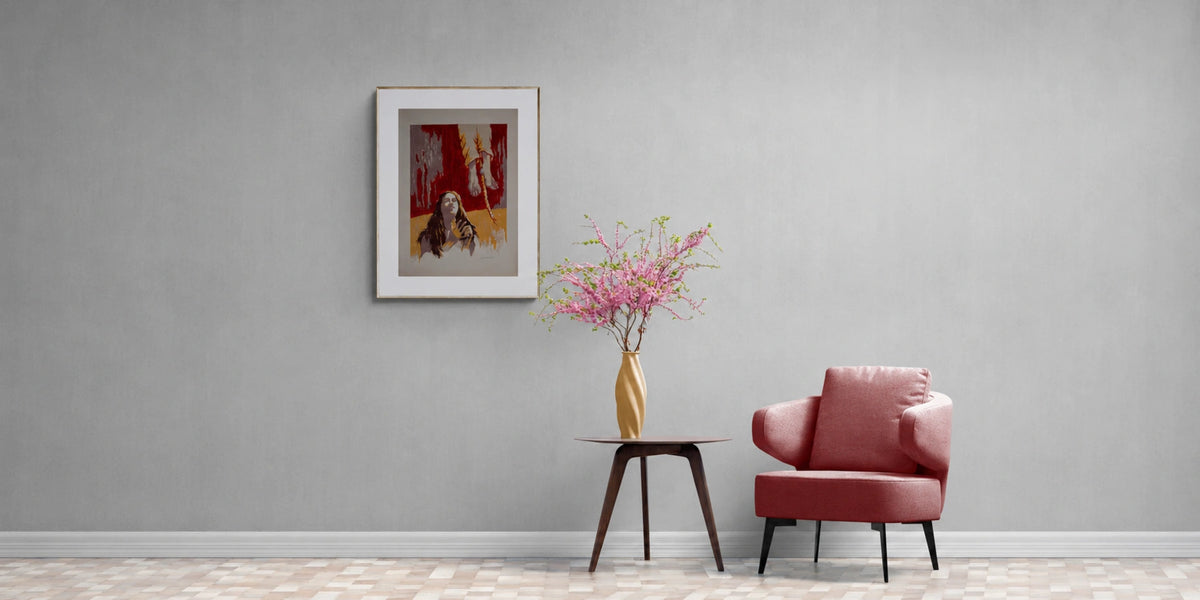
Choosing a work by Gianbecchina means making room for an individual artistic language. The works gathered here suggest combinations and perspectives to bring into your own surroundings, letting art guide your gaze.
DISCOVER THE ARTIST
Frequently asked questions
Answers to common questions about Gianbecchina, the artist’s life, works and value on the art market.
Who was Gianbecchina?
Gianbecchina is the stage name of Giovanni Becchina (1909–2001), a Sicilian painter linked to the representation of the landscape and popular life of the island. The countryside, farmers, figures and environments of Sicily return in his works. His painting combines observation of reality, personal memory and a particular attention to Mediterranean light and colour.
Why did Gianbecchina often paint Sicily?
The landscape and the Sicilian peasant world were at the center of his human and artistic experience. Fields, people at work and places on the island are not just picturesque views: they become evidence of a culture and daily life in transformation. Sicily is therefore the subject, memory and identity of his painting.
What subjects characterize Gianbecchina's paintings?
Rural landscapes, peasant figures, work scenes, still lifes and glimpses linked to the Sicilian territory recur. Language varies over time, but retains an abiding interest in people and places. When attributing a title or subject to a work, it is best to rely on available documentation rather than on a simple iconographic resemblance.
Did Gianbecchina also create graphic works?
Alongside painting, the artist practiced drawing and production on paper. In the catalog it is necessary to distinguish an original drawing from a lithograph or another print in edition size: the presence of the signature does not alone determine the technique. Description of the work, numbering and documentation help to understand the nature of the specimen.
What does the value of a painting by Gianbecchina depend on?
What counts above all are authenticity, period, subject, size, pictorial quality, conservation and provenance. An original painting is not directly comparable to a print, even if it represents a similar theme. To orient yourself on the market you need comparable works and verifiable sales results; a generic estimate per artist risks being misleading.