
Painter
Valerio Adami
Italian, 1935 –
Stay up to date with this artist
Leave your email to receive updates on newly available works and news about this artist.
Works by Valerio Adami
2 works

Valerio Adami
Valerio Adami (Bologna, 1935) is one of the leading figures in contemporary Italian figurative painting. His artworks are instantly recognizable for their black outlines, broad areas of uniform color, and figures broken down into essential forms. Behind a visual language that may bring comics to mind lies a painting rich in references to literature, philosophy, music, and mythology. Adami does not simply depict people and…
Read the full biographyClose the biography
Valerio Adami (Bologna, 1935) is one of the leading figures in contemporary Italian figurative painting. His artworks are instantly recognizable for their black outlines, broad areas of uniform color, and figures broken down into essential forms. Behind a visual language that may bring comics to mind lies a painting rich in references to literature, philosophy, music, and mythology. Adami does not simply depict people and objects: he transforms them into enigmatic images in which every element seems to suggest a larger story. Through paintings, drawings, and graphic artworks, he has built a personal figurative universe that combines the immediacy of color with the complexity of thought.
Biography and artistic training
Valerio Adami was born in Bologna on March 17, 1935. During his childhood, he moved with his family to Milan, where he became interested in drawing and painting. His training encompassed a range of experiences: he attended Felice Carena’s studio, met Oskar Kokoschka in Venice, and studied at the Brera Academy under Achille Funi. In Paris, he met artists such as Roberto Matta and Wifredo Lam, while during stays in London he developed an interest in Francis Bacon’s painting. From 1958 onward, he led a life marked by frequent travel and long stays in European cities and on other continents. Paris, London, New York, Latin America, and India became places of encounter and exploration.
His painting is thus enriched by a wide range of cultural references, becoming a means of interpreting experiences, reading, and memories.
The Emergence of Valerio Adami’s Style
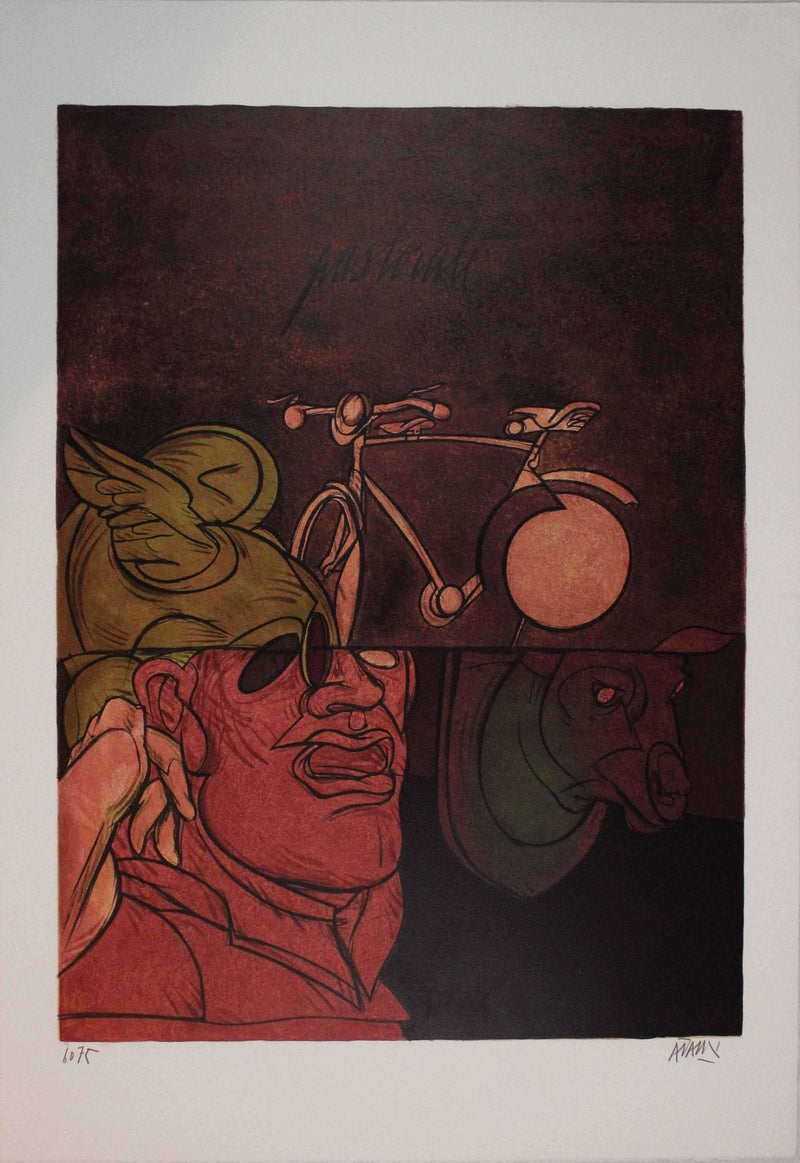
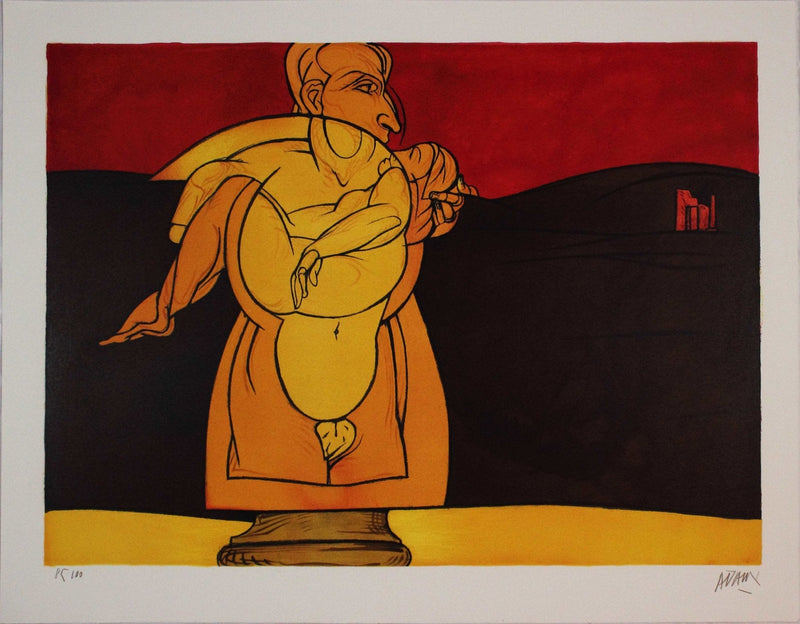
During the 1960s, the language that would make Valerio Adami instantly recognizable began to take shape. Figures are outlined by a continuous black line, while surfaces are filled with uniform colors, generally without gradients or traditional chiaroscuro. Bodies, objects, and settings are often fragmented, enlarged, or viewed from unusual angles. A face may be depicted through only a few details, while a room may become a web of elements that are difficult to piece together. The colors, arranged in solid areas, help create a crisp image, almost devoid of perspective depth. A style of painting emerges in which every element appears precisely defined, while retaining an open and sometimes mysterious meaning.
Valerio Adami Between Pop Art and New Figuration
Valerio Adami’s artworks are often associated with Pop Art because of their use of flat colors, bold outlines, and a visual language close to graphic design and comics. There are indeed some affinities with artists such as Roy Lichtenstein, especially in the immediacy of the images and the rejection of traditional painterly modeling. While some American Pop Art draws on images from advertising, consumer culture, and mass culture, Adami creates compositions that bring together everyday experiences, memory, literature, and intellectual reflection. His originality lies precisely in combining a direct visual language with complex content, leaving viewers to reconstruct the relationships between the elements of the image.
The 1960s: Objects, Interiors, and Fragments of Reality
In the 1960s, Valerio Adami paid particular attention to everyday objects and contemporary settings. His canvases feature interiors, furniture, architectural elements, bodies, and details that seem to belong to ordinary situations. In 1964, he took part in Documenta 3 in Kassel, one of the most important international events devoted to contemporary art. In 1968, he exhibited at the Venice Biennale, consolidating his presence in the European art world. The artworks from this period testify to the gradual maturation of a language in which drawing, color, and the fragmentation of forms become tools for a wholly original visual narrative.
Literature, Philosophy, and Music in Adami’s Painting
One of the most fascinating aspects of Valerio Adami’s work is its relationship with literary and philosophical culture. Throughout his life, the artist associated with writers, philosophers, and musicians such as Italo Calvino, Jacques Derrida, Octavio Paz, Carlos Fuentes, and Luciano Berio. These encounters were not merely biographical details, but helped fuel his imagination. Adami’s artworks may stem from a reading, a philosophical reflection, a historical figure, or a personal experience. L’image becomes the place where elements from different worlds are brought into relation. Painting thus becomes a form of thought, capable of expressing through images what a story or philosophical text develops through words.
Travel and the Relationship with Memory
Valerio Adami’s life was marked by extensive travel. Stays in Europe, the United States, Latin America, Israel, and India helped broaden the cultural references in his artworks. Travel, however, did not simply translate into depictions of landscapes or places visited. Experiences were processed through memory and transformed into images in which real, symbolic, and imaginary elements coexist. A setting may evoke a personal memory, while a figure may connect to a historical event or a mythological story.
Myth and the Great Allegories
From the late 1970s onward, references to mythology and the classical tradition became increasingly prominent in Valerio Adami’s work. During a stay in New York in 1978, the artist began creating a series of paintings devoted to mythological themes. Figures from antiquity are reinterpreted through his language of black outlines, blocks of color, and fragmented forms. Mythology becomes a tool for reflecting on memory, fate, human relationships, and the complexity of experience. References to myth give Adami’s painting a cultural depth that coexists with the apparent simplicity of his visual language.
Valerio Adami’s artworks: paintings, drawings, and graphic art
Valerio Adami's artistic output includes paintings, drawings, watercolors, graphic artworks, and monumental projects. Before defining the areas of color, the artist constructs the image through line, establishing relationships between the figures and the organization of the surface. In his drawings, this stage of his work can be observed especially clearly, as forms gradually take shape. The paintings develop the same language through intense colors and precise outlines. The subjects may come from everyday life, literature, music, or mythology, reflecting the breadth of the artist's interests. His painting shows how a language built on a few fundamental elements can generate ever-new images, capable of combining formal clarity with narrative complexity.
Major public artworks and international recognition
From the 1980s onward, Valerio Adami received important international recognition. In 1985, the Centre Georges Pompidou in Paris dedicated a major retrospective to him, later presented at Palazzo Reale in Milan. The exhibition traced the evolution of his language and confirmed the significance of his work in the European art scene. In 1988, the French state commissioned him to paint a portrait of composer Pierre Boulez. Lhe following year, he created large paintings for the foyer of the Théâtre du Châtelet in Paris. In 2019, four of his drawings entered the collections of the Uffizi Galleries, also confirming institutional recognition of the importance of his work on paper.
Valerio Adami today: painting that continues to tell stories
Valerio Adami's career spans more than sixty years of contemporary art history. Although he is often associated with Pop Art and New Figuration, his path cannot be fully attributed to a single movement. In 2024, Palazzo Reale in Milan dedicated the retrospective exhibition Valerio Adami. Painter of Ideas to him, tracing his career through paintings and drawings from different periods. In 2025, to mark his ninetieth birthday, new exhibitions explored his historical and recent work in greater depth. Looking at a work by Valerio Adami means entering a universe in which nothing is merely what it seems. It is precisely this ability to transform figuration into a language of ideas that makes his painting one of the most original experiences in contemporary Italian art.
Do you like Valerio Adami?
Leave your email to receive updates on newly available works and news about this artist.
Valerio Adami
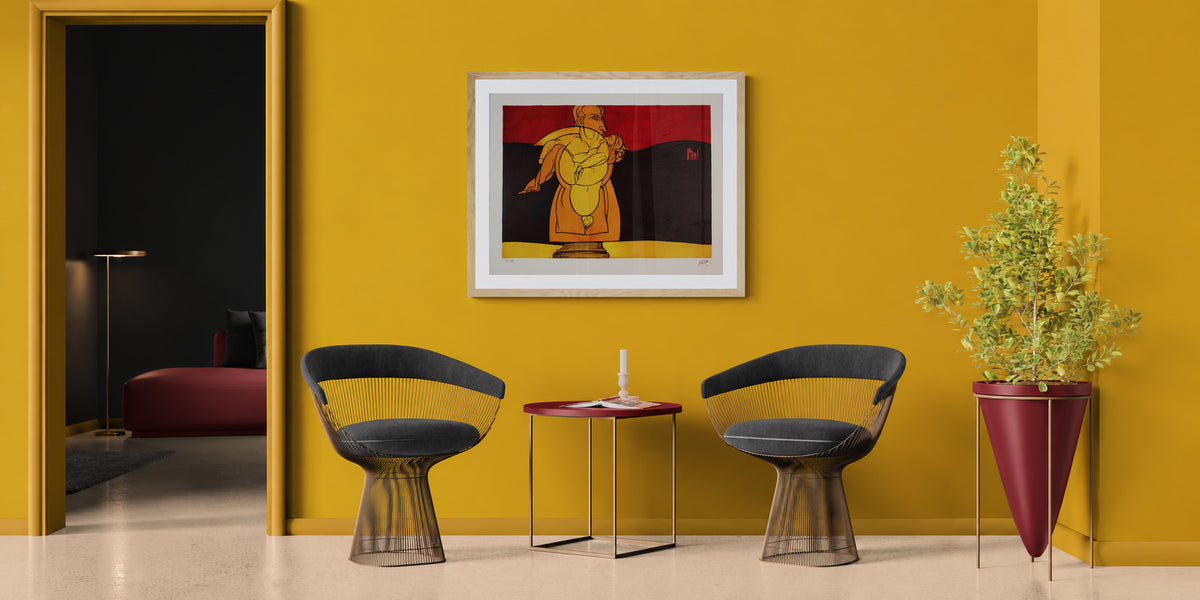
Art that lives in your spaces
Works by Valerio Adami bring the language of Pop art into everyday spaces. Paired with clean lines and contemporary furnishings, they become the starting point for a personal interior, open to colour and a dialogue with art.
DISCOVER THE ARTIST
Frequently asked questions
Answers to common questions about Valerio Adami, the artist’s life, works and value on the art market.
Who is Valerio Adami?
Valerio Adami, born in Bologna in 1935, is an Italian painter known for figurative compositions with sharply defined outlines and areas of uniform colour. His painting intertwines images of contemporary life, history, literature and memory.
Which artistic movement is Valerio Adami associated with?
His visual language is often associated with Pop Art and New Figuration, but retains its own distinctive qualities. Rather than reproducing images from the mass media, Adami constructs complex visual narratives through fragments, quotations and symbols.
How can you recognise a work by Valerio Adami?
A distinctive feature is the dark, continuous outline that defines areas of flat colour. Figures, objects and settings are broken down and reassembled into images that invite a narrative reading without offering a single, unequivocal meaning.
Which techniques does Valerio Adami use?
Painting is central to his practice, alongside drawing and fine-art printmaking. For works on paper, the technique must be checked individually: an original lithograph, a screenprint and a reproduction are not equivalent.
How should you choose a print by Valerio Adami?
Check the title, technique, dimensions, signature, numbering, publisher and condition. The edition size and documentation help identify the individual impression correctly. Any works listed on Emporium Art have product pages detailing the available information.