
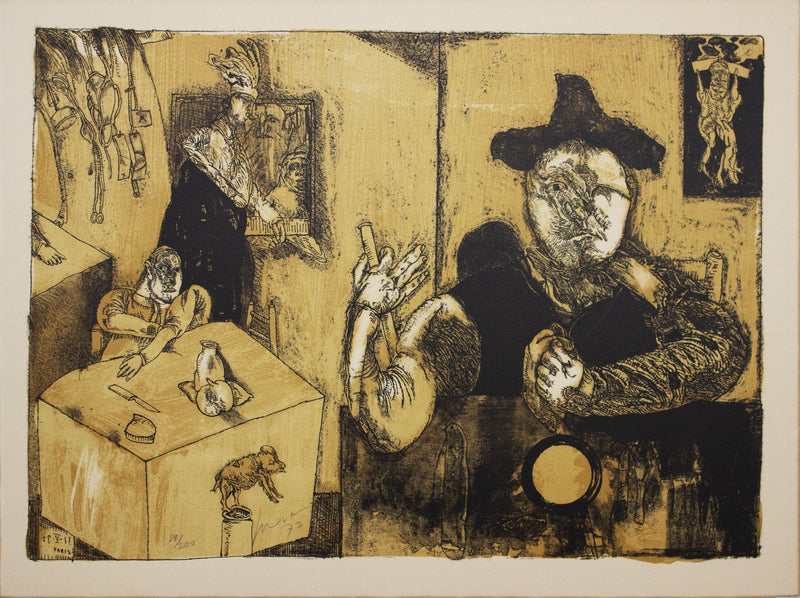
Visual artist
José Luis Cuevas
Mexico, 1934–2017
Stay up to date with this artist
Leave your email to receive updates on newly available artworks and news about this artist.
Artworks by José Luis Cuevas
1 artwork

Biography of José Luis Cuevas
José Luis Cuevas (Mexico City, 1934–2017) is a central figure of the Generación de la Ruptura, a period that challenged muralism's dominance in Mexican artistic culture in the second half of the twentieth century. A draftsman, printmaker, and sculptor, he developed a world populated by distorted bodies, troubled faces, and characters marked by loneliness. His intense and often provocative figurative art does not seek idealized…
Read the full biographyClose the biography
José Luis Cuevas (Mexico City, 1934–2017) is a central figure of the Generación de la Ruptura, a period that challenged muralism's dominance in Mexican artistic culture in the second half of the twentieth century. A draftsman, printmaker, and sculptor, he developed a world populated by distorted bodies, troubled faces, and characters marked by loneliness. His intense and often provocative figurative art does not seek idealized beauty; instead, it uses line and distortion to address the contradictions of the human condition, in dialogue with Goya's tradition and European literature.
L'childhood and the discovery of drawing
Cuevas was born in Mexico City on February 26, 1934, and grew up in a family environment connected to the production of paper and drawing supplies: his grandfather ran a factory that made drawing materials. Early exposure to these materials fostered a calling that emerged in childhood, when he won a contest devoted to children's self-portraits. His education was largely self-taught, although he briefly attended the La Esmeralda art school. An illness forced him to interrupt his studies, and during his recovery he devoted himself intensely to reading and drawing, developing an independent sensibility.
From the outset, drawing was not simply a preparatory exercise for him, but the core of his artistic inquiry. His line depicts bodies and faces, heightens their tensions, and sometimes deliberately distorts their proportions. This distortion does not stem from an inability to depict the human figure, but from a desire to make its vulnerabilities, fears, and inner conflicts visible. He often turned his attention to marginalized individuals, solitary figures, and psychologically complex presences.
The early exhibitions and break with muralism
In 1953, Cuevas presented a solo exhibition at the Galería Prisse in Mexico City, attracting attention with an approach far removed from the main official trends. International recognition came quickly: he exhibited at the Pan American Union in Washington in 1954, in Paris in 1955, and in New York in 1957. The circulation of his drawings outside Mexico helped establish an independent position, grounded in expressive freedom and engagement with international artistic culture.
His career is closely linked to the Generación de la Ruptura, a range of different artistic experiences united by the desire to move beyond the hegemony of Mexican muralism. Cuevas takes a particularly polemical stance, and in 1958 he publishes La cortina de nopal, a text in which he criticizes the idea that national art should be identified with a single language. His opposition concerns not only a pictorial style, but also the very principle of an artistic culture governed by official models. In 1967, he also creates an ephemeral mural, a temporary artwork that provocatively questions the monumentality and permanence of the traditional mural.
Goya, distortion, and the human condition
Among Cuevas's most important influences is Francisco Goya, particularly his ability to turn drawing and printmaking into tools for critically examining human beings. As with the great Spanish artist, the grotesque does not necessarily amount to caricature: it can reveal painful or contradictory aspects of existence. In Cuevas's drawings, faces are sometimes exaggerated, bodies appear disproportionate, and gazes take on a particular intensity, giving shape to a world in which vulnerability matters more than outward harmony.
Loneliness, suffering, and marginalization run through many of his images, but his exploration is not limited to immediate social criticism. Cuevas is also interested in questions of identity and representation, as evidenced by his numerous self-portraits, in which his own image becomes a subject for irony, unease, and personal reflection. L's expressiveness of the line makes each character recognizable as a psychological presence, even when the anatomical features are profoundly transformed.
Lithographs, prints, and major graphic series
Original graphics play a fundamental role in Cuevas's oeuvre. Through lithographs and prints, he develops a language in which the line retains its immediacy and intensity, while tonal variations contribute to the construction of figures. For him, printmaking is not merely a means of disseminating images: it becomes an autonomous field of inquiry, capable of embracing narrative, literary, and psychological themes.
Among the series mentioned in the documentation are Recollections of Childhood (1962), dedicated to childhood memories, and Cuevas Charenton (1964), linked to the exploration of psychological suffering. These were followed by Crime by Cuevas (1968), in which the theme of crime is translated into images of great tension, and Homage to Quevedo (1969), a testament to his dialogue with Spanish literature. In these artworks, the relationship between subject and printmaking process is particularly close: the image’s power comes from the way the mark constructs the character, rather than from a literal description of events.
Cuevas worked with specialized workshops, including the Tamarind Lithography Workshop in the United States and Polígrafa in Barcelona. These experiences contributed to his development of printmaking techniques and the international circulation of his artworks. To correctly identify a print, it is important to consider the actual technique, whether it belongs to a series, and the edition details, distinguishing original prints from reproductions.
Sculpture, Museum, and Awards
Alongside drawing and printmaking, Cuevas developed a body of sculptures, often in bronze, in which he transferred the expressive distortions of figures on paper into three-dimensional space. The bodies retain a strong psychological charge, while volume allows for a deeper exploration of the relationship between physical presence and inner tension. In 1992, the José Luis Cuevas Museum opened in Mexico City, housed in the former Convent of Santa Inés, to present his oeuvre alongside that of other contemporary artists.
During his career, he received important awards, including the First Prize for Drawing at the São Paulo Biennial in 1959 and the National Prize for Sciences and Arts of Mexico in 1981. His artworks entered international collections, including that of the Museum of Modern Art in New York. He died in Mexico City on July 3, 2017, leaving an essential contribution to the renewal of Latin American figurative art: an art that, through freedom of drawing and expressive distortion, was able to represent the complexity and anxieties of the human being.
Do you like José Luis Cuevas?
Leave your email to receive updates on newly available artworks and news about this artist.
José Luis Cuevas
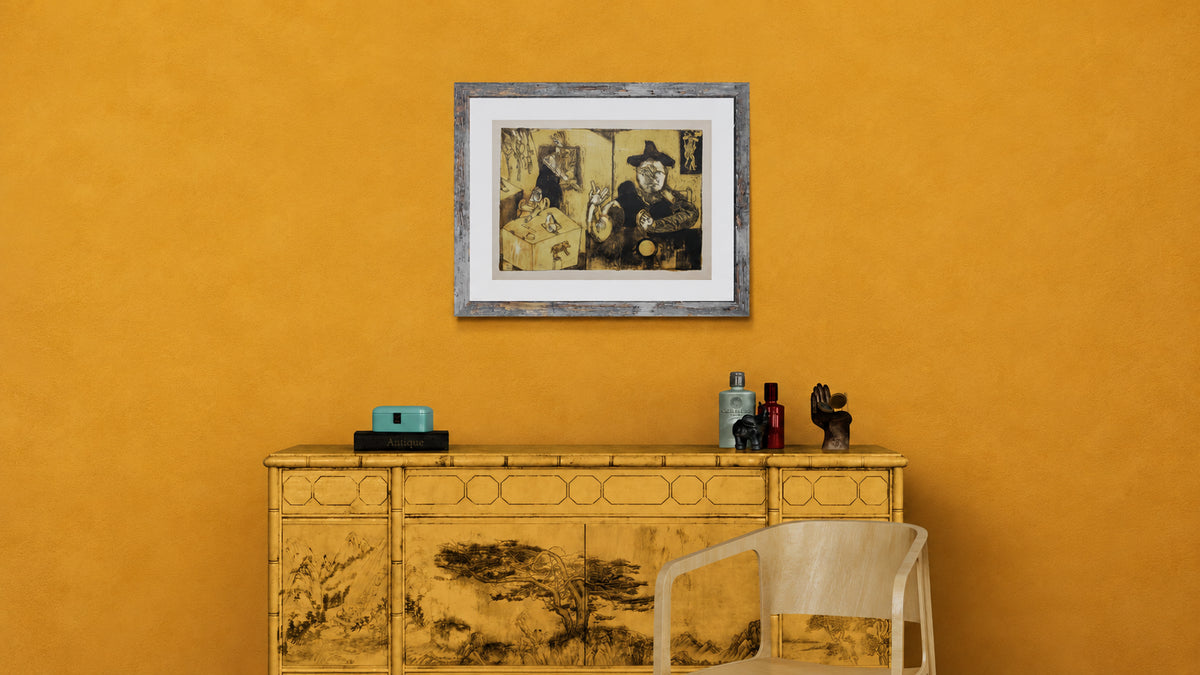
Art that lives in your spaces
Choosing an artwork by José Luis Cuevas means making room for an individual artistic language. The artworks gathered here suggest combinations and perspectives to bring into your own surroundings, letting art guide your gaze.
DISCOVER THE ARTIST
Frequently asked questions
Answers to common questions about José Luis Cuevas, the artist’s life, artworks and value on the art market.
Who was José Luis Cuevas?
José Luis Cuevas (1934–2017) was a Mexican artist known above all for drawings, engravings and intense figuration, often dedicated to the fragility and contradictions of the human being. His research had an important role in the renewal of twentieth-century Mexican art.
Why did José Luis Cuevas oppose Mexican muralism?
Cuevas criticized the cultural dominance of muralism and called for greater expressive freedom for Mexican artists. His position is often linked to the so-called Generación de la Ruptura, a heterogeneous set of experiences that cannot be traced back to a single style.
What figures did José Luis Cuevas represent?
His artworks often feature deformed bodies, restless faces, marginal characters and situations full of psychological tension. Drawing becomes a tool for investigating identity and the human condition, rather than for faithfully reproducing the external appearance.
What engraving techniques did José Luis Cuevas use?
Cuevas produced numerous graphic artworks with different techniques. The precise technique must be verified for each sheet, together with any numbering, signature and edition data: "print" does not automatically indicate a lithograph or etching.
How to recognize an original graphic by José Luis Cuevas?
It is necessary to examine the printing technique, paper, signature, print run, possible publisher and provenance. A signed plate or printed reproduction is not the same as a hand-signed example; the evaluation requires information on the specific edition.
Discover more artists
Explore more leading figures in modern and contemporary art
