
Sculptor and Painter
Giuseppe Maraniello
Italiana, 1945 –
Stay up to date with this artist
Leave your email to receive updates on newly available works and news about this artist.
Works by Giuseppe Maraniello
1 work

Giuseppe Maraniello
Born in Naples in 1945, Giuseppe Maraniello is one of the Italian artists who helped to renew the relationship between painting, sculpture and image in the second half of the twentieth century. His research is developed through a recognizable language, populated by enigmatic figures, symbols, anthropomorphic forms and structures that seem to belong simultaneously to the ancient world and to contemporary sensibility. His work is…
Read the full biographyClose the biography
Born in Naples in 1945, Giuseppe Maraniello is one of the Italian artists who helped to renew the relationship between painting, sculpture and image in the second half of the twentieth century. His research is developed through a recognizable language, populated by enigmatic figures, symbols, anthropomorphic forms and structures that seem to belong simultaneously to the ancient world and to contemporary sensibility. His work is not easily traced back to a single discipline: the painting can acquire sculptural features, while the sculpture often preserves a graphic and pictorial dimension. This continuous contamination represents one of the fundamental elements of his poetics.
From photography to painting renewal
In 1971 Maraniello moved to Milan, a city offering a particularly favourable environment for artistic experimentation. Here he entered into contact with the gallery of Luciano Inga-Pin, where he exhibited between 1973 and 1975. During the first phase of the career, we are interested in photography and the possibilities of contemporary languages, taking part in a cultural climate in which the traditional boundaries of the work of art are questioned. The relationship between image, perception and representation is already an important theme of its research, intended to develop later through different materials and techniques.
In the second half of the 1970s, the artist progressively directs his work towards the painting and the traditional languages of art, without sacrificing the experimental freedom acquired in previous experiences. This change does not represent a nostalgic return to the past, but the will to use historically consolidated tools to build new images. The painting is a space of invention, in which the figure can emerge through essential signs, intense colors and charged forms of symbolic meanings.
His presence in the exhibitions L'estetico e il selvaggio, organized in Modena in 1979, and Italiana Nuova Immagine, curated by Achille Bonito Oliva in Ravenna in 1980, testifies the role assumed by the artist in the debate on the return of the image and the redefinition of expressive languages. Maraniello participates in this season maintaining an autonomous position: his interest does not only concern the recovery of figuration, but the possibility of creating a visual universe in which recognizable elements and abstract forms coexist without contradiction.
A language between painting and sculpture
The perhaps most evident feature of the production of Maraniello is the superior of the separation between surface and volume. In the paintings, the presence of signs, silhouettes and figures can suggest a depth that goes beyond the two-dimensional space; in the sculptures, on the other hand, the profile and the contour often maintain an importance comparable to that of the drawing. His works seem to develop in an intermediate area, in which the pictorial and plastic language is mutually influenced.
The figures that populate this universe sometimes assume the appearance of fantastic creatures, archaic characters or suspicious presences between human and animal. It is not generally narrative representations in the traditional sense, but images open to different interpretations. Their strength comes from the ability to evoke memories, myths and associations without turning into illustrations of a precise story. The artist thus builds a personal iconographic vocabulary, in which each form seems to possess a previous story and, at the same time, belong to a world still to be invented.
The relationship between full and empty plays an essential role. A shape can be defined both by matter and by space that surrounds it; an opening can become as important as a compact surface. This principle allows the works to dialogue with the environment and to change the perception of the viewer. The form is never completely isolated, but it acquires meaning through the relationships that establishes with what is around it.
Engaging with classicism and memory
One of the most original aspects of Maraniello's research is the comparison with the classical tradition and with the archaic imagination. The artist looks at the history of art not as a repertoire of models to be reproduced, but as a set of forms and meanings to be transformed. His creatures can recall mythological figures, archaeological finds or symbols belonging to distant cultures, while maintaining a fully contemporary identity.
This relationship with the past also manifests itself in the particular attention to the body. The human body is not necessarily represented according to anatomical or naturalistic criteria: it can be reduced to a shape, fragmented, transformed into a sign or evoked through an abstract structure. The figure thus becomes a meeting point between individual and collective imaginary memory, between recognizability and mystery.
In its production they frequently coexist seemingly opposite elements: archaic and modern, male and female, lightness and monumentality, irony and solemnity. This ability to keep contradictions open gives the works a particular vitality. Images may appear playful and immediate, but retain a complexity that emerges through observation. The ludic dimension does not eliminate the symbolic dimension; on the contrary, it makes accessible meanings that otherwise would risk to appear excessively abstract.
Graphical techniques and research continuity
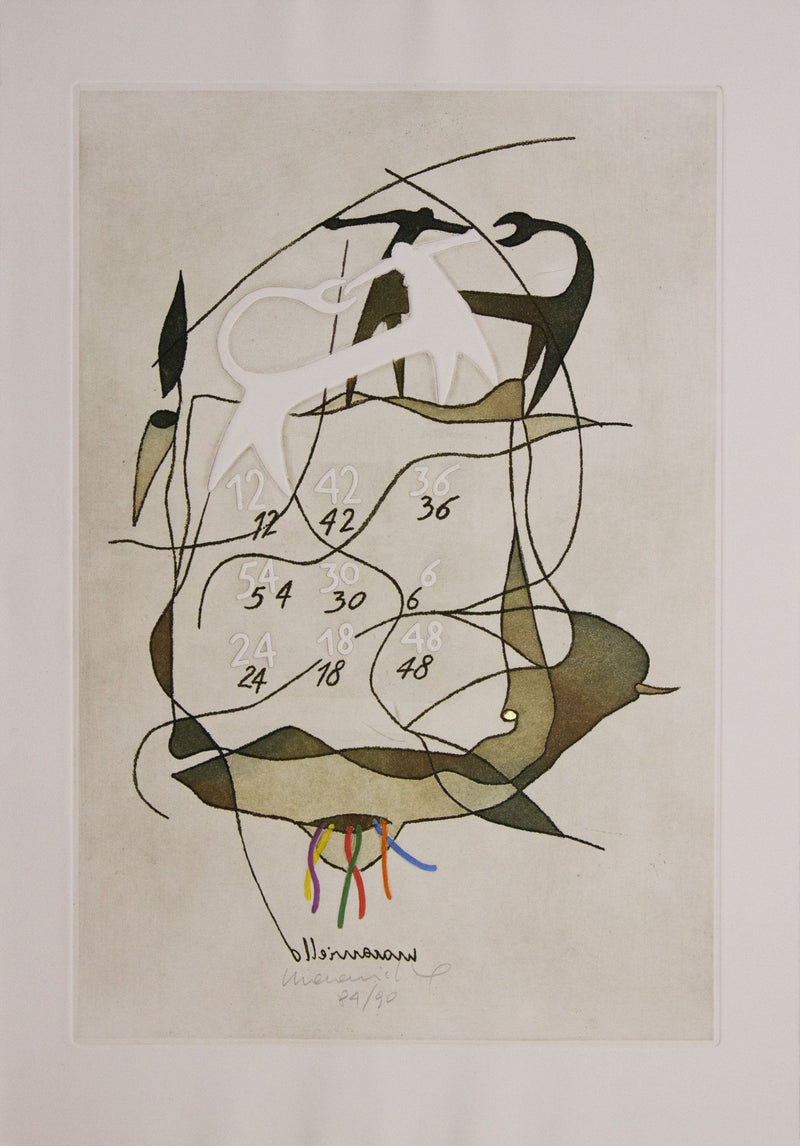
Beside painting and sculpture, Maraniello develops an interest in graphic drawing and original printing techniques. In this area, the relationship between the line and the surface acquires a particular evidence. The fork allows to work on the engraving of the sign, on the differences of intensity and on the relationship between figures and empty spaces. The characteristic forms of his visual universe can thus be interpreted through a particularly effective synthesis, in which even few elements contribute to the construction of a complex image.
The graphics represent a natural extension of its research, because the design plays a central role in the three-dimensional works. The profile of a figure, the rhythm of a line or the layout of a few signs can define a recognizable presence without requiring a detailed description. This formal economy is one of the most significant qualities of its language.
The work of Giuseppe Maraniello occupies an original position in contemporary Italian art precisely because of the ability to cross different languages without losing coherence. His research shows that tradition can become an instrument of experimentation and that figuration can preserve an enigmatic and conceptual dimension. Through symbolic figures, materials, colors and essential forms, the artist builds a world in which the memory of the ancient dialogues continuously with the expressive possibilities of the present.
Do you like Giuseppe Maraniello?
Leave your email to receive updates on newly available works and news about this artist.
Giuseppe Maraniello
Art that lives in your spaces
Choosing a work by Giuseppe Maraniello means making room for an individual artistic language. The works gathered here suggest combinations and perspectives to bring into your own surroundings, letting art guide your gaze.

DISCOVER THE ARTIST
Frequently asked questions
Answers to common questions about Giuseppe Maraniello, the artist’s life, works and value on the art market.
Which media does Maraniello use?
He works in painting, sculpture and printmaking. Figures and silhouettes retain the force of the drawn line across media.
How does antiquity inform his work?
Archaic forms and myths feed a contemporary visual vocabulary open to interpretation.
Which work is in the catalogue?
EmporiumArt lists a signed original etching from 2016.
Where did he first exhibit in Milan?
He exhibited at Luciano Inga-Pin’s gallery in the 1970s.
How does he use negative space?
The spaces around the silhouettes and inside their openings help define the contours of his sculptures.