
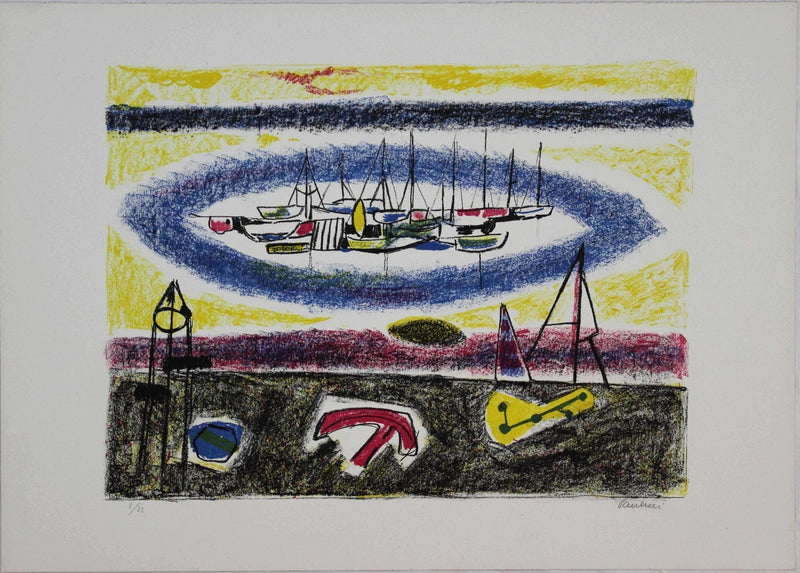
Painter
Enrico Paulucci
Italy, 1901–1999
Stay up to date with this artist
Leave your email to receive updates on newly available artworks and news about this artist.
Artworks by Enrico Paulucci
1 artwork

Biography of Enrico Paulucci
Enrico Paulucci (Genoa, 1901 – Turin, 1999) was one of the protagonists of the renewal of Italian painting between the two wars and after the Second World War. His oeuvre, based on a free and sensitive relationship with colour, passes through landscapes, still lifes, figures and compositions in which reality is transformed into a luminous experience. While remaining predominantly figurative, Paulucci did not seek a…
Read the full biographyClose the biography
Enrico Paulucci (Genoa, 1901 – Turin, 1999) was one of the protagonists of the renewal of Italian painting between the two wars and after the Second World War. His oeuvre, based on a free and sensitive relationship with colour, passes through landscapes, still lifes, figures and compositions in which reality is transformed into a luminous experience. While remaining predominantly figurative, Paulucci did not seek a detailed description: he preferred to construct images through chromatic agreements, simplifications and visual rhythms.
Turin and the experience of the Six Painters
Trained in the Turin environment, Paulucci went through a brief period of interest in Futurism before participating, in 1929, in the birth of the group of the Six Painters of Turin, together with Gigi Chessa, Nicola Galante, Carlo Levi, Francesco Menzio and Jessie Boswell. The group opposed the more rhetorical and monumental tendencies of the Italian twentieth century, looking instead at modern French painting and the possibility of a more spontaneous, free and personal language.
The experience of the Six did not produce a uniform style. What united the artists was above all the idea that painting had to recover expressive autonomy. For Paulucci, this meant attributing a decisive role to color: not a covering of the forms, but an element capable of constructing them and transmitting the atmosphere of the scene. The comparison with the Fauves and with French figurative culture fueled a lively palette, without erasing the attention to composition.
The Turin experience must also be read in the light of relations with European culture. The group of Six was not only looking for a formal alternative to official painting, but claimed the possibility of observing the world without subjecting it to a pre-established rhetoric. The comparison with France offered models of chromatic freedom and independence of gaze. Above all, Paulucci drew from it the idea that color could organize a painting without being subordinated to a rigid design.
This position did not imply indifference to reality. Landscapes, interiors and people continued to constitute the starting point, but were reinterpreted through color relationships that expressed the atmosphere. Fidelity to the subject gave way to fidelity to a sensation: the brightness of a place, the rhythm of a street or the calm of a room.
Landscapes, figures and chromatic harmonies
Seascapes, urban views, landscapes, interiors and still lifes recur in his paintings. The objects and places are recognisable, but appear simplified in backgrounds that interact with each other. A facade, a tree or a stretch of coast can above all become an opportunity to combine shades, create contrasts and suggest depth through color rather than through a descriptive design.
Paulucci's painting is not devoid of structure: behind the apparent lightness we recognize a precise organization of the masses. The luminous surfaces coexist with synthetic contours and a sense of proportion that prevents the composition from dispersing. Even when the colors become more intense, the scene retains an intimate, almost musical balance.
His painting requires observing how colors influence each other. A blue next to an orange can accentuate its warmth; a clear area can give breathing space to a dense composition of objects. These relationships do not function as simple decorative contrasts: they suggest depth, temperature and distance. The scene remains recognizable precisely because the backgrounds are arranged according to a carefully constructed balance.
In still lifes, the choice of a few objects allows us to focus attention on shapes and intervals. In landscapes, however, the horizon, architecture and vegetation become elements of a chromatic score. The brushstroke can remain evident, allowing the gesture and the succession of the layers to be perceived. The image thus acquires a lively character, distant from the impersonal finish of a purely descriptive representation.
This capacity for synthesis makes Paulucci close to some experiences of European modernity without erasing his personality. Color is never just a sign of belonging to a current: it becomes the means with which the artist transforms daily experience into painting.
Teaching and the graphic arts
Paulucci also played an important role as a teacher and director of the Albertina Academy of Turin, contributing to the training of new generations. He was also interested in scenography, drawing and engraving, areas in which his sense of composition found different expressions. The graphics allow us to observe how the synthesis of shapes can work even when the palette is reduced and the sign becomes more evident.
When cataloging his artworks on paper it is necessary to distinguish original drawings, engravings, lithographs and editorial reproductions. They are typologies with different processes and characteristics; signature, print run, paper, possible publisher and catalog references must be checked on the individual copy. The quality of his research does not depend on the complexity of the subject, but on the ability to transform an everyday image into an experience of colour, balance and modern sensitivity.
The teaching activity adds an important dimension to his figure. Teaching painting also means transmitting a method of observation: learning to recognize the relationships between colours, to distribute masses and to understand when a detail strengthens or weakens the whole. This attention to the construction of the image is found in his artworks on paper, where few signs can suggest a complete structure.
The original graphics also allow us to consider the relationship between invention and process. A lithograph can preserve a quality close to the drawing, while an engraving highlights the function of the line and the tones obtained through the matrix. However, these techniques should not be attributed to an example based on appearance alone. To describe it correctly it is necessary to check the specific information of the edition and distinguish the size of the image from that of the sheet.
The variety of means confirms the continuity of Paulucci's research: whatever the support, the composition tends to maintain a carefully constructed lightness, in which the color or the sign not only illustrate the world, but reinterpret it.
Do you like Enrico Paulucci?
Leave your email to receive updates on newly available artworks and news about this artist.
Enrico Paulucci
Art that lives in your spaces
Choosing an artwork by Enrico Paulucci means making room for an individual artistic language. The artworks gathered here suggest combinations and perspectives to bring into your own surroundings, letting art guide your gaze.
DISCOVER THE ARTIST
Frequently asked questions
Answers to common questions about Enrico Paulucci, the artist’s life, artworks and value on the art market.
Who was Enrico Paulucci?
Enrico Paulucci (1901–1999) was an Italian painter linked to the Turin artistic environment of the twentieth century. His painting is recognizable for its attention to color and for a synthesis of forms often referring to landscapes and figures.
What relationship did Enrico Paulucci have with the Group of Six of Turin?
Paulucci was one of the protagonists of the Group of Six of Turin, an experience born at the end of the 1920s and important for the renewal of Italian painting in dialogue with European culture.
What subjects did Enrico Paulucci paint?
Landscapes, seascapes, still lifes and figures recur in his production. The interest is not only descriptive: color and compositional balance play a decisive role in the image.
How to distinguish an original lithograph by Paulucci from a reproduction?
It is necessary to verify the printing technique, the print run, any handwritten signature, numbering, publisher and documentation. The mere presence of the signature printed in the image does not prove that the sheet is an original graphic.
How much are Enrico Paulucci's artworks worth?
There is no single price: paintings, drawings and prints have different markets. Period, size, quality, provenance, state of conservation and comparable sales results are the main elements to consider.