

Printmaker and Painter
Mario Avati
Principality of Monaco, 1921 – 2009
Stay up to date with this artist
Leave your email to receive updates on newly available works and news about this artist.
Works by Mario Avati
2 works
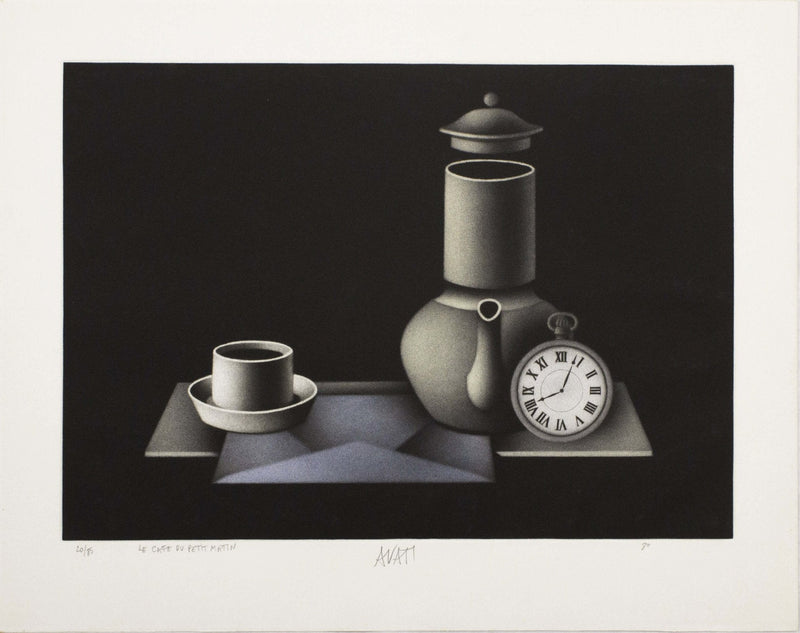

Mario Avati
Mario Avati (Monte Carlo, 1921 – Paris, 2009) was an engraver and painter of Italian origin, considered one of the great contemporary practitioners of mezzotint. His work is characterized by still lifes, fruit, everyday objects and animals that emerge from dark backgrounds through delicate gradations of light. After his early works, which also focused on urban views and figures, Avati developed a distinctive style in…
Read the full biographyClose the biography
Mario Avati (Monte Carlo, 1921 – Paris, 2009) was an engraver and painter of Italian origin, considered one of the great contemporary practitioners of mezzotint. His work is characterized by still lifes, fruit, everyday objects and animals that emerge from dark backgrounds through delicate gradations of light. After his early works, which also focused on urban views and figures, Avati developed a distinctive style in which the simplicity of his subjects coexists with mysterious atmospheres, irony and poetry. From black-and-white compositions to color prints, his work transformed ordinary objects into silent, almost theatrical presences, helping to renew artistic printmaking in the second half of the twentieth century.
Biography and artistic training
Mario Avati was born on May 27, 1921, in the Principality of Monaco to a family of Italian descent. He initially attended the École nationale des arts décoratifs in Nice and later the École nationale supérieure des beaux-arts in Paris. The artist Édouard Goerg, known for his fantastical imagery and work as an illustrator, played an important role in his artistic training. For Avati, printmaking gradually became the primary medium through which he developed a personal visual language.
Early Prints: Paris, Figures, and Urban Life
In the 1940s and early 1950s, Mario Avati created prints featuring subjects different from those that would characterize his mature work. Among the artworks held at the Museum of Modern Art in New York are Puppet (1950), La Métropolitaine (1952), Notre Dame de Lorette (1952), XIV Arrondissement (1952), and VIII Arrondissement (1953). These works testify to the artist’s interest in the city and in scenes of contemporary life. The images can take on an enigmatic quality, with spaces that seem to suggest stories not fully told.
Discovering Mezzotint in 1957
The year 1957 marked a turning point in Mario Avati’s career. After around ten years of experimenting with different printmaking techniques, the artist began to focus primarily on mezzotint. His earlier artworks were often built around mark-making and line; in the new prints, the interplay between darkness and light takes center stage. Mezzotint allows Avati to develop an exceptionally rich range of tones, from deep blacks to the most delicate grays.
Mario Avati’s Still Lifes
The still life is the most representative subject of Mario Avati’s mature work. His engravings feature fruit, bottles, vessels, eggs, flowers, musical instruments, and small objects from everyday life. Avati, however, interprets them through a personal visual language in which each element takes on particular significance. The objects are arranged with great care, often on simple surfaces against dark backgrounds. They seem illuminated by a light carefully designed to emphasize their presence.
The relationship with Giorgio Morandi
One of the most significant points of reference for understanding Mario Avati's painting and printmaking is Giorgio Morandi. Like the Bolognese painter, Avati pays close attention to everyday objects and their arrangement in space. The comparison with Morandi centers above all on the ability to transform a still life into an independent visual experience. In Morandi's artworks, objects are often immersed in diffused light and atmospheres marked by delicate variations in color. Avati thus reworks the still-life tradition through an individual sensibility.
Chiaroscuro and light in the prints
Light is one of the fundamental elements of Mario Avati's artistic practice. A fruit can emerge from an almost completely black background, while a metallic surface can reflect a sudden gleam. The objects thus acquire an intense physical presence, while remaining immersed in a spare space. In some artworks, he creates a calm, contemplative atmosphere; in others, he introduces an element of mystery. Light thus becomes a narrative tool, capable of transforming how objects are perceived.
Fruit, eggs, and everyday objects
Certain subjects recur frequently in Mario Avati's work: lemons, pears, apples, strawberries, eggs, vessels, and musical instruments. These elements form a kind of personal repertoire that the artist reworks in ever-changing compositions. A notable example is Citron, Bol et Compotier (1967), held at MoMA in New York. Another important work is Artichaut sur un plat en argent (1964), documented by the Bibliothèque nationale de France. Through their arrangement and use of chiaroscuro, he gives each element a specific role in the image.
Animals in the artworks of Mario Avati
Alongside still lifes, Mario Avati created numerous prints featuring animals. Snails, butterflies, insects, and other creatures appear in compositions marked by the same attention to light and form. One example is Snail, probably dating to 1977 and held at the National Gallery of Art in Washington. Its spiral shape becomes a point of compositional interest, while the contrast between light and shadow emphasizes its presence. The animals are not necessarily placed in naturalistic settings.
From black and white to color mezzotint
In 1969, Mario Avati began regularly introducing color into his mezzotints. Delicate or more intense tones appear in his still lifes, transforming the atmosphere of the compositions. Among the artworks documenting this period is Où l'on songe à Kamakura (1976), a color mezzotint presented by the French Académie des beaux-arts. The shift to color did not mean abandoning the fundamental principles of Avati’s practice. The innovation lay in the possibility of achieving more varied atmospheres while retaining the characteristic depth of his prints.
L’irony and poetry in Avati’s artworks
One of the most original aspects of Mario Avati’s output is its subtle irony. His subjects often come from everyday life, but are combined or presented in ways that suggest unexpected associations. Works such as La Jeunesse de Mozart, La Truite de Schubert, Une théorie de dominos and Pourquoi bleue? show the artist’s interest in musical references, wordplay, and enigmatic situations. The poetry arises precisely from the encounter between visual precision and freedom of imagination.
Mario Avati and Literary Illustration
Alongside his independent prints, Mario Avati developed an important practice of book illustration. In 1955, he contributed illustrations to Chiméra, a volume featuring two photographic stories by Lewis Carroll. In 1956, he created prints for an edition of Villiers de l’Isle-Adam’s Contes cruels. In 1961, he contributed to an edition of Jean Anthelme Brillat-Savarin’s Aphorismes, menus et variétés. As in his still lifes, Avati used visual precision to create images that retain a poetic and imaginative dimension.
Mario Avati’s graphic artworks and the catalogue raisonné
Mario Avati’s output comprises over a thousand prints, created over more than fifty years. L’s extensive output is documented in the Catalogue raisonné de l'œuvre gravé, published in several volumes and associated above all with the work of Roger Passeron. Beginning in 1969, color introduced new expressive possibilities without changing the central role of light. The continuity of his research shows how Avati succeeded in transforming printmaking into a personal, immediately recognizable language.
The Exhibitions and International Recognition
Mario Avati received important recognition as early as the 1950s. In 1957, he received the Prix de la Critique in Paris, one of the first significant awards of his career. In 1967, he worked at the Tamarind Lithography Workshop in Los Angeles, an experience that attests to his connection with the world of American printmaking. These include the Museum of Modern Art in New York, the National Gallery of Art in Washington, the Victoria and Albert Museum in London, and numerous French institutions.
His final years and artistic legacy
Mario Avati continued working in Paris until the final years of his life. Still lifes, animals, and small objects continued to become the subjects of images marked by a distinctive balance between rigor and imagination. In 2013, the Académie des beaux-arts established the Prix de gravure Mario Avati, with support from the artist and his wife, Helen. L's legacy lies above all in his success in bringing mezzotint back to the forefront of international attention. It is this combination of precision, mystery, and poetry that makes his work one of the most original contributions to twentieth-century printmaking.
Do you like Mario Avati?
Leave your email to receive updates on newly available works and news about this artist.
Mario Avati
Art that lives in your spaces
Choosing a work by Mario Avati means making room for an individual artistic language. The works gathered here suggest combinations and perspectives to bring into your own surroundings, letting art guide your gaze.
DISCOVER THE ARTIST
Frequently asked questions
Answers to common questions about Mario Avati, the artist’s life, works and value on the art market.
Who was Mario Avati?
Mario Avati (Monaco, 1921 – Paris, 2009) was a French printmaker and artist of Italian origin, renowned for his mastery of mezzotint. His works, often devoted to still lifes and everyday objects, are distinguished by delicate transitions of light.
What is the mezzotint technique used by Mario Avati?
Mezzotint is an intaglio printing technique that produces very soft gradations from deep black to light. The plate is prepared to retain ink and then worked to bring out the lighter areas.
What subjects did Mario Avati depict?
Avati is best known for still lifes featuring fruit, bottles, glasses and other everyday objects. Through pared-down compositions and refined tonal relationships, he gives these subjects a quiet, almost theatrical presence.
What makes Mario Avati’s prints distinctive?
His skill in mezzotint allowed him to model volumes and atmospheres through extremely subtle shading. In many works, the contrast between a dark background and illuminated objects creates an effect of intense visual concentration.
How can you identify an original print by Mario Avati?
It is necessary to establish that the work is an original print rather than a reproduction, checking the technique, signature, numbering, image and sheet dimensions, condition and catalogue references. The description must always refer to the individual impression.