
Artist and designer
Marcello Morandini
1940 –
Stay up to date with this artist
Leave your email to receive updates on newly available works and news about this artist.
Works by Marcello Morandini
1 work

Marcello Morandini
Black and white, geometric structures and illusions of movement constitute the vocabulary of Marcello Morandini (Mantua, 1940), an Italian artist and designer who has built an immediately recognizable language on the border between art, architecture and design. His works often seem animated by invisible forces: flat surfaces suggest depth, regular lines bend into unexpected structures, repeated modules produce a rhythm that changes according to the…
Read the full biographyClose the biography
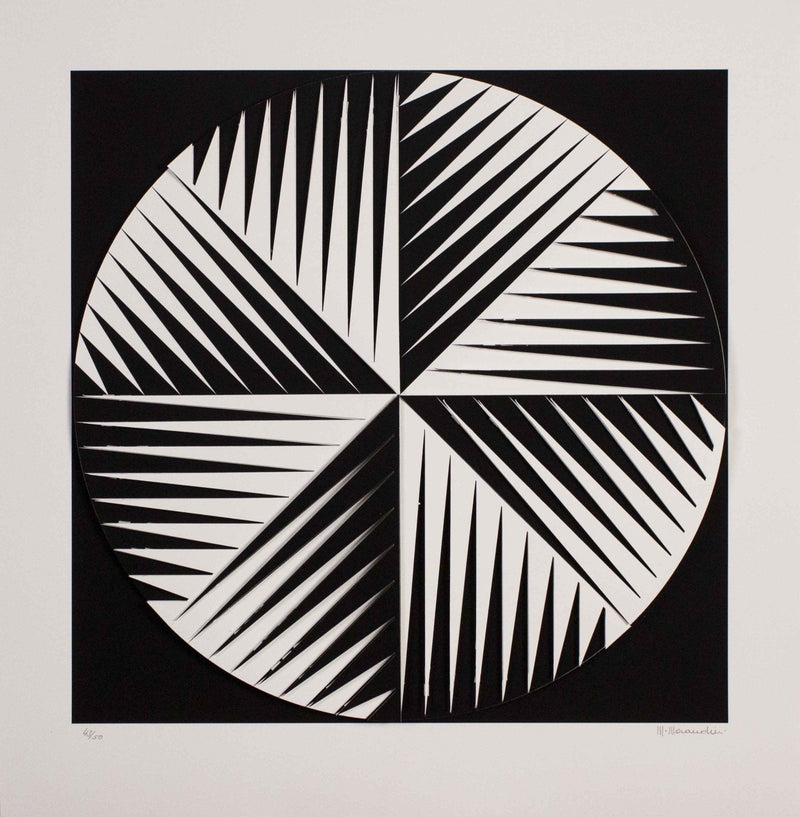
Black and white, geometric structures and illusions of movement constitute the vocabulary of Marcello Morandini (Mantua, 1940), an Italian artist and designer who has built an immediately recognizable language on the border between art, architecture and design. His works often seem animated by invisible forces: flat surfaces suggest depth, regular lines bend into unexpected structures, repeated modules produce a rhythm that changes according to the observer's position. Behind this perceptive complexity lies a rigorous method, based on the transformation of simple elements through precise compositional rules.
From graphic design to three-dimensional research
Grown artistically in the environment of design and visual communication, Morandini developed an interest in geometry as a language capable of overcoming the boundaries between disciplines since the 1960s. His research does not start from the imitation of nature nor from the story of personal experiences: it focuses on the possibilities offered by lines, angles, curves, symmetries and progressions. A geometric figure can be rotated, deformed, repeated or translated, generating new configurations without losing the clarity of the initial principle.
Morandini's method is best understood by observing how a minimal variation can produce a radical change. A line repeated at regular intervals builds an orderly surface; if the same sequence is inclined or curved, the eye perceives a new tension. The artist works on this threshold between prediction and surprise. The spectator recognizes a rule, but the result seems to escape its stability.
Geometry thus becomes a generative language, not a repertoire of decorations. Each composition can be read as the coherent development of a principle, and the quality of the work depends on the way in which that principle is carried through to its visual consequences. This attitude brings artistic practice closer to the project without reducing it to a purely technical problem.
The transition from plan to volume thus becomes a natural consequence. The graphic surface suggests objects, reliefs and architecture, while the three-dimensional structures in turn seem to develop according to the logic of a drawing. The relationship between concrete art, optical-perceptive research and design helps to place his work, but does not exhaust it: Morandini does not limit himself to creating visual effects, because he also investigates the possibility of translating a formal system into different materials and functions.
In three-dimensional works the geometric transformation meets the resistance of the materials. A curve must find a constructive solution, a surface must maintain continuity and a repeated module must maintain precision even when it changes scale. This is where the transition from drawing to object becomes particularly interesting: the abstract idea must measure itself with weight, thickness, light and method of assembly.
The result can be a sculpture, a relief or an architectural element, but the relationship between project and perception remains central. The public does not just observe an optical effect: it encounters a concrete structure, whose form depends on measurable decisions and precise construction work.
Black, white and movement perception
The recurring choice of black and white does not arise from a renunciation of color for decorative reasons. By reducing the palette, the artist focuses attention on the relationships between solids and voids, light and shadow, continuity and interruption. Alternating lines can generate optical vibration; inclined surfaces suggest twisting; a succession of modules can appear to be moving while remaining completely still. The eye tries to reconstruct the shape, but is continually stimulated by changes in direction and rhythm.
In many works the perceptual effect does not depend on an illusion as an end in itself: it makes visible the relationship between an abstract rule and the concrete experience of the spectator. The image is not identical for all observation points and, in three-dimensional structures, the light further modifies the reading of the volumes. This attention to visual behavior explains why Morandini's language can develop both in wall works and in sculptures, objects and environmental interventions.
Black and white also allows you to clearly distinguish the rhythm of the sequences. The absence of a broad palette does not impoverish the composition: it makes the deviations in direction, the twists and the relationships between surface and depth more legible. The alternation of full and empty spaces can suggest an impossible structure, or make a perfectly static shape appear mobile.
Vision also changes with distance. From afar the unity of the composition emerges; as you get closer you recognize the modules and transformations that generate it. This double level of reading invites active observation and explains the particular effectiveness of his works in contemporary spaces.
Art, design, architecture and works on paper
Morandini has extended his research to design objects, furnishings, architectural projects and public creations, maintaining a strong coherence between the different scales. A module born as a drawing can become a habitable structure or an object of use, without the transition implying a simple ornamental application. The project remains the center of the work: what changes are the material conditions through which it takes shape.
The relationship with design is deeper than a simple stylistic similarity. In both fields Morandini considers the clarity of the system, the coherence of the proportions and the behavior of the object in space to be fundamental. When a geometric structure becomes furniture or architecture, it meets needs of use and material constraints that can generate new formal solutions.
This continuity between disciplines allows us to read the works without rigidly contrasting autonomous art and functional object. The project is a form of research, and the transition from one medium to another can reveal different aspects of the same compositional principle. Even the dimensions modify the experience: a sequence observed on a sheet of paper does not produce the same physical involvement as an environmental structure.
Graphics and paper editions also require attention to this design dimension. A silkscreen, when actually documented, allows you to obtain clear backgrounds and controlled color relationships, particularly suitable for geometric compositions; However, not every printed image is an original screenprint. Correct cataloging must distinguish unique works, art prints, multiples and reproductions, verifying technique, edition size, publisher and signature. Morandini's research demonstrates how geometric rigor can produce dynamic, surprising and accessible images, capable of questioning our trust in what we see.
Original graphics are particularly suitable terrain for this language because it allows a controlled definition of the backgrounds and relationships between shapes. Screen printing can produce clean edges and homogeneous surfaces, but the identification of the technique must be based on the documentation of the edition. A digital print, an editorial offset and an artist's screenprint can show similar images despite having different natures.
For a catalog entry, the possible intervention of the artist in the design of the matrix, the number of specimens, the artist's proofs and the publisher's instructions are also important. The rigor with which Morandini constructs the images makes it even more necessary to precisely describe the process that produced them.
Do you like Marcello Morandini?
Leave your email to receive updates on newly available works and news about this artist.
Marcello Morandini
Art that lives in your spaces
Choosing a work by Marcello Morandini means making room for an individual artistic language. The works gathered here suggest combinations and perspectives to bring into your own surroundings, letting art guide your gaze.

DISCOVER THE ARTIST
Frequently asked questions
Answers to common questions about Marcello Morandini, the artist’s life, works and value on the art market.
Who is Marcello Morandini?
Marcello Morandini (born 1940) is an Italian artist and designer known for black and white geometric compositions. His research crosses art, architecture and design, with a constant interest in modular structures, spatial transformations and visual perception.
Why are Marcello Morandini's works often in black and white?
The contrast between black and white makes the rhythm, symmetry, rotation and deformation of geometric shapes particularly legible. By reducing the role of color, Morandini focuses attention on the relationships between structure, surface and perception.
Does Marcello Morandini belong to Op Art?
His work dialogues with optical and kinetic art through the use of geometric sequences and perceptual effects. However, his production also includes objects, furnishings and architectural projects: the Op Art label describes only part of his research.
What is the relationship between art and design in Morandini's works?
Morandini applies similar geometric principles to autonomous works and functional objects. Modules, twists and sequences can become two-dimensional images, sculptures or design elements, maintaining a recognizable formal coherence.
How to recognize an original screenprint by Marcello Morandini?
It is necessary to verify that it is an original graphic edition, checking the technique, paper, dimensions, signature, numbering and editorial documentation. A decorative print reproducing an image of the artist does not automatically have the same status as an original screenprint.