
Painter
Giosetta Fioroni
Italy, 1932
Stay up to date with this artist
Leave your email to receive updates on newly available artworks and news about this artist.
Artworks by Giosetta Fioroni
3 artworks

Biography of Giosetta Fioroni
Giosetta Fioroni (Rome, 1932) is one of the protagonists of Italian art of the second half of the twentieth century, capable of building a personal language between painting, photography, theatre, ceramics and literature. Associated with the Scuola di Piazza del Popolo and the Roman Pop art season, she stands out for an approach far from the simple celebration of consumption: in her artworks, faces, gestures,…
Read the full biographyClose the biography
Giosetta Fioroni (Rome, 1932) is one of the protagonists of Italian art of the second half of the twentieth century, capable of building a personal language between painting, photography, theatre, ceramics and literature. Associated with the Scuola di Piazza del Popolo and the Roman Pop art season, she stands out for an approach far from the simple celebration of consumption: in her artworks, faces, gestures, everyday objects and images taken from the media become fragments of memory. The famous Argenti cycle, with its luminous and elusive apparitions, summarizes a poetics based on the relationship between image and memory. From painting to artworks on paper, from Theatres to ceramic sculptures, Fioroni has continued to question the way in which images preserve emotions, stories and identities.
Training and decisive meetings
Born in Rome on 24 December 1932, Fioroni grew up in a family in which art belonged to everyday life: her father Mario was a sculptor, while her mother Francesca Barbanti Brodano was a painter and puppeteer. This environment fostered an early interest in images, craftsmanship and theatre, elements that would return in different forms throughout her career. At the Academy of Fine Arts in Rome she follows the courses of Toti Scialoja and frequents a cultural context crossed by the research of Afro, Alberto Burri and meetings with international artists such as Cy Twombly.
Her exhibition activity began early: she participated in the Quadrennial of Rome in 1955 and the Biennale of Venice in 1956. In 1957 she held a solo exhibition at the Galleria Montenapoleone in Milan, presented by Emilio Vedova. Between the end of the 1950s and the beginning of the 1960s she spent long periods in Paris, where she encountered a lively environment, open to the comparison between European avant-garde and American art. She also works in a studio linked to Tristan Tzara. The Parisian experience helps to make her research freer, without erasing the connection with Rome.
The Piazza del Popolo School and a personal Pop art
Returning to the Roman environment, Fioroni participates in the season of the Scuola di Piazza del Popolo, alongside artists such as Franco Angeli, Mario Schifano and Tano Festa. A fundamental place for meeting and experimentation is Plinio De Martiis's Galleria La Tartaruga, where she also exhibited in 1965. In 1964 she participated in the Venice Biennale, in a particularly important edition for the international diffusion of Pop art.
Although her oeuvre shares pop culture's attention to photographs, newspapers and images of contemporary life, Fioroni offers a profoundly individual reading of it. She is not interested in mechanically repeating an icon: she prefers to isolate a face, a look or a gesture and transform it into an apparition full of suggestions. Her painting maintains an evident manual dimension, in which the artist's mark remains essential.
The Argenti: photographs transformed into memory
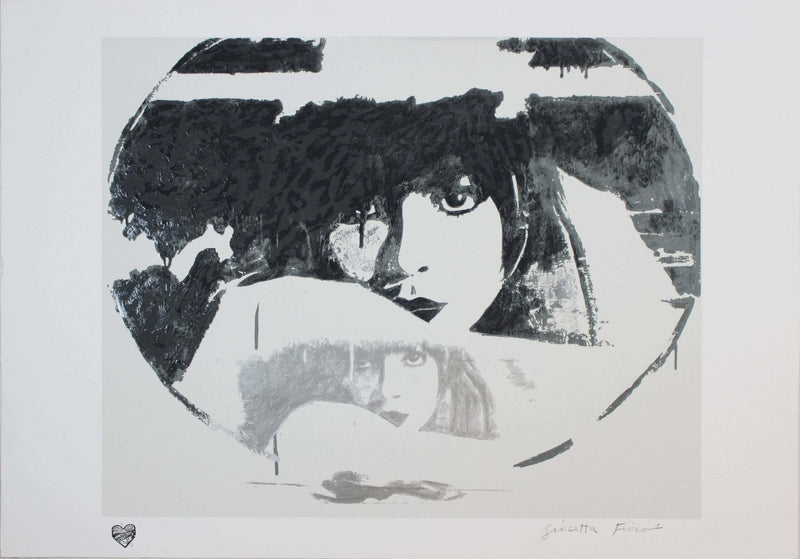
The Argenti cycle, developed especially in the 1960s, constitutes one of Fioroni's most original contributions to Italian painting. The artist uses photographic images, often projected onto the surface, to obtain silhouettes, faces and fragments of scenes which she paints with aluminium-coloured industrial enamels and paints. The silver tone produces reflection and fading effects: what appears clear from one point of view can become uncertain from another, as happens with memories that resurface in the mind.
These images are not simply intended to reproduce a photograph. Through painting, the photographic source loses part of its documentary function and acquires an emotional character. Edges can fade, details disappear and characters seem suspended between presence and absence. A significant example of this sensitivity is Memory of a little girl, in which personal memory is intertwined with the evanescent quality of the surface. The metallic color therefore becomes much more than an aesthetic choice: it is a tool to talk about time, perception and the fragility of the image.
The Optical Spy, the Little Theaters and the world of fairy tales
In 1968 Fioroni inaugurated the Teatro delle Mostre at the Galleria La Tartaruga with La Spia Ottica, an action that introduced the dimension of performance and observation into her research. The public is invited to engage with an image seen through a device, in a situation that makes the relationship between those who look and those who are looked at evident. The artist thus expands the reflection on the vision already present in the Argenti, transferring it from the canvas to an experience in space.
Starting in 1969 she created the Teatrini, small environments built and populated with objects and figures, conceived as miniature worlds. The childhood passion for puppets, theater and storytelling finds a new form here. During the Seventies, spent partly in the Venetian countryside together with the writer Goffredo Parise, her interest in fairy tales, legends and popular imagery also deepened. Houses, stars, hearts, animals and fantastic presences are not simple decorations: they become signs through which to evoke desires, fears and memories.
Painting, drawing, graphics and ceramics
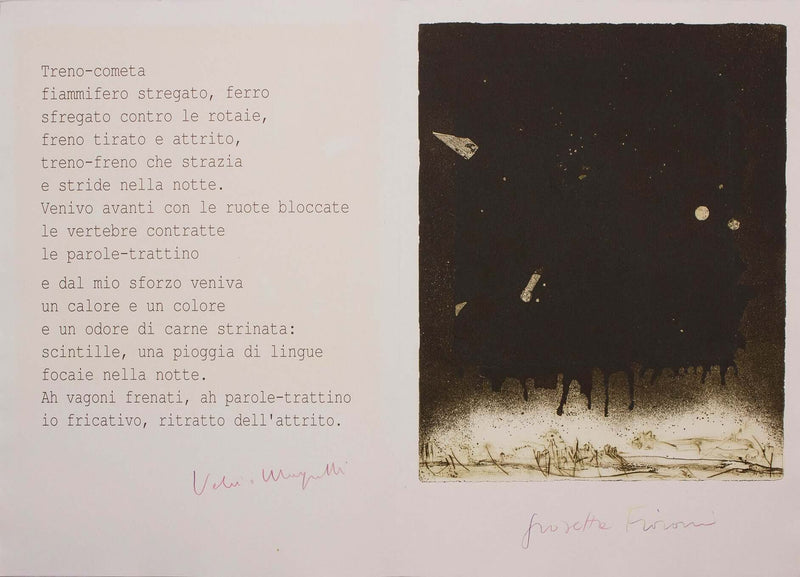
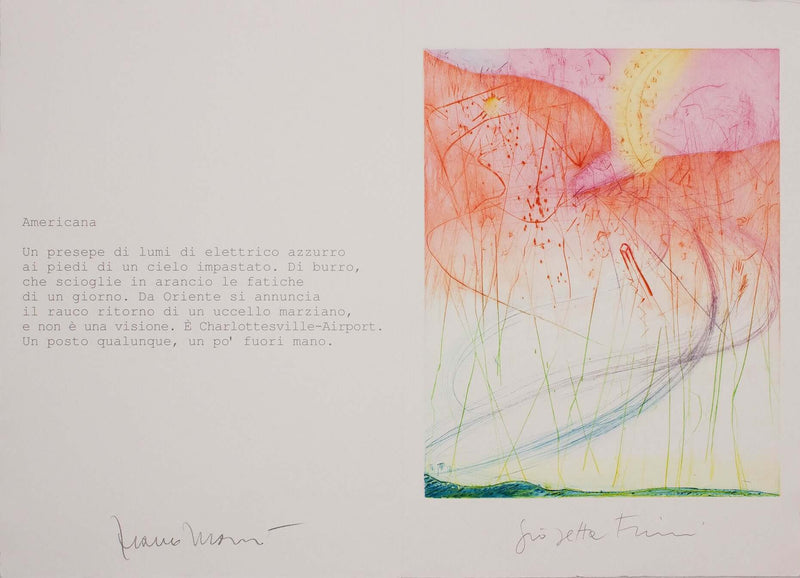
Fioroni's production does not end with silver paintings. It includes drawings, watercolors, pastels, collages and artworks on paper, in which the relationship between line, color and image is continually renewed. Some recurring motifs — hands, hearts, flowers, figures and small objects — form a sort of personal vocabulary, close to what the artist has called stenograms: synthetic signs capable of suggesting a story without telling it entirely.
An important role is played by the dialogue with poets and writers, including Parise, Alberto Arbasino, Andrea Zanzotto and other protagonists of Italian culture. From these meetings are born artists' books, special editions and artworks in which writing and image go hand in hand. For the collector it is useful to distinguish unique artworks on paper - such as drawings, mixed media and watercolors - from original prints, when documented as such, and from simple editorial reproductions. The presence of a signature or numbering, alone, is not enough to establish the technique: it is always necessary to verify the description, support, printing process and possible publisher.
Since 1993 Fioroni has explored ceramics at the Bottega Gatti in Faenza, transforming it into an important field of expression. Three-dimensional artworks are created linked to figures, clothes, animals, trees and flowers, in which the continuity with her pictorial universe is recognised.
Exhibitions, awards and current research
Fioroni's path has been recognized by numerous Italian and international institutions. Among the most important exhibitions include the large anthology at the Trajan's Markets in Rome in 2003, the L'Argento exhibition at the Drawing Center in New York in 2013 and My Story at the Galleria Nazionale d'Arte Moderna e Contemporanea in Rome, also in 2013. In 2018 the Museo del Novecento in Milan dedicates Sentimental Journey to her. In 2016 she entered the National Academy of San Luca and in 2018 the Goffredo Parise and Giosetta Fioroni Foundation was born, committed to the protection and valorisation of their respective artworks.
Its importance does not depend only on belonging to Roman Pop art. Fioroni has been able to cross different techniques and languages while maintaining a coherent vision: the image as a place where the present meets memory. Her silver faces, small theatres, graphic artworks and ceramics testify to a research that combines experimentation and delicacy, contemporary visual culture and autobiographical depth. It is this ability to make visible what normally escapes us - an emotion, a memory, an apparition - that makes her oeuvre still recognizable and current.
Do you like Giosetta Fioroni?
Leave your email to receive updates on newly available artworks and news about this artist.
Giosetta Fioroni
Art that lives in your spaces
Artworks by Giosetta Fioroni bring the language of Pop art into everyday spaces. Paired with clean lines and contemporary furnishings, they become the starting point for a personal interior, open to colour and a dialogue with art.
DISCOVER THE ARTIST
Frequently asked questions
Answers to common questions about Giosetta Fioroni, the artist’s life, artworks and value on the art market.
Who is Giosetta Fioroni?
Giosetta Fioroni (born 1932) is an Italian artist associated with the Piazza del Popolo School. She is known for research that combines painting, photography, memory and images of contemporary culture.
What are Giosetta Fioroni's 'silvers'?
The 'silvers' are artworks characterized by the use of silver tones and images often derived from photographs. The result recalls the photographic surface and introduces a poetic distance between memory and representation.
What is the relationship between Fioroni and Pop Art?
Fioroni dialogues with pop imagery, but develops an autonomous sensitivity, more linked to memory, intimacy and the transformation of photographic images than just the celebration of consumption.
What subjects appear in Giosetta Fioroni's artworks?
Faces, female figures, details of the body, images of childhood and fragments of memory appear in many phases of her oeuvre. The iconographic choices change with time and with the materials used.
How to recognize an original graphic by Giosetta Fioroni?
It is important to read the technique indicated in the sheet, verify signature, numbering and edition and distinguish the art print from a reproduction. Publisher, provenance and condition of the paper are also useful elements.
Discover more artists
Explore more leading figures in modern and contemporary art


