
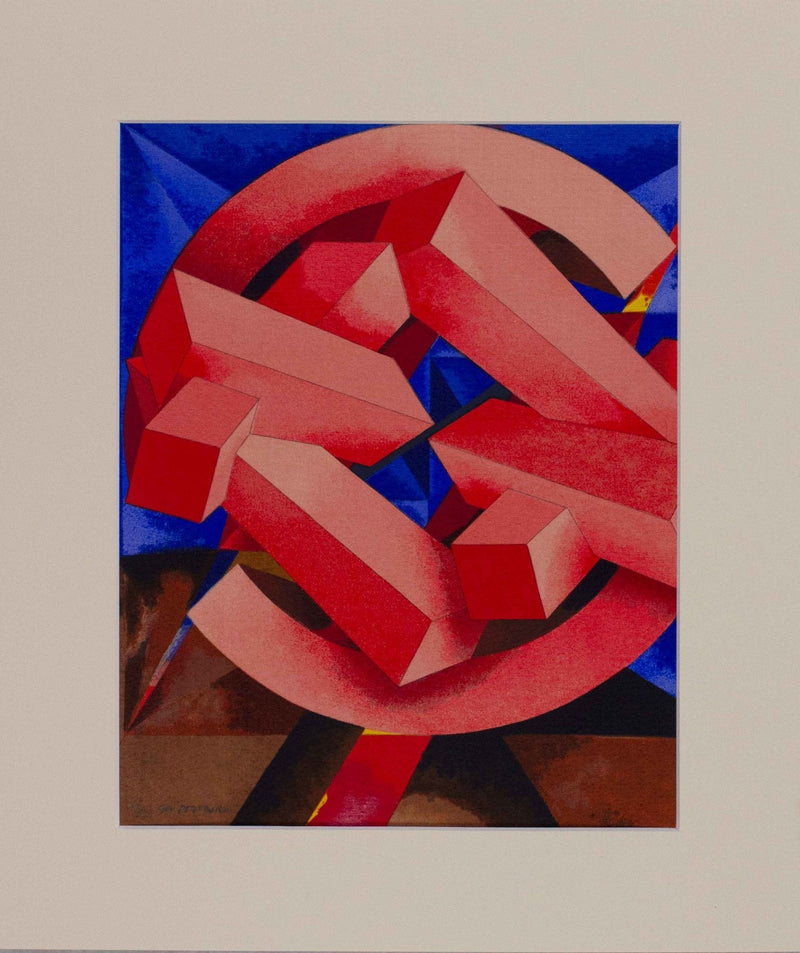
Sculptor
Giò Pomodoro
1930 – 2002
Stay up to date with this artist
Leave your email to receive updates on newly available works and news about this artist.
Works by Giò Pomodoro
1 work

Giò Pomodoro
Giò Pomodoro (Orciano di Pesaro, 1930 – Milan, 2002) was one of the great protagonists of Italian sculpture of the second half of the twentieth century. His research, distinct from that of his brother Arnaldo, is recognized for its attention to matter, light and the construction of forms that seem to arise from internal tensions. Marble, bronze and other materials become tools for exploring the…
Read the full biographyClose the biography
Giò Pomodoro (Orciano di Pesaro, 1930 – Milan, 2002) was one of the great protagonists of Italian sculpture of the second half of the twentieth century. His research, distinct from that of his brother Arnaldo, is recognized for its attention to matter, light and the construction of forms that seem to arise from internal tensions. Marble, bronze and other materials become tools for exploring the relationship between weight and movement, energy and order, surface and space.
From the first experiments to sculpture
After moving to Milan in the 1950s, Pomodoro came into contact with the avant-garde environment and took part in experiences linked to the experimentation of materials and languages. In his early works, the sign and the material take on growing importance. The artist is not looking for a figure to faithfully reproduce, but a structure capable of making a process visible: compressions, openings, twists and relationships between different parts.
This attention to the genesis of form led him to conceive sculpture as a dynamic organism. Even when the work is built with heavy materials, the surface seems to be crossed by a force that moves it from the inside. The dialogue between full and empty spaces is not a simple decorative effect, but the means through which the artist organizes the perception of space.
Pomodoro's research develops in a climate in which many sculptors try to overcome the idea of form as a closed volume. The material is no longer just what from which to obtain an image: it becomes a reality to be interrogated through pressure, incision and articulation. In the first experiments the sign may suggest a force passing through the surface; subsequently this tension acquires an increasingly explicit presence in three-dimensional space.
The distinction from his brother Arnaldo's work is important for understanding his identity. While sharing a background and some research contexts, Giò develops a specific interest in organic structures, light and the processes of growth of form. The sculpture does not appear as a casing to be opened to show the internal mechanism, but as an organism in which the parts generate each other.
Solar tensions, surfaces and shapes
Over time, Pomodoro developed cycles of works in which the material is excavated, modeled and articulated according to increasingly complex relationships. The s became one of the central motifs of his maturity: not a naturalistic representation of the star, but an image of energy, radiation and cosmic measurement. The surfaces can open into grooves, folds and directions that collect light and transform it into an active element of the composition.
The sculpture thus invites a vision in movement. From one position you can capture the profiles and the masses; from another emerge cavities, protrusions and luminous variations. The choice of material is also decisive: marble makes perceivable continuity between shape and original block, while bronze allows for different articulations and a specific relationship with the patina.
Light plays a constructive role because it makes differences in depth perceptible. A smooth surface can reflect it continuously, while a cavity holds it and creates a more intense shadow. Moving around the work, these relationships change and suggest a transforming form. Sculpture therefore does not have a single definitive aspect: it invites a physical and temporal experience.
The reference to the sun allows us to connect this research to the reflection on energy. It is not simply a matter of representing a luminous disk, but of giving shape to radiation, voltages and measurement relationships. Structures can suggest a center and the forces that propagate from it. Geometric order and organic vitality coexist without canceling each other out, producing monumental images even when the dimensions are small.
The choice between marble and bronze profoundly changes the result. The marble maintains a direct relationship with the block and with the work of subtraction; bronze instead allows passages through modeling, molds and casting. Each material introduces possibilities and constraints that the artist transforms into expressive qualities.
Public art and dialogue with architecture
Pomodoro dedicated a significant part of his activity to large-scale works and interventions in public spaces. In these creations, the sculpture is not simply placed in a place, but redefines the experience. The observer can cross the space, get closer to the details and recognize how the work establishes relationships with the landscape, with the buildings and with natural light.
Alongside sculpture, the artist dedicated himself to drawing and graphics. Works on paper allow us to grasp the importance of the sign in the construction of forms, but require precise technical identification. Engraving, lithography, screen printing, drawing and reproduction are different categories; for each copy, technique, edition size, signature, support and documentation count. Even the bronzes in edition require checking of numbering, foundry and provenance.
Giò Pomodoro's legacy lies in the ability to give matter an almost cosmic dimension without losing its concreteness. His sculptures do not tell a story through characters, but make perceptible forces and relationships that belong both to nature and to human experience.
In public interventions, the relationship with the place becomes part of the composition. A sculpture can guide the eye towards a building, interrupt a perspective or create a resting space. Its surfaces react to natural light and change appearance throughout the day, making time perceived through variations in shadows and reflections. The work thus dialogues with daily life without losing its autonomy.
Drawings and graphic works are also useful for understanding this plastic thinking. A line can indicate a direction of force, a tangle of signs can suggest a relief and a background can make the weight of a mass perceptible. However, the original print should not be confused with the photographic reproduction of a sculpture: the relationship between matrix, ink and paper constitutes a specific process, to be documented when an example is presented.
For edition bronzes, verifying the print run and foundry is particularly important. Numbering, possible brands, dimensions and provenance help to reconstruct the history of the work; for works on paper, data on the technique and support are required. This precision allows us to enhance the variety of unitary research, centered on the relationship between energy and matter.
Do you like Giò Pomodoro?
Leave your email to receive updates on newly available works and news about this artist.
Giò Pomodoro
Art that lives in your spaces
Marks, rhythms and forms: works by Giò Pomodoro bring a new sense of balance to a space. Understated furnishings give the composition room to breathe and invite you to rediscover it every day from a different perspective.

DISCOVER THE ARTIST
Frequently asked questions
Answers to common questions about Giò Pomodoro, the artist’s life, works and value on the art market.
Who was Giò Pomodoro?
Giò Pomodoro (1930–2002) was an Italian sculptor and artist known for his research on matter, sign, light and plastic forms. He has created sculptures, reliefs, works on paper and graphics.
What is the difference between Giò Pomodoro and Arnaldo Pomodoro?
They were two brothers, both sculptors, but with independent paths and languages. To correctly attribute a work it is necessary to verify the author's name and not rely solely on the surname Pomodoro.
What materials did Giò Pomodoro use in his sculptures?
Different materials appear in his production, including bronze and marble. Material, casting or processing technique and possible edition must be verified for each work.
What are Giò Pomodoro's 'Soli'?
The sun is an important theme in his plastic and monumental research. The works linked to this motif explore energy, light and formal tensions through sculpted surfaces and structures.
How is the circulation of a sculpture by Giò Pomodoro verified?
It is necessary to check numbering, signature or marks, documentation of the fusion, provenance and bibliographical references. The editions of sculptures should not be confused with those of graphic works.