
Conceptual artist
Gilberto Zorio
Italy, 1944
Stay up to date with this artist
Leave your email to receive updates on newly available artworks and news about this artist.
Artworks by Gilberto Zorio
1 artwork

Biography of Gilberto Zorio
Born in Andorno Micca, in the Biella area, in 1944, Gilberto Zorio is one of the protagonists of Arte Povera, the movement that has radically renewed the Italian artistic language since the second half of the Sixties. His research focuses on energy, transformation and instability: the artwork is not necessarily a finished object, but can be a system of materials that react, change color, produce…
Read the full biographyClose the biography
Born in Andorno Micca, in the Biella area, in 1944, Gilberto Zorio is one of the protagonists of Arte Povera, the movement that has radically renewed the Italian artistic language since the second half of the Sixties. His research focuses on energy, transformation and instability: the artwork is not necessarily a finished object, but can be a system of materials that react, change color, produce sounds or establish unpredictable relationships with space.
Turin and the birth of a new idea of sculpture
Zorio was trained in the Turin environment, attending the Accademia Albertina in a moment of great experimentation. The first exhibition experiences date back to the 1960s, when several Italian artists began to question the idea of sculpture as a stable and monumental volume. Iron, cement, rubber, chemical substances and commonly used objects enter the artwork not as poor materials in a simply economic sense, but as presences endowed with physical properties and the possibility of transformation.
In Zorio's research the material does not serve to represent something else: it acts directly. A surface can change in contact with a substance, a structure can suggest tension and precariousness, a suspended element can make the force of gravity visible. Attention thus shifts from the definitive appearance of the object to the processes that pass through it.
The industrial Turin of the 1960s constitutes a significant context for understanding this sensitivity. Attention to production processes, technical materials and transformations of matter runs through an important part of the artistic research of the period. Zorio, however, does not assume the language of industry as simple machine aesthetics. He is interested in what materials can do: react, support weight, change, transfer energy. Sculpture no longer coincides only with the form given to an inert material, but with a set of conditions that make an event possible. The visitor is called to perceive these conditions even when the transformation is slow or barely visible. In this sense, time enters the structure of the artwork and calls into question its apparent immobility.
Chemical reactions, time and energy
One of the emblematic artworks of his first season is Pink-blue-pink (1967), in which cobalt chloride can change color in relation to environmental conditions. The image is not immobile: the passage of time and the interaction with the environment become an integral part of the experience. This sensitivity brings art closer to a laboratory of transformations, while maintaining a poetic and symbolic dimension.
Artworks may include fluids, acids, electric light, industrial materials and devices capable of triggering processes. Zorio does not limit himself to illustrating a scientific phenomenon: he uses its strength to question the relationship between matter and life. Transformation is both a physical event and a metaphor for the possibility of change.
The use of reactive substances raises an essential problem: can an artwork change without losing its identity? For Zorio the variation is not necessarily an accidental deterioration; in certain artworks it is foreseen by the project and constitutes its conceptual core. This does not mean that every material change is desired or that conservation can be neglected. It is necessary to distinguish intentional reactions from damage caused by inappropriate conditions. Light, humidity, temperature and contact between substances can affect the experience and duration of the installation. This dimension makes technical documentation particularly important. The artwork appears as a temporary balance between different forces: some are visible, others must be imagined through their consequences. The experimental character is thus intertwined with a reflection on the fragility and continuity of natural processes.
Stars, canoes and archetypal shapes
In his language, images such as the star, the canoe, the javelin and the crucible recur. They are forms that cross different cultures and times, evoking orientation, travel, energy, launch and metamorphosis. The star, in particular, can become a luminous structure or a sign of tension in space; the canoe suggests a potential movement, a crossing that exists even when the object is still.
These elements do not constitute a decorative repertoire. Zorio connects them with materials and processes, creating installations that can involve the viewer's body and change the perception of the environment. The artwork does not end in a photograph: it often requires to be encountered in real space, observing its scale, light and transformations.
The recurrence of stars and canoes allows us to recognize a personal vocabulary without reducing it to a series of fixed symbols. A star can suggest orientation, but also radiation or instability; a canoe can evoke a journey, while remaining suspended in an exhibition space. The archetypal form acquires meaning from the material that constitutes it and from the relationships it establishes with the other elements. This is especially evident in installations, where distance, height and placement are not minor details. Drawings and projects also help to understand the construction of these relationships: they are not necessarily preparatory images without autonomy, but they can record ideas and possibilities of transformation. To describe a multiple or an artwork on paper it is essential to verify whether the specimen is an original project, an art print or documentation of the installation. The value of Zorio's research lies precisely in making perceptible what we normally consider invisible: the continuous action of forces on matter.
Drawings, multiples and documentation of the artworks
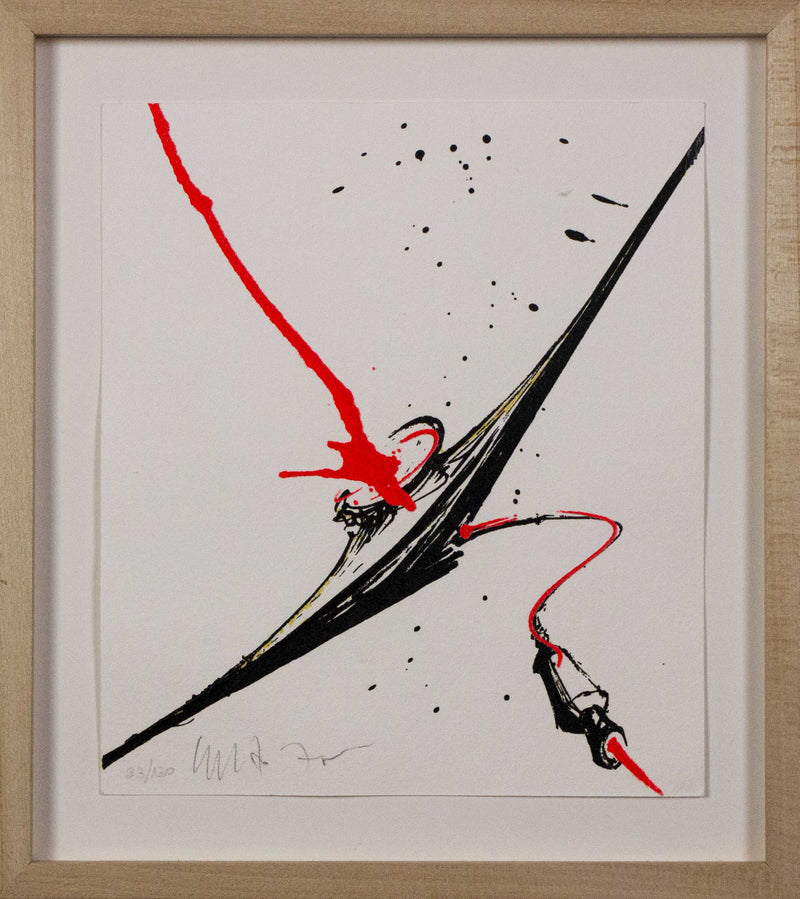
Zorio's research also includes drawings, projects and artworks on paper. When dealing with editions or multiples, it is essential to distinguish an original print from a photographic documentation of an installation and from a mass-produced object. For a reliable catalog card, the technical process, materials, print run, signature and any documentation of the artist or publisher count.
Zorio's legacy consists in having given sculpture an active dimension. His artworks remind us that matter is never completely inert: it can react, consume itself, transform and make visible an energy that normally escapes the gaze.
Do you like Gilberto Zorio?
Leave your email to receive updates on newly available artworks and news about this artist.
DISCOVER THE ARTIST
Frequently asked questions
Answers to common questions about Gilberto Zorio, the artist’s life, artworks and value on the art market.
Who is Gilberto Zorio and what relationship does he have with Arte Povera?
Gilberto Zorio is an Italian artist associated with Arte Povera. His research focuses on energy, transformation and physical and chemical processes, using different materials and often essential forms. Rather than representing a phenomenon, many artworks try to make its presence and change perceptible.
What materials does Gilberto Zorio use in his artworks?
Zorio's production includes industrial materials, metallic elements, substances and devices capable of suggesting or activating transformation processes. The choice of materials is part of the meaning of the artwork. For conservation and safety reasons, each artwork must be evaluated according to its specific technical characteristics.
What does the star represent in Gilberto Zorio's artworks?
The shape of the star is one of the recurring motifs of his research. It can take on a spatial and symbolic presence, interacting with light, energy and tension of materials. However, there is no single meaning valid for all artworks: what matters is the context in which the sign appears and the way in which it is created.
Why is the concept of transformation important in Gilberto Zorio's artworks?
Transformation is a central theme because materials are not always considered static elements: they can react, change or evoke an ongoing energy. This attention to the process brings his research closer to one of the nuclei of Arte Povera, which explored the relationship between matter, time and space.
What to check before purchasing an artwork or graphic by Gilberto Zorio?
It is necessary to identify with technical precision, materials, dimensions, year, origin and available documentation. In the case of prints or multiples, it is necessary to check the edition and numbering, if applicable. For artworks with particular materials it is also important to know the conservation and installation instructions, avoiding unauthorized interventions.
Discover more artists
Explore more leading figures in modern and contemporary art


