

Painter and sculptor
Aligi Sassu
Italy, 1912–2000
Stay up to date with this artist
Leave your email to receive updates on newly available artworks and news about this artist.
Artworks by Aligi Sassu
5 artworks

Biography of Aligi Sassu
Aligi Sassu (Milan, 1912 – Pollença, Mallorca, 2000) was a painter and engraver capable of navigating some of the main artistic and political events of the twentieth century without giving up an intensely personal imagery. His horses, battles, mythological characters, religious cycles and scenes of contemporary life reveal a constant faith in the expressive power of figure and colour. Red, often dominant, is not just…
Read the full biographyClose the biography
Aligi Sassu (Milan, 1912 – Pollença, Mallorca, 2000) was a painter and engraver capable of navigating some of the main artistic and political events of the twentieth century without giving up an intensely personal imagery. His horses, battles, mythological characters, religious cycles and scenes of contemporary life reveal a constant faith in the expressive power of figure and colour. Red, often dominant, is not just a chromatic choice: it becomes a form of energy, passion and narrative tension.
Futurism, commitment and figurative renewal
Having approached Futurism at a very young age, Sassu participated in the search for an art capable of representing modernity and movement. Soon, however, he developed a different language, more attentive to the human body and the emotional strength of painting. The Red Men series, started at the end of the 1920s, shows figures immersed in an unreal light, in which formal simplification and chromatic intensity surpass naturalistic description.
In the 1930s the artist also developed a strong anti-fascist commitment. Arrested in 1937, he experienced prison, an experience that profoundly marked his personal story. He was then close to the Corrente environment, which opposed the cultural rigidities of the regime and claimed a painting capable of dealing with man and history. Civil commitment and passion for the European figurative tradition thus intertwined in a research in which beauty does not exclude drama.
The early futurist experience is significant above all because it reveals an early interest in dynamism. Subsequently, however, the movement no longer depends only on the decomposition of the shapes: it arises from the intensity of the poses, the directions of the bodies and the energy of the color. The Red Men already show this transformation, giving the figure an almost visionary character. The political events of the 1930s introduce a further dimension. The arrest and detention cannot be reduced to an isolated biographical episode: they help to understand the weight attributed by the artist to freedom, human dignity and civil responsibility. In later artworks the commitment does not necessarily take the form of a direct denunciation; it can also emerge in the choice to represent bodies in tension, collective scenes or figures that resist a condition of violence.
Horses, myths and tales of the world
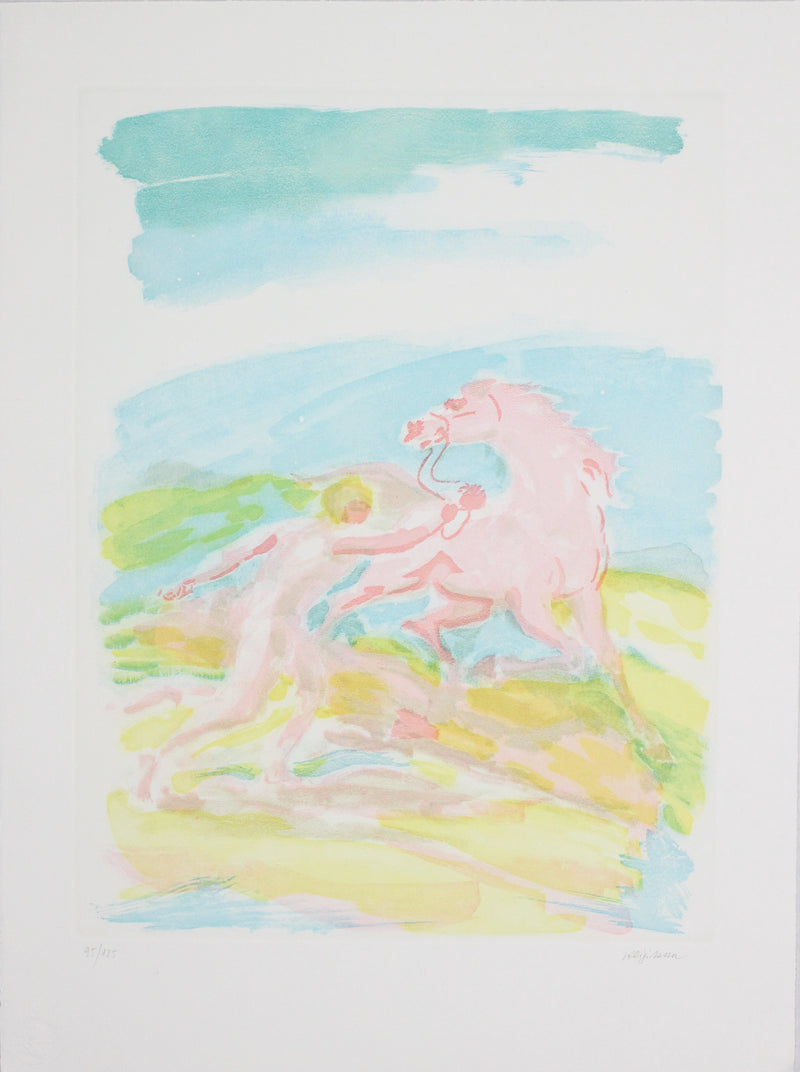
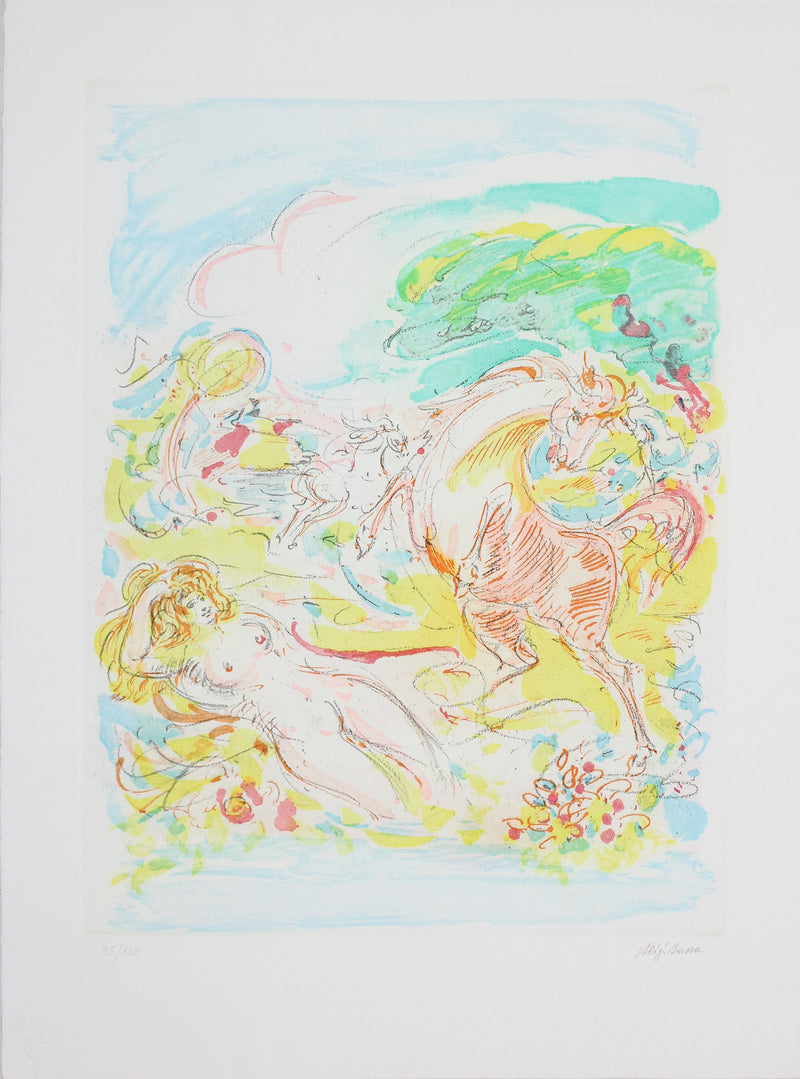
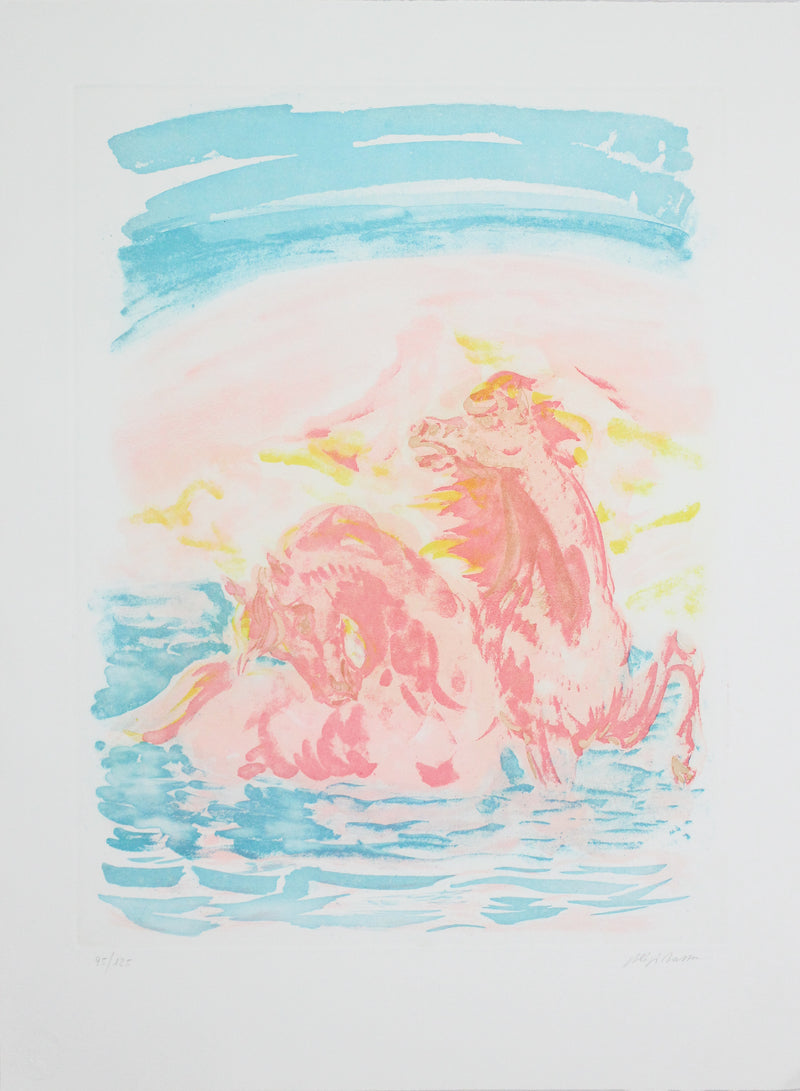
The horse is one of the most recognizable motifs of its production. Sometimes it appears as a free and powerful animal, other times it accompanies knights, battles or mythological scenes. Sassu interprets its shape through dynamic lines and color contrasts, transforming it into a symbol of vitality and movement. The same energy runs through the female figures, the religious compositions and the images dedicated to the Mediterranean world.
His painting maintains a link with the great masters of the past, but does not try to reproduce their style. The shapes can be simplified or deformed, the colors intensified to the point of making the scene almost visionary. In his mature years the artist expanded his subjects and materials, moving from painting to ceramics, from mosaic to large decorations. This variety reveals the desire to take the image beyond the private dimension of the painting, towards shared spaces and collective stories.
Horses allow us to follow the evolution of his language because they return in different contexts. They can appear immersed in a landscape, associated with knights or transformed into almost autonomous protagonists of the composition. Their body offers a dynamic structure: neck, legs and mane become directions that organize the pictorial space. Red also changes function according to the artwork, going from expressive lighting to a dominant element of the atmosphere. The reference to the myth expands this research. The classic characters are not re-proposed as archaeological exercises, but as images still capable of speaking of desire, conflict and transformation. Furthermore, the relationship with the Mediterranean introduces a light and chromatic sensitivity that accompany his mature production. The narrative character does not prevent painting from maintaining a strong formal autonomy. The relationship with narration does not mean that each artwork tells a recognizable episode. Even a single figure can suggest an entire story through the pose and the tension of color. This capacity for condensation explains why some of his motifs return years later without exhausting themselves in the repetition of the subject.
Engraving, lithography and illustration
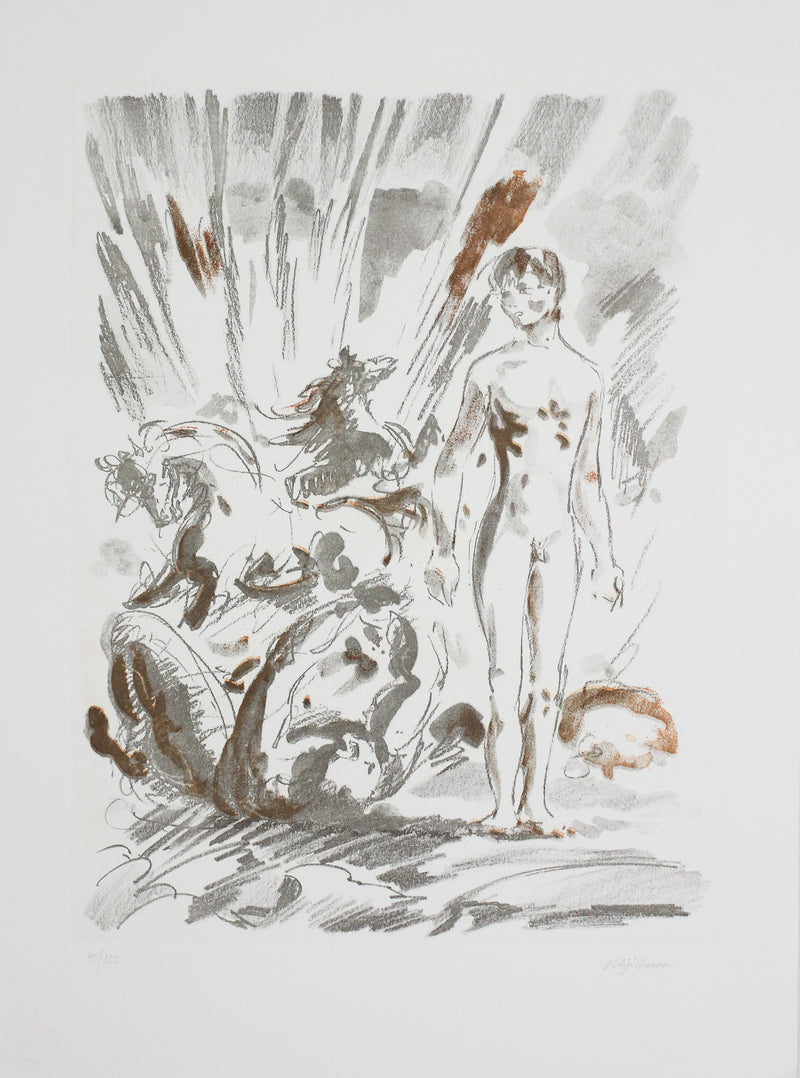
Sassu dedicated considerable attention to graphics, creating printed artworks and illustrative cycles also linked to literature. The relationship with the book allows him to develop narrative sequences, while lithography and engraving offer different ways of interpreting drawing and colour. The illustrations of the Divine Comedy testify to his interest in the visual translation of great literary texts.
For the collector it is important to distinguish between original lithograph, etching, silkscreen and reproduction, always checking the data of the individual edition. edition size, signature, support and editorial references are essential elements for an accurate description. Sassu's legacy consists in having kept alive an intense and modern figuration, in which myth, history and feeling coexist without losing the immediate strength of colour.
Graphic production requires particular attention because it includes artworks created in relation to literary texts and images conceived as autonomous artworks. In an illustrative cycle the succession of sheets contributes to the story, while a single print can focus on a moment or a character. Lithography allows a direct relationship between drawing and matrix; the etching builds the image through engraved grooves and bites; screen printing employs passes of color through a prepared fabric. They are different processes, even when they produce similar subjects. An illustrated edition must be described by distinguishing the original print from any typographical reproduction and considering, if present, colophon, publisher and numbering. The breadth of Sassu's production makes this precision indispensable. It also allows us to appreciate how the artist has translated into different materials the same trust in the ability of color and the figure to narrate human experiences.
Do you like Aligi Sassu?
Leave your email to receive updates on newly available artworks and news about this artist.
Aligi Sassu
Art that lives in your spaces
Choosing an artwork by Aligi Sassu means making room for an individual artistic language. The artworks gathered here suggest combinations and perspectives to bring into your own surroundings, letting art guide your gaze.
DISCOVER THE ARTIST
Frequently asked questions
Answers to common questions about Aligi Sassu, the artist’s life, artworks and value on the art market.
Who was Aligi Sassu and what themes did he paint?
Aligi Sassu (1912–2000) was an Italian painter and sculptor with a very wide production. Among his most recognizable themes are horses, knights, mythological scenes, human figures and compositions of strong chromatic intensity. His research also includes ceramics, sculpture and graphics.
Why are horses so frequent in Aligi Sassu's artworks?
The horse is one of the artist's best-known iconographic motifs. Sassu uses it to express movement, energy, tension and freedom, often through bright colors and dynamic shapes. Not all Sassu horses belong to the same period or are made with the same technique.
Was Aligi Sassu linked to Futurism?
As a young man, Sassu came into contact with the futurist environment and the theme of dynamism. His career, however, developed in many directions and cannot be reduced to Futurism. To interpret an artwork it is important to consider the dating and context of the specific artistic phase.
What graphic techniques did Aligi Sassu use?
Sassu created numerous artworks on paper and original prints, including lithographs and etchings. The technique must always be verified in the specimen sheet: an original lithograph does not coincide with a reproduction print. Any signature and numbering must be described precisely.
How to recognize and purchase an original lithograph by Aligi Sassu?
Before purchasing it is useful to check that the technique is actually lithographic, verify the print run, signature, dimensions, condition of the sheet and origin. The presence of a number is not sufficient, in itself, to guarantee authenticity. It is advisable to compare the artwork with reliable documentation and catalogues.
Discover more artists
Explore more leading figures in modern and contemporary art


