
Painter and sculptor
Lucio Fontana
Argentina, 1899–1968
Stay up to date with this artist
Leave your email to receive updates on newly available artworks and news about this artist.
Artworks by Lucio Fontana
2 artworks

Biography of Lucio Fontana
With Lucio Fontana, the canvas ceases to be merely a surface on which to paint: it can be pierced, cut, and traversed by space. This transformation makes his research one of the decisive turning points in 20th-century art. Founder of Spatialism, Fontana is not simply seeking a new image, but a new relationship between artwork, material, light, and environment, overcoming conventional divisions between painting and…
Read the full biographyClose the biography
With Lucio Fontana, the canvas ceases to be merely a surface on which to paint: it can be pierced, cut, and traversed by space. This transformation makes his research one of the decisive turning points in 20th-century art. Founder of Spatialism, Fontana is not simply seeking a new image, but a new relationship between artwork, material, light, and environment, overcoming conventional divisions between painting and sculpture.
From sculpture to spatial conception
Fontana was born in Rosario, Argentina, on February 19, 1899, into a family of Italian origin. His father, Luigi, ran a sculpture workshop and introduced him to the craft. After studying in Italy and serving in the Italian army during the First World War, the young artist returned to Argentina and worked as a sculptor. In 1928, he returned to Milan and attended the Brera Academy, where he studied with Adolfo Wildt. His oeuvre began with the figure, but soon opened up to deformation, movement, and approaches close to abstraction. In 1930, he held a solo exhibition at the Galleria del Milione.
In the 1930s, ceramics became an essential field of experimentation. In Albisola, and later in France as well, Fontana modeled figures, animals, and abstract compositions, energetically working the surfaces and using intensely colored glazes. L's direct experience of the material prepared the way for a conception of the work as a physical presence in space. During the 1940s, this intuition took theoretical form: in 1946, in Buenos Aires, Fontana contributed to the White Manifesto; in 1947, the first Spatialist manifesto was published in Milan. From this perspective, new art must engage with the possibilities opened up by light, movement, technology, and real space.
Environments, Holes, and Cuts
In 1949, Fontana created the Spatial Environment in Black Light, in which suspended forms and ultraviolet lighting transform the space perceived by the visitor. It is no longer a matter of observing an isolated object: the viewer physically enters the artwork. Around the same time, the Holes began, interventions that perforate the surface of the Spatial Concepts. Depth is not simulated through perspective, but made concrete by opening up the canvas.
In the late 1950s, the celebrated Cuts appeared, often associated with the title Concetto spaziale, Attese. One or more slashes cross frequently monochrome canvases, creating an essential relationship between color, surface, and void. The gesture, simple only in appearance, stems from precise preparation and introduces an additional dimension beyond the pictorial plane. Red, white, yellow, black, and the other hues used do not depict objects: they define the visual field in which the cut gains strength.
Fontana's oeuvre did not end with these two innovations. In the Stones, he applied fragments of colored glass that capture and reflect light; in the Plasters and Oils, he experimented with reliefs, thicknesses, incisions, and perforations. Between 1963 and 1964, he created The End of God, a series of large, perforated oval canvases whose shape can evoke an egg and a primordial dimension. In the Little Theaters of the mid-1960s, shaped frames instead enclose monochrome surfaces, suggesting small stages where form and depth once again meet.
Artworks on Paper, Recognition, and Legacy
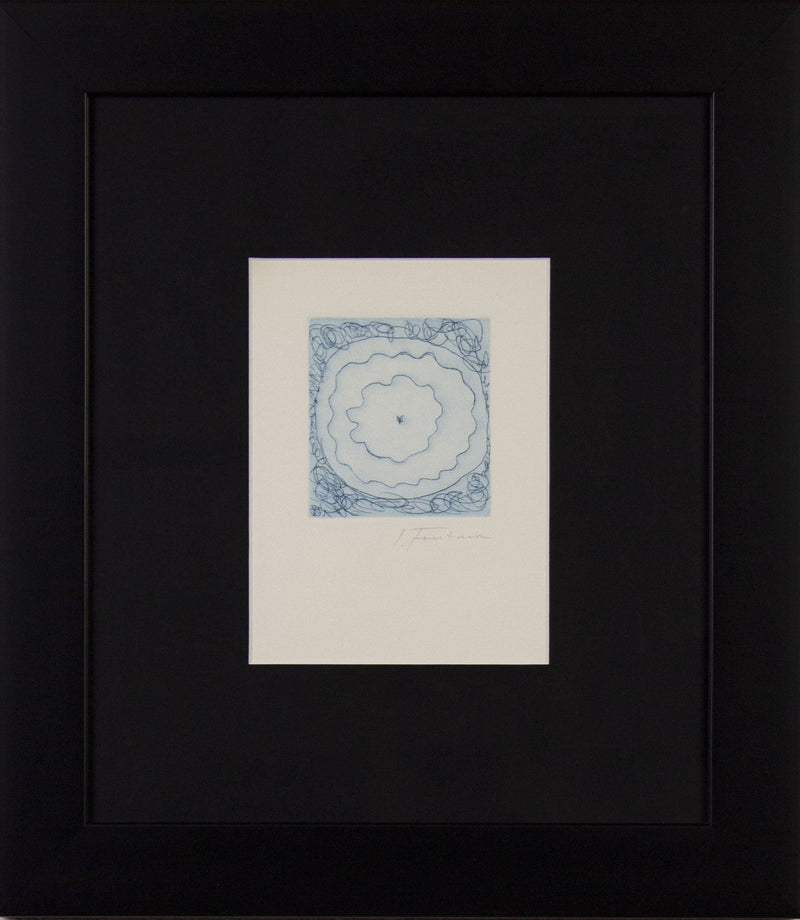
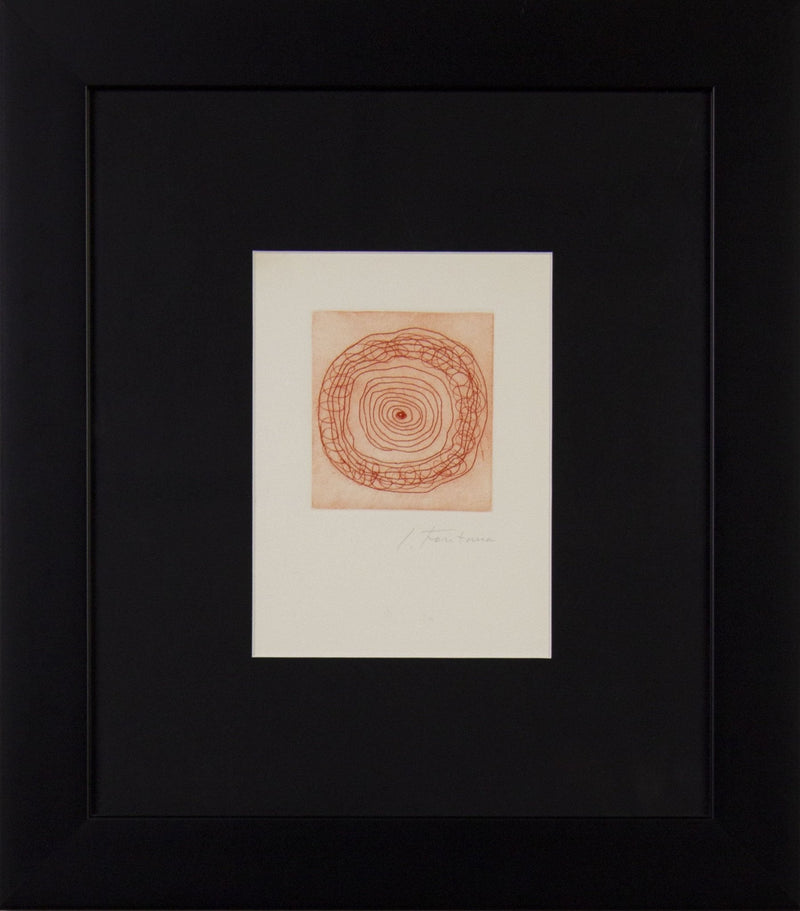
Alongside his sculptural artworks and environments, Fontana produced drawings, etchings, lithographs, and screen prints. In graphic art, too, mark-making and surface are central concerns, but each print requires proper technical identification. A photograph of a slashed canvas printed on paper is not, in fact, equivalent to a cut physically made by the artist. For editions, it is important to verify, when available, signature, edition size, publisher, and catalog references, distinguishing an original print from a simple reproduction.
Her oeuvre gained international recognition, and in 1966 Fontana received the Grand Prize for Painting at the Venice Biennale. He died in Comabbio on September 7, 1968. The significance of his oeuvre goes beyond the iconic image of the slashed canvas: it lies in demonstrating that space does not necessarily need to be represented, because it can become an integral part of the artwork itself.
Do you like Lucio Fontana?
Leave your email to receive updates on newly available artworks and news about this artist.
Lucio Fontana
Art that lives in your spaces
Choosing an artwork by Lucio Fontana means making room for an individual artistic language. The artworks gathered here suggest combinations and perspectives to bring into your own surroundings, letting art guide your gaze.

DISCOVER THE ARTIST
Frequently asked questions
Answers to common questions about Lucio Fontana, the artist’s life, artworks and value on the art market.
Who was Lucio Fontana?
Lucio Fontana (1899–1968) was an Italian-Argentine artist and the founder of Spatialism. He is best known for artworks that overcome the traditional surface of painting through holes and cuts.
What do Lucio Fontana's cuts mean?
The cuts are not simple destructive gestures: they ideally open the surface of the artwork to real space. Fontana thus questions the painting as a closed plane, proposing a new relationship between matter, light and space.
What is the difference between Fontana's 'holes' and 'cuts'?
Both belong to the research of spatial concepts. The holes pierce the surface with a plurality of openings; the cuts introduce clear fissures, often on monochrome canvases. The two solutions correspond to distinct developments in his research.
Why are many of Fontana's artworks titled 'Concetto spatial'?
The title indicates an investigation that does not only concern the image, but the relationship between the artwork and space. Fontana used it for different artworks: to identify one you must also consider the subtitle, date, materials and documentation.
How to verify the authenticity of an artwork by Lucio Fontana?
It is necessary to examine provenance, documents, bibliography, possible archiving and opinions of the competent bodies. Signature and visual appearance alone are not enough; for important artworks it is advisable to contact qualified specialists.
Discover more artists
Explore more leading figures in modern and contemporary art


