

Painter
Franco Gentilini
Italy, 1909–1981
Stay up to date with this artist
Leave your email to receive updates on newly available artworks and news about this artist.
Artworks by Franco Gentilini
2 artworks

Biography of Franco Gentilini
The fantastical cathedrals, female figures, and circus characters that populate the artworks of Franco Gentilini seem to belong to a recognizable world that, at the same time, is impossible to place in any precise location. The architecture has something familiar about it but eludes the rules of perspective, while acrobats, animals, and silent figures inhabit compositions in which lightness coexists with a subtle melancholy. This…
Read the full biographyClose the biography
The fantastical cathedrals, female figures, and circus characters that populate the artworks of Franco Gentilini seem to belong to a recognizable world that, at the same time, is impossible to place in any precise location. The architecture has something familiar about it but eludes the rules of perspective, while acrobats, animals, and silent figures inhabit compositions in which lightness coexists with a subtle melancholy. This is a painting that does not renounce reality, but reworks it through memory, a taste for storytelling, and a particular sensitivity to color and material.
From Faenza to the Roman art scene
Born in Faenza in 1909, Gentilini came into contact with craftwork at an early age through an apprenticeship in a ceramics workshop. His familiarity with surfaces, the preparation of materials, and the behavior of color helped shape a sensibility that would stay with him even when he devoted himself fully to painting. After formative experiences in the Emilia art scene, he moved to Rome in 1929, the city where he would spend most of his life and connect with artists, writers, and intellectuals.
The context of the Roman School, despite encompassing very different personalities and styles, is one of the cultural reference points within which his artistic exploration takes shape. Gentilini, however, does not adhere to a single stylistic formula. From his early figures and landscapes, he gradually develops a personal world in which drawing retains a decisive role and reality is transformed into a poetic representation. Forms become simplified, spatial relationships less predictable, and objects seem to acquire a life of their own, as happens in stories where everyday life suddenly opens up to fantasy.
Cathedrals, figures, and poetic invention
Among the most recognizable subjects are the cathedrals, often built as imaginary architectures. Facades, towers, and openings are arranged through geometric and decorative rhythms that evoke the medieval tradition without seeking to reconstruct it faithfully. More than real buildings, these structures seem to condense the memory of a city, the appeal of ancient architecture, and the pleasure of composition. Their fantastical character depends not only on the distortion of proportions, but also on the way colors and marks transform the structure into an almost animated presence.
Alongside architecture, female figures recur, often characterized by composed poses, essential lines and suspended atmospheres. The acrobats, jugglers and animals in the circus repertoire, too, take on a dimension beyond the spectacle’s description. Gestures may seem frozen in an indefinite moment, while a sense of wonder is sometimes accompanied by an impression of loneliness. It is precisely this oscillation between playfulness and melancholy that makes Gentilini’s images less simple than their apparent immediacy might suggest.
Color plays a full part in this balance. Bright tones and harmonious relationships are not merely pleasing decorative effects: they create the artwork’s atmosphere and help bring narrative elements and stylized forms together. The treatment of the surface also reveals the artist’s attention to painterly material, developed since his years of artisanal training. Line defines contours without making the figures rigid; areas of color bring order to the composition without erasing its evocative character.
Illustration, lithography and engraving
His relationship with storytelling finds a natural extension in his oeuvre as an illustrator. Gentilini creates images for literary artworks, including texts related to Franz Kafka and Gianna Manzini. The printed page offers him a setting different from painting, in which the figure must interact with the words and the sequence of images. L’illustration, in his case, does not simply repeat what the text describes: it selects moods and suggestions, creating an independent visual commentary.
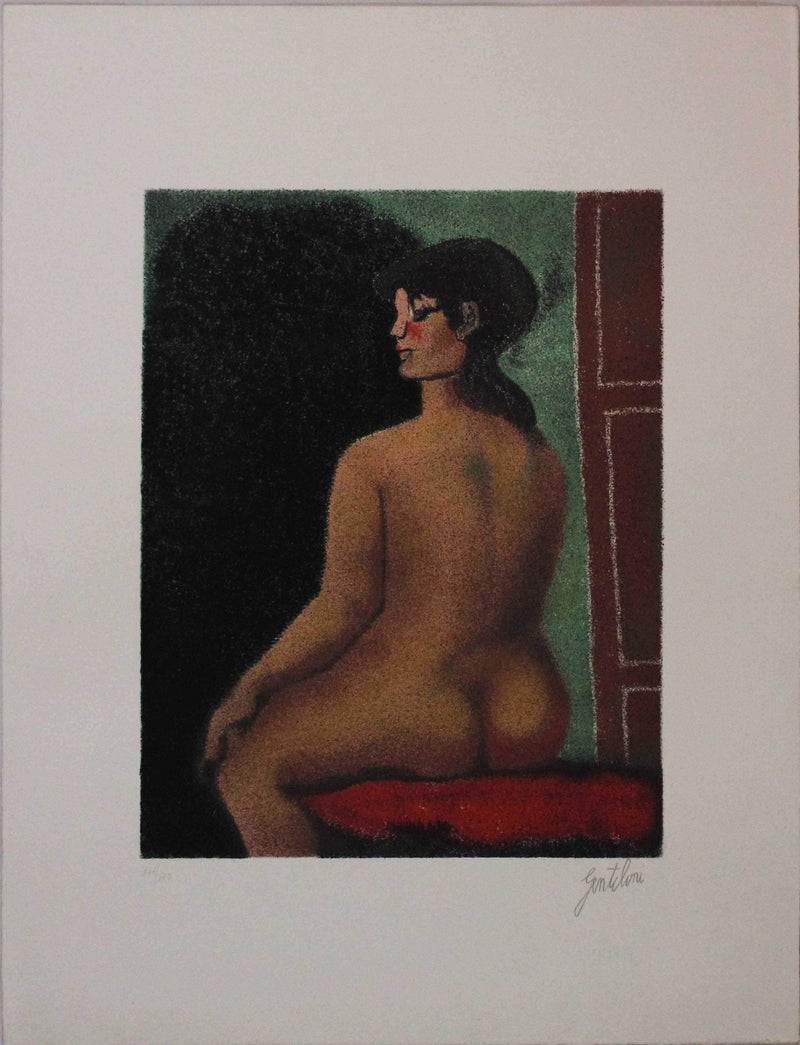
An important chapter of his oeuvre is his original prints, including lithographs and etchings. In lithography, the drawing can retain considerable freedom of line, a quality particularly suited to an artist for whom contour and the rhythm of forms are fundamental. L’etching, by contrast, allows for the development of an intricate engraved line through work on the metal plate, effective both in defining figures and in constructing architecture. The prints may revisit familiar subjects from his paintings, but they should not therefore be considered mere copies: each technique has specific possibilities and limitations that influence the visual result.
To accurately describe a Gentilini print, it is necessary to distinguish an original lithograph from an etching and an editorial reproduction, referring to the documentation of the artwork and edition. The technique cannot be determined solely from the subject or the presence of a signature. This is particularly important for an artist whose highly recognizable iconographic repertoire was also widely disseminated in print.
Throughout his career, Gentilini took part in important Italian exhibitions, including the Venice Biennale and the Rome Quadriennale, and also taught at the Academy of Fine Arts in Rome. He died in the capital in 1981, leaving behind a body of work that holds a distinctive place in twentieth-century figurative art. Its strength lies not only in the recognizability of its cathedrals and figures, but also in its ability to transform an apparently simple repertoire into a language in which memory, imagination, and attention to materials remain inseparable.
Do you like Franco Gentilini?
Leave your email to receive updates on newly available artworks and news about this artist.
Franco Gentilini
Art that lives in your spaces
Choosing an artwork by Franco Gentilini means making room for an individual artistic language. The artworks gathered here suggest combinations and perspectives to bring into your own surroundings, letting art guide your gaze.

DISCOVER THE ARTIST
Frequently asked questions
Answers to common questions about Franco Gentilini, the artist’s life, artworks and value on the art market.
Who was Franco Gentilini?
Franco Gentilini (1909–1981) was an Italian painter and engraver born in Faenza and active mainly in Rome. It is recognizable for a poetic figuration made of cathedrals, squares, female figures, jugglers and imaginary architecture. In his painting, reality is transformed through incisive signs, material surfaces and intensely suggestive colours.
What are the most famous subjects of Gentilini's paintings?
Recurring subjects include cathedrals, facades, squares, female figures, acrobats and reinvented urban scenes. Gentilini was not looking for a photographic representation of the city: he simplified the architecture and filled it with atmosphere, as if they were sets of memory. The presence of these themes must however be evaluated in relation to the period of the artwork.
How can you recognize Franco Gentilini's style?
Gentilini's artworks often feature marked contours, stylized architectural constructions, figures suspended in an almost theatrical space and surfaces with a material appearance. The composition combines recognizable figurative elements and a strong inventive freedom. It is not correct to authenticate a painting based only on these characters: documentary verifications are needed.
Did Franco Gentilini make lithographs and engravings?
Yes, alongside paintings Gentilini cultivated drawing, illustration and art graphics. The artworks on paper can be unique originals or prints made with different techniques, including lithography. To correctly describe an example it is important to read the technical data sheet and distinguish an original print from a simple reproduction.
How much is a signed lithograph by Franco Gentilini worth?
There is no single price valid for all lithographs. Subject, technique, size, print run, state of conservation, signature, documentation and comparable sales results have an impact. Even two examples by the same artist can have very different prices. For a reliable evaluation it is necessary to identify the artwork and compare it with documented transactions, not just with online advertisements.