
Painter
Antoni Tàpies
Spain, 1923 – 2012
Stay up to date with this artist
Leave your email to receive updates on newly available works and news about this artist.
Works by Antoni Tàpies
2 works

Antoni Tàpies
In European art of the second half of the twentieth century, Antoni Tàpies (Barcelona, 1923–2012) gave the pictorial surface an almost physical presence, transforming dust, sand, signs and common objects into tools for reflection on life. His work does not just ask us to recognize an image: it invites us to observe the traces left by time, the weight of materials and the meaning of…
Read the full biographyClose the biography
In European art of the second half of the twentieth century, Antoni Tàpies (Barcelona, 1923–2012) gave the pictorial surface an almost physical presence, transforming dust, sand, signs and common objects into tools for reflection on life. His work does not just ask us to recognize an image: it invites us to observe the traces left by time, the weight of materials and the meaning of what we usually consider poor or insignificant. Painter, engraver, sculptor and author of writings on art, Tàpies has built a language in which matter becomes both memory, symbol and experience.
From post-war Barcelona to «Dau al Set»
His training was largely self-taught. During a long convalescence as a youth he devoted himself intensely to reading, drawing and painting; he later abandoned his law studies to follow his artistic vocation. Post-war Barcelona, marked by Franco's dictatorship, was a difficult environment but one characterized by lively cultural research. In 1948 Tàpies participated in the foundation of Dau al Set, an experience that brought together artists and intellectuals interested in Surrealism, poetry and the freedom of the imagination. The first paintings reveal affinities with Joan Miró, Paul Klee and dream images, but already show a personal attention to enigmatic signs and the consistency of surfaces.
Dau's experience at Set was also decisive for the freedom with which Tàpies learned to make different languages dialogue. The group was not a school of rigid poetics: magazines, images, texts and meetings offered a laboratory in which Catalan culture sought new expressive spaces. When the artist moved away from the first fantastic suggestions, he retained this willingness to question the symbols. The progressive centrality of the material did not therefore erase the imagination, but transferred it from the painted figure to the surface itself, where a crack or a trace could suggest stories without telling them directly.
International recognition came in the 1950s, when his research approached Material Informal. Tàpies did not simply intend to replace the subject with a thicker mixture: he wanted to question the very idea of the painting as an illusory window. The canvas became a wall, a terrain, a fragment of reality on which to read engravings, abrasions, deposits and cancellations. Even the colours, often concentrated on greys, earths, blacks and whites, contributed to this sensation of density and concentration.
Walls, crosses and everyday objects
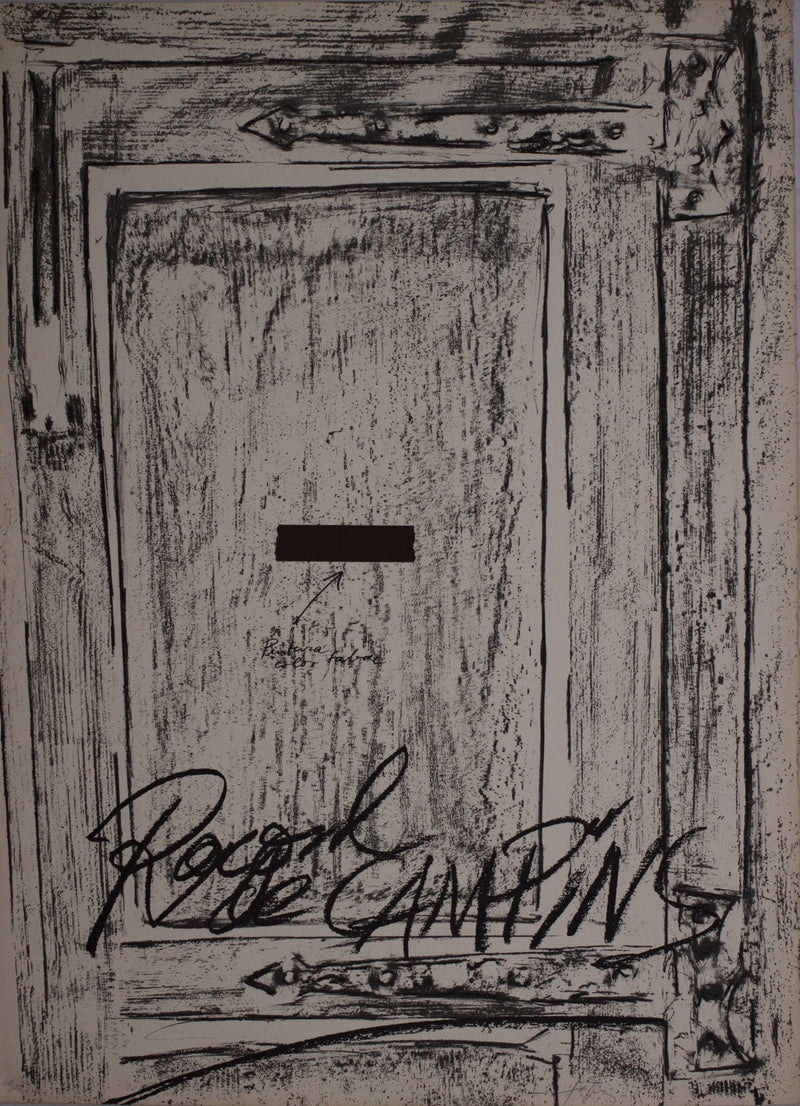
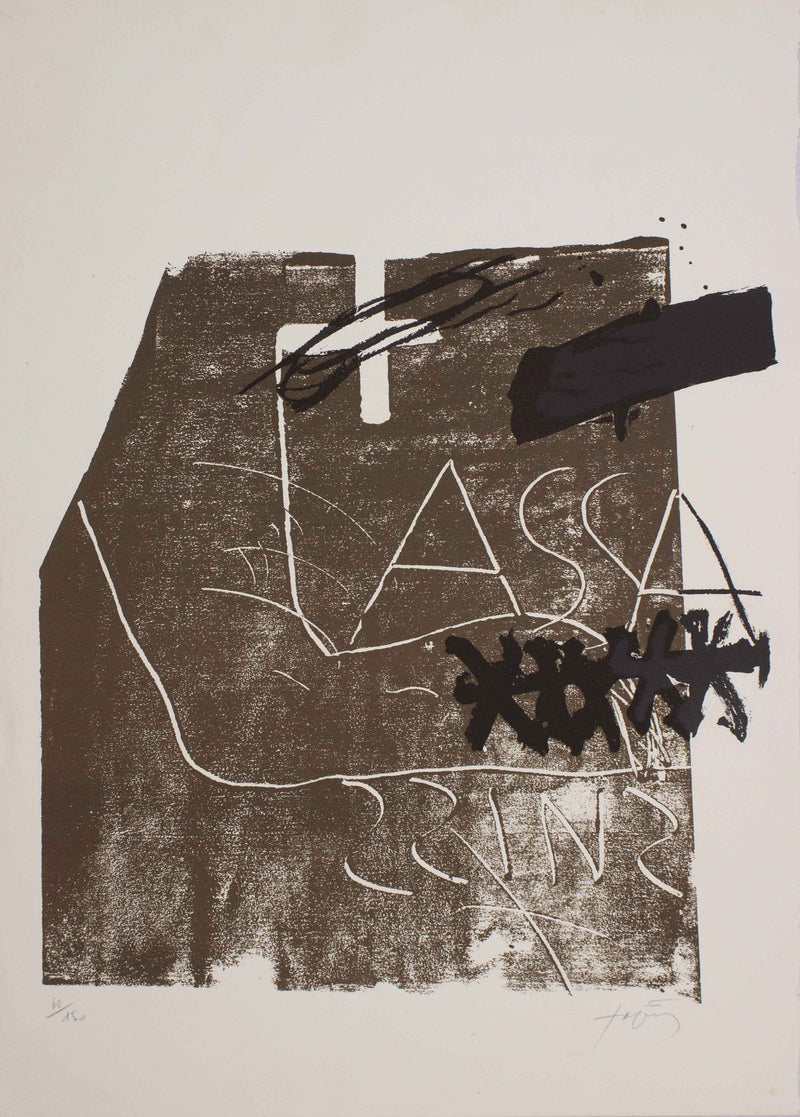
His compositions feature crosses, letters, numbers, footprints, hands and graffiti-like signs. The cross can be read as a geometric shape, a spatial indication or a spiritual symbol, without being limited to a single meaning. The letter sometimes appears as a fragment of writing, other times as a pure visual presence. The surface bears the signs of human passage, almost as if it were a wall on which different generations have left testimonies.
The wall is one of the most fruitful metaphors for understanding his painting. It can be a barrier and protection, a place of isolation and at the same time a collective space on which to leave a message. The engravings and signs drawn on the surfaces evoke the passage of anonymous people, while the presence of isolated letters often prevents a definitive reading. This ambivalence is essential: the work does not deliver a secret code to be solved, but invites us to recognize how memory, physical experience and imagination are deposited in objects. Even the relationship with the body passes through imprints, fragments and allusions, rather than through a traditional anatomical representation.
The choice of unconventional materials - sand, marble dust, fabric, ropes, cardboard and everyday objects - did not arise from a taste for provocation as an end in itself. Tàpies attributed value to ordinary reality and its ability to suggest philosophical questions. In this sense his work dialogues with Eastern thought, with attention to the void and with a conception of art as an exercise in awareness. The Catalan political and cultural dimension emerges in some signs and references, but coexists with more general questions about the fragility of the body, suffering and transformation.
Original graphics and surface experimentation
Paper production occupies an important place in its activity. Lithographs, etchings, aquatints, serigraphs and artists' books allowed him to experiment with the relationship between gesture, matrix and impression. In lithography the sign is processed on a surface suitable for planographic printing; in etching a metal plate is engraved through the bite; in screen printing the ink passes through the open parts of a prepared fabric. These procedures can be combined with material interventions and mixed techniques, but the exact definition must be verified for each work.
In printed works, experimentation may require multiple matrices, color passages and interventions that modify the surface of the sheet. It is useful to distinguish the print run, which indicates how many copies belong to an edition, from the state of a matrix, which can document different processing phases. A pencil signature or numbering are important descriptive clues, but they do not replace examination of technique and provenance. The presence of reliefs, collages or applied materials also requires a more precise description than the generic print label. In artists' books, the dialogue with the poetry and with the sequence of pages adds another dimension: the work is discovered over the time of reading, not just in a single glance.
Even when working in editions, Tàpies maintains the idea of the surface as a place of stratification. The sheet is not a simple neutral support: it can become a symbolic wall, crossed by imprints and signs. It is therefore important for the collector to distinguish an original print from a reproduction, checking technique, publisher, print run, signature and bibliographical references. His legacy consists in having shown that the humblest matter can open up a reflection of surprising depth.
Do you like Antoni Tàpies?
Leave your email to receive updates on newly available works and news about this artist.
Antoni Tàpies
Art that lives in your spaces
Choosing a work by Antoni Tàpies means making room for an individual artistic language. The works gathered here suggest combinations and perspectives to bring into your own surroundings, letting art guide your gaze.
DISCOVER THE ARTIST
Frequently asked questions
Answers to common questions about Antoni Tàpies, the artist’s life, works and value on the art market.
Who was Antoni Tàpies and why is he important in contemporary art?
Antoni Tàpies (1923–2012) was a Catalan artist among the major protagonists of European art of the second half of the twentieth century. His research has transformed the surface of the painting into a place of material experimentation: dust, sand, signs and common objects become tools for reflecting on time, memory and human experience. He is associated with the informal, despite having developed a personal language.
What materials and techniques did Antoni Tàpies use?
Tàpies is known for his material paintings, in which he mixed pigments and materials such as marble dust and sand to obtain dense and irregular surfaces. He also used collage, assemblage, engraving and lithographs. To understand a single work it is important to read the technique reported in the sheet, because an original print does not necessarily have the same material as a painting.
What do the crosses and signs in Tàpies' works mean?
Crosses, letters, numbers, footprints and scratches recur in Tàpies' work. They do not always have a univocal meaning: they can evoke the body, spirituality, erasure or memory. The artist invited us to observe even the humblest materials as bearers of meaning. The interpretation therefore depends on the work and its context, not on a simple dictionary of symbols.
Did Antoni Tàpies also make lithographs and etchings?
Yes. Alongside paintings and assemblages, Tàpies developed an important graphic activity, experimenting with lithography, etching and other printing techniques. An original graphic comes from a matrix or a process created by the artist and should not be confused with a photographic reproduction. Edition, signature, numbering and documentation are elements to be verified for each copy.
How to recognize an original graphic by Antoni Tàpies?
It is necessary to examine the printing technique, the quality of the paper, any signature, numbering and bibliographical references or to the catalog raisonné, when available. Not all authentic works are necessarily signed in pencil or numbered: the characteristics vary according to the edition. Before purchasing it is useful to request detailed images and specific documentation of the specimen.