

Painter and sculptor
Mel Ramos
United States, 1935–2018
Stay up to date with this artist
Leave your email to receive updates on newly available artworks and news about this artist.
Artworks by Mel Ramos
1 artwork

Biography of Mel Ramos
Mel Ramos (Sacramento, 1935 – Oakland, 2018) was one of the protagonists of American Pop Art, capable of transforming the images of advertising and comics into an ironic reflection on desire, consumption and the representation of the body. His immediately recognizable language combines idealized female figures with commercial products, packaging and everyday objects. Behind the apparent lightness of these images lies a comparison with the…
Read the full biographyClose the biography
Mel Ramos (Sacramento, 1935 – Oakland, 2018) was one of the protagonists of American Pop Art, capable of transforming the images of advertising and comics into an ironic reflection on desire, consumption and the representation of the body. His immediately recognizable language combines idealized female figures with commercial products, packaging and everyday objects. Behind the apparent lightness of these images lies a comparison with the history of the nude in art and with the way in which mass culture constructs models of beauty.
From California to comic book superheroes
Growing up in California, Ramos studied art in Sacramento and developed his education in the artistic climate of the West Coast of the United States. The painter Wayne Thiebaud, his teacher and figure of reference, encouraged him to carefully consider painting as a concrete practice, made of colour, surface and image construction. Before finding his own pop language, Ramos went through experiences of figuration and abstraction; in the early sixties he then began to paint characters taken from comics, such as superheroes and clear-cut female figures.
The Californian scene offered Ramos a relationship with commercial images different from that of the European pictorial tradition. Billboards, packaging and comics constituted a daily visual repertoire, recognizable without the need for explanations. Transferring these subjects to canvas, however, meant changing the way of looking at them: what in advertising is consumed in a few moments acquired the duration and physical presence of a painting. The precision of the contours and the control of the surfaces were not just a citation of the commercial language, but a pictorial choice capable of making the artificial character of those images more evident.
This choice brought him closer to a generation of artists who questioned the separation between high culture and popular images. The difference compared to a simple illustration consisted in transferring the language of the mass media onto the pictorial surface, modifying its scale, intensity and context. The figures appeared familiar and at the same time alienated: removed from the original narrative, they became autonomous presences, almost emblems of a collective imagination.
Advertising, nudity and consumer culture
The best-known phase of its production associates female nudes with cigars, drinks, fruit, sweets and commercial packaging. The composition is often constructed with advertising clarity: bright colors, smooth surfaces and a subject that immediately captures attention. Ramos connects two apparently distant visual traditions, the nude of Western painting and the seductive promise of the consumer product. The combination may appear funny, provocative or deliberately excessive.
The juxtaposition between body and product also acts through scale. A normally small object can become monumental, while the figure assumes a pose constructed to occupy the space as clearly as a brand. This inversion modifies the hierarchies of the image: it is not always clear whether the product is the background of the model or the opposite. Ramos exploits precisely this ambiguity, transforming the apparent simplicity of the composition into a comparison between desire, recognizability and consumption. The bright color contributes to the effect, but its function goes beyond the decorative one: it clearly separates the shapes and accentuates the sensation of a reality already mediated by advertising.
The meaning of these artworks remains open to different readings. On the one hand, the theatricality of the poses and the absurdity of the combinations can be interpreted as an ironic comment on advertising mechanisms; on the other, the representation of the female body reproduces stereotypes that today raise questions about the gaze and objectification. This tension is part of the artist's critical history and should not be erased by reducing the images to simple pop decorations.
Ramos maintained a constant interest in the pictorial tradition. In some series he reinterpreted the relationship between model and artist and reread famous images from the history of art, demonstrating that Pop Art could communicate not only with supermarkets and magazines, but also with museums. The formal elegance of the compositions thus coexists with a conscious cultural ambiguity.
The dialogue with the masters of the past allows us to observe his artworks also from the point of view of the construction of the nude. The poses, attributes and organization of the scene recall consolidated conventions of Western painting, but are transferred into a universe of industrial objects and commercial signs. The result may appear parodic and, at the same time, confirm some traditional models of representation. This double reading is essential: a historically aware interpretation must neither reduce Ramos to an advertising illustrator nor ignore the issues raised by the representation of the female body.
Painting and graphic artworks
His production includes paintings, drawings and edition prints, in which the precision of the outline and the liveliness of the chromatic backgrounds find a particularly effective means. Screen printing, when documented, allows color to be deposited through matrices prepared on a frame, favoring clean surfaces and controlled overlaps; other artworks can be created with different procedures. It is therefore essential to verify the technique of the individual print, without automatically identifying each pop artwork with a silk-screen.
In the original graphics, the relationship between project and print requires particular attention. Uniform backgrounds may suggest screen printing, but a similar effect can be achieved with other processes. It is therefore appropriate to distinguish the declared technique from the visual impression and verify, when available, the publisher, printer and catalog references. An artist's proof or a non-numbered print should be described for what it is, without confusing it with a unique example. The state of the paper and the fidelity of the colors also matter: in a language based on sharp contrasts, alterations and fading can significantly modify the experience of the artwork.
For a correct catalog entry, the edition, signature, publisher, size of the sheet and image and the possible presence of stamps or documents count. Ramos' artworks maintain an immediate visual force, but acquire greater depth when they are read as images born from the encounter between painting, advertising and transformations of customs in the second half of the twentieth century.
Do you like Mel Ramos?
Leave your email to receive updates on newly available artworks and news about this artist.
Mel Ramos
Art that lives in your spaces
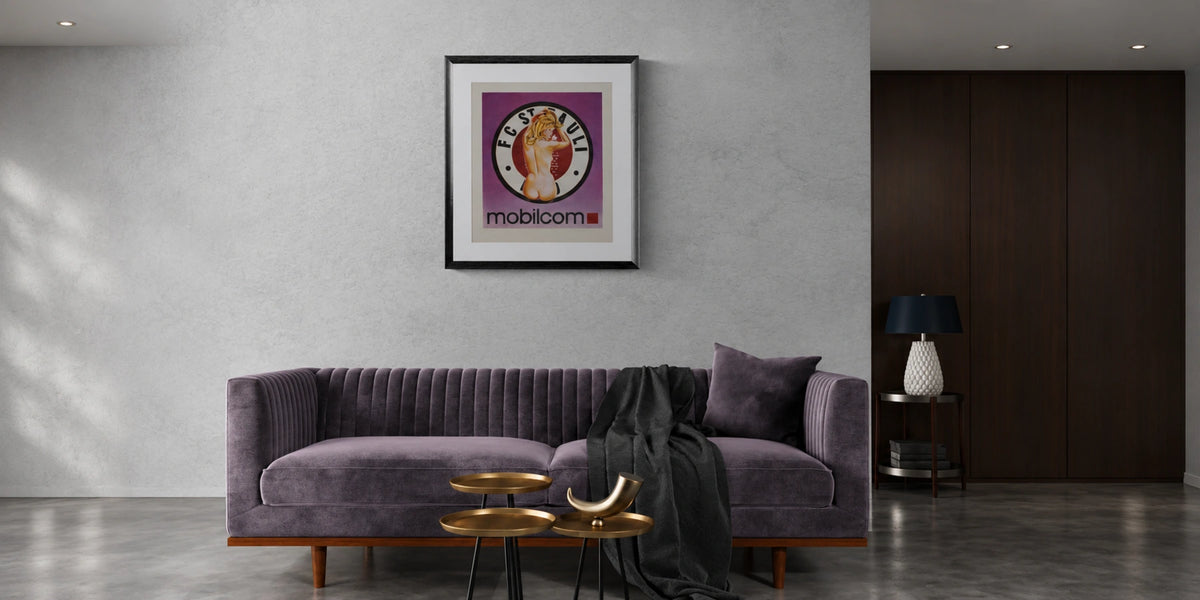
Artworks by Mel Ramos bring the language of Pop art into everyday spaces. Paired with clean lines and contemporary furnishings, they become the starting point for a personal interior, open to colour and a dialogue with art.
DISCOVER THE ARTIST
Frequently asked questions
Answers to common questions about Mel Ramos, the artist’s life, artworks and value on the art market.
Who was Mel Ramos and what relationship did he have with Pop Art?
Mel Ramos (1935–2018) was an American artist associated with Pop Art. He is best known for images that combine idealized female figures, commercial products and advertising language. Through clear colors and references to mass culture, his painting explores the relationship between desire, consumption and representation.
Why did Mel Ramos paint pin-ups and commercial products?
Ramos combined figures taken from pin-up imagery with packaging, brands and consumer objects to stage the mechanisms of advertising. The images may appear ironic and seductive, but they also raise questions about the way the female body is used in commercial communication.
Did Mel Ramos also represent comic book superheroes?
Yes. In the first phase of his Pop production, Ramos reinterpreted comic book characters and superheroes, before focusing on female figures associated with consumer products. Both strands demonstrate his interest in images already disseminated by the mass media and recognizable by the general public.
What is the difference between a painting and a screenprint by Mel Ramos?
The painting is a pictorial artwork performed on a specific support; a silk-screen print is a print made using matrices and can belong to a single edition. In Ramos' graphics, numbering, signature, publisher, year and state of conservation are particularly important. An original artist print should not be confused with a simple reproduction poster.
How to verify an original artwork by Mel Ramos?
It is useful to check the declared technique, sheet size, possible numbering, signature, publisher and provenance. The presence of a signature, alone, does not demonstrate authenticity. For an artwork of value it is necessary to compare the data with catalogues, publications or specialist documentation relating to the specific edition.