
Sculptor
Christo
Bulgarian, 1935 – 2020
Stay up to date with this artist
Leave your email to receive updates on newly available works and news about this artist.
Works by Christo
1 work

Christo
Christo Vladimirov Javacheff, internationally known as Christo, was one of the most innovative artists of the second 20th century, famous for the great temporary interventions made together with his wife and collaborator Jeanne-Claude. Born on June 13, 1935 in Gabrovo, Bulgaria, he died in New York on May 31, 2020, he contributed to transform the concept of work of art, overcoming the traditional boundaries of…
Read the full biographyClose the biography
Christo Vladimirov Javacheff, internationally known as Christo, was one of the most innovative artists of the second 20th century, famous for the great temporary interventions made together with his wife and collaborator Jeanne-Claude. Born on June 13, 1935 in Gabrovo, Bulgaria, he died in New York on May 31, 2020, he contributed to transform the concept of work of art, overcoming the traditional boundaries of painting and sculpture to intervene directly on buildings, monuments, landscapes and public spaces. His research has made possible a new relationship between art and everyday life, in which the experience of the viewer assumes a central role.
Training and meeting with Jeanne-Claude
Christo studied at the Sofia Academy of Fine Arts between 1953 and 1956, entering into contact with an artistic training still linked to the principles of traditional representation. After leaving Bulgaria, he crosses several European cities and in 1958 he reaches Paris, where he meets Jeanne-Claude de Guillebon, born in Casablanca on June 13, 1935. The meeting marks the beginning of a collaboration destined to become one of the most original experiences of contemporary art.
In the early years Christo produces works characterized by the use of common objects, fabrics, ropes and packaging materials. Bottles, jars, containers and other everyday elements are wrapped, tied and transformed, losing part of their original function and acquiring a new visual presence. These works anticipate one of the fundamental principles of his poetics: modify temporarily the appearance of an object to make it again perceivable form, volume and meaning.
The gesture of packing should not only be interpreted as a cloaking operation. The fabric can hide some details, but at the same time highlights the overall structure of the object, its relationship with space and its physical presence. The artist invites us to look at what appears familiar through a different perspective.
From object to urban space
In the early 1960s, Christo and Jeanne-Claude gradually expanded the scale of their interventions. In 1962 they built in Paris Wall of Oil Barrels – The Iron Curtain, a wall made up of metal barrels placed in rue Visconti. The work temporarily transforms an urban space and introduces a reflection on the relationship between art, urban environment and collective perception.
In 1964 the couple settled in New York, a city that became the main organizational center of subsequent projects. From this moment on, their research takes on an increasingly monumental dimension, involving public places and natural landscapes. The realization of each intervention requires a long process of design, authorizations, technical studies and collaboration with professionals of different disciplines.
Among the first major environmental works is Wrapped Coast, made in Australia in 1969, in which a stretch of coast is temporarily covered with fabric. The intervention shows how a light material can transform the perception of a large landscape, making evident profiles, volumes and relationships that normally escape observation.
Large environmental projects
In the 1970s and 1980s, Christo and Jeanne-Claude realized some of the most important interventions of their career.Running Fence, completed in California in 1976, consists of a long structure of fabric that crosses the landscape, creating a temporary sign able to relate hills, land and horizon. The work does not permanently change the territory, but proposes a new reading through a visual experience destined to last only for a limited period.
With Surrounded Islands, built in 1983 in Biscayne Bay in Miami, eleven islands are surrounded by large floating surfaces of pink fabric. The project transforms the relationship between land and water, highlighting the contours of the islands and creating an image of extraordinary colour intensity. The temporary nature of the intervention is an essential element: the work exists for a determined time and survives later through photographs, films, drawings and documentation.
In 1985 it was completed The Pont Neuf Wrapped in Paris, a project that includes the coating of the famous bridge with fabric. Ten years later, in 1995, the couple created Wrapped Reichstag in Berlin, temporarily transforming the German Parliament's palace into a great sculptural presence. These interventions show how art can change the perception of buildings deeply linked to history and collective identity.
The Gates and its relationship with the viewer
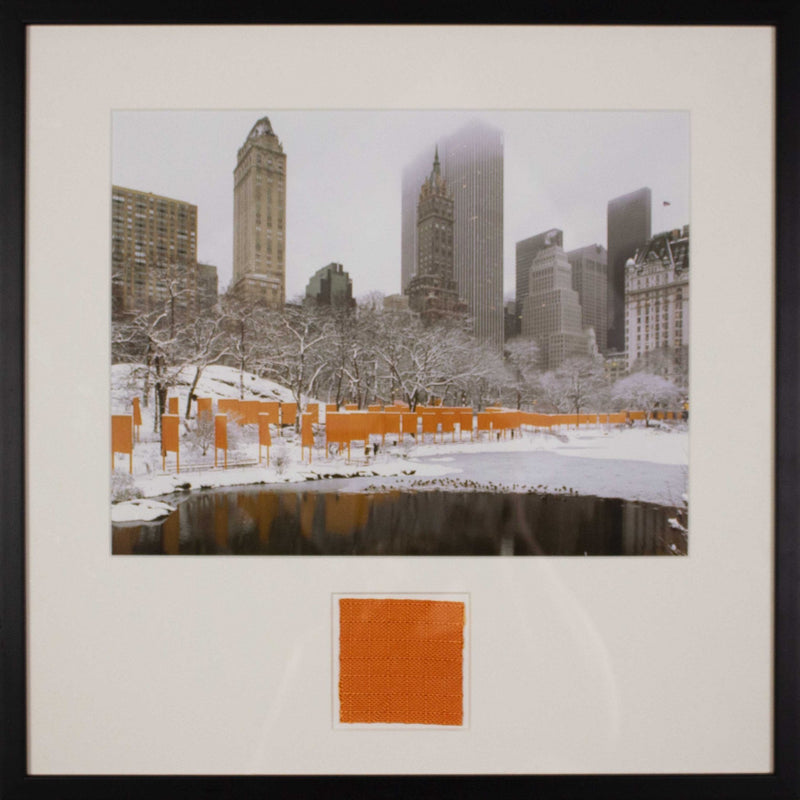
One of the most popular projects is The Gates, built in Central Park, New York, in 2005, after a long design journey started in 1979. The intervention includes 7.503 structures arranged along the paths of the park, from which panels of saffron-coloured fabric descend. The result is an environmental experience in which the public is invited to cross a sequence of chromatic elements that temporarily change the landscape.
Unlike a traditional work, The Gates cannot be fully understood from a single point of view. Its structure develops through the visitor's movement, the change of light and the relationship between the color of the fabric and the natural environment. The work exists as a shared experience, accessible to people with very different artistic knowledge.
This public dimension is a fundamental element of the research of Christo and Jeanne-Claude. Their projects do not necessarily require entry into a museum or gallery, but they are placed in places frequented daily, temporarily transforming the collective experience of space.
Drawings, collages and graphic works
In addition to the monumental installations, Christo develops a vast production of preparatory drawings, collages, projects and original graphic works. These works are of fundamental importance because they allow us to understand the process through which an idea is transformed into an environmental intervention.
The drawings frequently combine photographic images, graphic elements, technical annotations and material samples. They do not represent simple illustrations of the projects, but works equipped with their own aesthetic autonomy. Through the composition, color and relationship between different elements, Christo makes visible the tension between artistic imagination and concrete realization.
The graphic works also allow to deepen the design dimension of its research, showing how the transformation of the space born from a long process of study and experimentation. The importance of the design remains central even in the most monumental projects, because it allows to define the relationship between form, environment and perception.
The latest projects and artistic heritage
After Jeanne-Claude's death in 2009, Christo continues to develop shared projects. In 2016 he realized The Floating Piers on Lake Iseo, in Italy, a temporary system of floating catwalks that allows visitors to walk on the water through a path covered with yellow-orange fabric. The intervention renews the relationship between art and landscape, transforming the movement of the public into an integral part of the work.
In 2021, after Christo's death, he was created in Paris L'Arc de Triomphe, Wrapped, a project conceived many decades before and carried out according to the artist's indications.
Christo and Jeanne-Claude's legacy is to have shown that the work of art can be temporary, monumental and collective, without losing intensity and autonomy. Through interventions capable of transforming known places, they invited millions of people to observe the world with new eyes. Their research remains a fundamental reference to understand the possibilities of environmental art and the relationship between creativity, public space and participation.
Do you like Christo?
Leave your email to receive updates on newly available works and news about this artist.
Christo
Art that lives in your spaces
Choosing a work by Christo means making room for an individual artistic language. The works gathered here suggest combinations and perspectives to bring into your own surroundings, letting art guide your gaze.

DISCOVER THE ARTIST
Frequently asked questions
Answers to common questions about Christo, the artist’s life, works and value on the art market.
Who created Christo’s major environmental projects?
Christo and Jeanne-Claude developed temporary projects together, including Running Fence, Wrapped Reichstag and The Gates.
Where and when was The Gates presented?
It opened in Central Park, New York, in 2005. Structures along the paths supported saffron-coloured fabric panels.
Which work is in the catalogue?
EmporiumArt lists The Gates, Central Park, New York City 1979–2005.
What role does fabric play in their projects?
Wrapping buildings or landscapes brings their outlines and volumes into focus.
Why are Christo’s preparatory drawings important?
They trace the projects through photographs, notes and samples of materials and stand as works in their own right.