
Painter and printmaker
Zoran Mušič
Slovenia, 1909–2005
Stay up to date with this artist
Leave your email to receive updates on newly available artworks and news about this artist.
Artworks by Zoran Mušič
5 artworks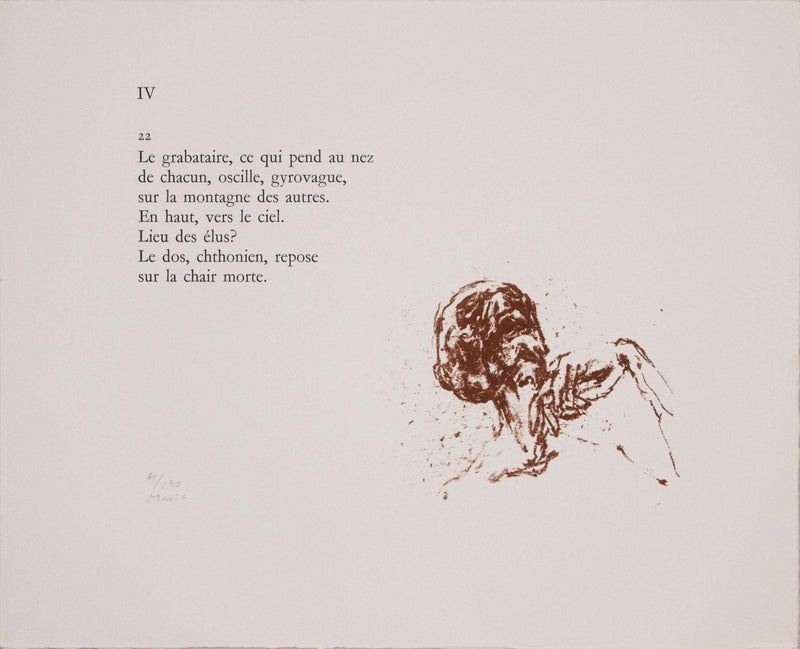

Biography of Zoran Mušič
Bare landscapes, horses, stony hills and human figures reduced to fragile presences run through the artwork of Zoran Mušič (Bukovica, 1909 – Venice, 2005), one of the most intense protagonists of European painting of the second half of the twentieth century. His research develops across different cultures and territories, but retains a profound coherence: the interest in what remains when the superfluous is eliminated. In…
Read the full biographyClose the biography
Bare landscapes, horses, stony hills and human figures reduced to fragile presences run through the artwork of Zoran Mušič (Bukovica, 1909 – Venice, 2005), one of the most intense protagonists of European painting of the second half of the twentieth century. His research develops across different cultures and territories, but retains a profound coherence: the interest in what remains when the superfluous is eliminated. In his paintings and engravings the color can become dust, the line an almost erased trace and the landscape a space of memory. Behind this essentiality we sense a personal story marked by war, deportation and the need to deal with images that are difficult to tell.
Between the Slovenian world, Venice and the experience of war
Born in a territory then belonging to the Austro-Hungarian Empire, Mušič grew up in a border context, crossed by different languages and traditions. He studied at the Academy of Fine Arts in Zagreb and developed a particular sensitivity for drawing and landscape. The travels and the relationship with Venice contribute to forming a vision in which the observation of nature is accompanied by a progressive reduction of details. The arid lands of Dalmatia and the Karst, with their light and their stony surfaces, will become fundamental references in his imagination.
In 1944 he was arrested and deported to the Dachau concentration camp. During his imprisonment he clandestinely created some drawings that testify to the horror he experienced. This experience cannot be reduced to a simple psychological explanation of his later art, but constitutes a decisive fracture in his life. After his liberation, Mušič returned to painting, developing over time an increasingly intimate language, in which the memory of violence coexists with the contemplation of the landscape and the search for essential beauty.
The subsequent activity between Venice and Paris contributes to defining a language that does not coincide with a single national or stylistic affiliation. The memory of the places crossed is sedimented in the images: a hill can recall the Karst, a group of horses can evoke a distant landscape, but the result is never a simple view. The shape is progressively reduced until it becomes a trace.
This subtraction does not imply indifference towards reality. On the contrary, it seems to seek that which resists the dispersion of details. In Mušič's journey, the silence of surfaces and the fragility of signs acquire a particular value precisely because they coexist with a painful historical memory.
Landscapes, horses and lands of memory
In the post-war paintings, horses, hills, rocks and arid expanses recur, subjects that the artist transforms through a few signs and attenuated tones. Horses are not described with anatomical precision: they can become light silhouettes, almost childish presences crossing suspended surfaces. Even the landscape tends to lose perspective depth, transforming into a succession of traces, backgrounds and chromatic vibrations. The natural world seems observed from afar, like a memory that retains intensity precisely because it is no longer entirely defined.
The relationship with Venice introduces another quality of light, but does not interrupt this research. Mušič often artworks on earthy tones, greys, ocher and delicate variations that make the surface similar to a material worn by time. His images are placed in a particular area between figuration and abstraction: the subject remains recognisable, but what is striking above all is the silence that surrounds it. Painting does not tell a complete story; leaves space for the memory of the viewer.
The relationship between figure and ground is often deliberately uncertain. A horse can emerge from an almost uniform background, while the profile of a hill seems to dissolve into color. This suspended quality forces the viewer to slow down: to recognize the subject it is necessary to follow a few clues, accepting that part of the image remains open.
The pictorial material contributes to this experience. Dusty tones and subtly modulated surfaces suggest the action of time without turning into a decorative effect. The chromatic reduction does not impoverish the landscape: it concentrates its evocative capacity and makes memory a visible element.
"We are not the last" and the return of the figures
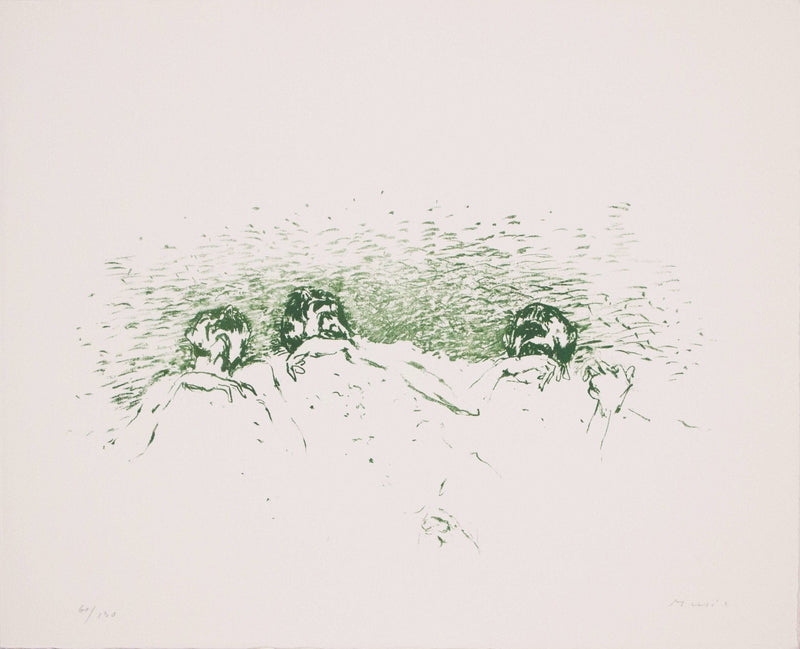
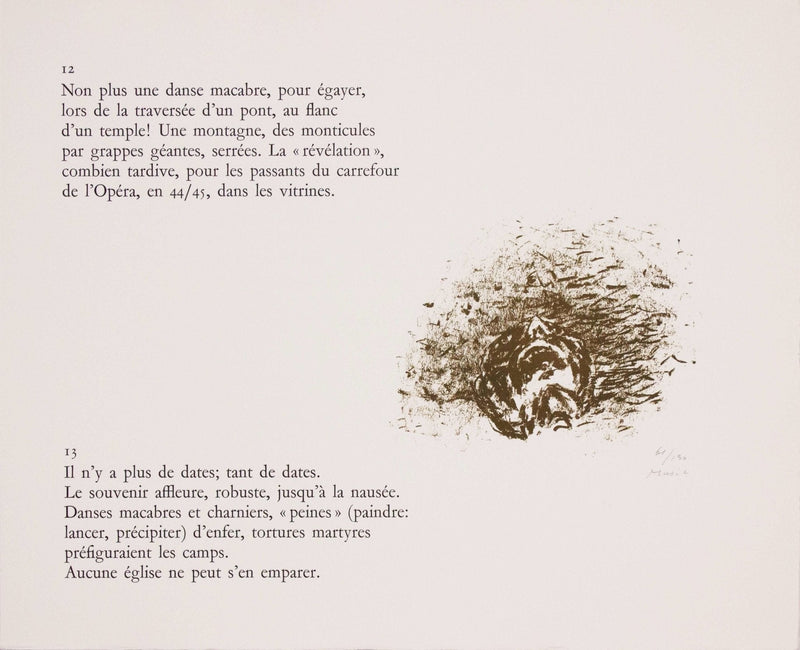
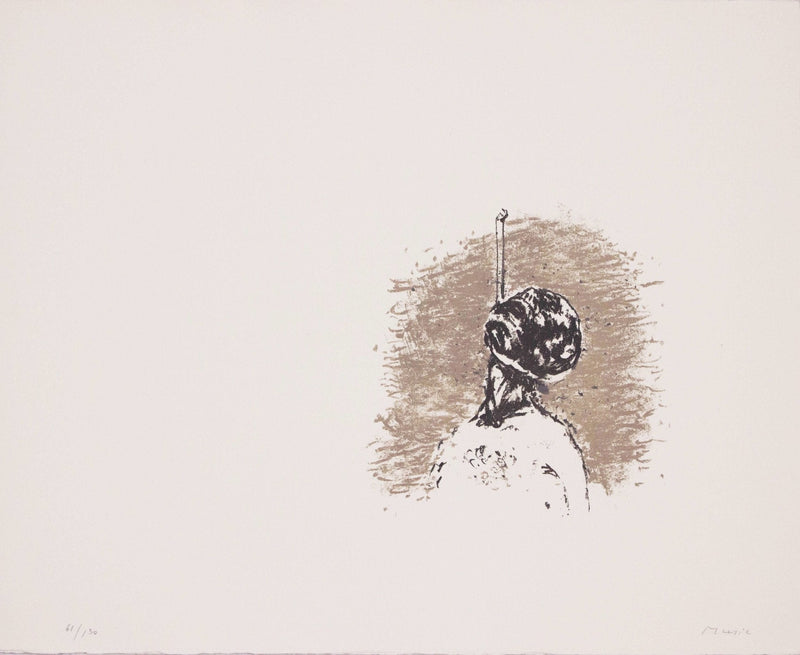
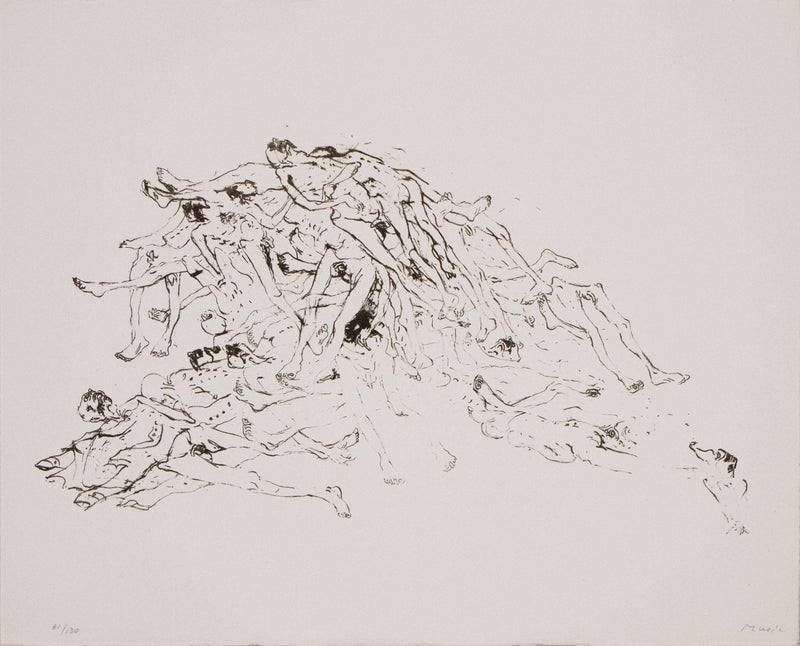
Starting from the Seventies, the cycle We are not the last (Nous ne sommes pas les derniers) brings the experience of the concentration camps back to the foreground, with dramatic intensity. Massed bodies, hollowed faces and figures reduced almost to skeletons emerge from essential surfaces. They are not images designed to produce a spectacular effect, but testimonies of a memory that cannot be erased. The title broadens the meaning of personal experience: violence does not only belong to the past, and the danger of its repetition concerns all of humanity.
Even in these artworks Mušič's language remains controlled. The subtraction of details accentuates the presence of the bodies, while the dull tones and rarefied surfaces make the silence part of the image. The human figure, already reduced to a sign in the landscapes, now returns as a direct testimony of vulnerability. It is one of the most important passages of his oeuvre, because it shows how an essential visual language can support a historical and ethical content of extraordinary depth.
The strength of the We Are Not the Last cycle also comes from its distance from a spectacular representation of horror. The bodies are returned with reduced means, often through a sparse design that accentuates their vulnerability. The surrounding emptiness becomes part of the story, because it allows us to perceive the absence and loss without filling them with details.
The title invites us to consider memory not as a concluded chapter, but as a responsibility aimed at the present. Mušič's painting thus shows how personal experience can be transformed into collective testimony without losing its intimacy. The language remains consistent with that of the landscapes, but the emotional tension that runs through it radically changes.
Engraving, lithography and artworks on paper
Mušič's graphic production includes engravings, lithographs and drawings, through which his sensitivity for the sign finds a particularly concentrated dimension. In engraving the line arises from the processing of the matrix and can suggest corroded surfaces, evanescent figures or barely perceptible structures; in lithography the relationship with the drawing allows freer passages and different tonal modulations. Paper becomes a suitable place to express the fragility of images, but each technique requires specific identification: it is not correct to call a print an etching just because it has a thin mark, nor to confuse an original artwork with a reproduction.
For the cataloging of one of your sheets, the documented technique, the signature, any numbering, the paper, the publisher and the catalog references are important. Mušič's artwork remains one of the most significant testimonies of art's ability to preserve historical memory and poetic experience together. In his landscapes as in the figures marked by suffering, the image does not impose a conclusion: it invites us to observe slowly and to recognize what resists time.
Do you like Zoran Mušič?
Leave your email to receive updates on newly available artworks and news about this artist.
Zoran Mušič
Art that lives in your spaces
Choosing an artwork by Zoran Mušič means making room for an individual artistic language. The artworks gathered here suggest combinations and perspectives to bring into your own surroundings, letting art guide your gaze.
DISCOVER THE ARTIST
Frequently asked questions
Answers to common questions about Zoran Mušič, the artist’s life, artworks and value on the art market.
Who was Zoran Mušič?
Zoran Mušič (1909–2005) was a painter and printmaker born in the area of present-day Slovenia, active for a long time between Venice and Paris. His oeuvre traverses landscapes, figures and memories of deportation, with a sober and intensely evocative pictorial language.
What does the series «We are not the last» by Zoran Mušič represent?
The series, also known by the French title «Nous ne sommes pas les derniers», reworks the memory of the artist's deportation to the Dachau camp. The skeletal figures and marked bodies become evidence of historical violence and a warning against its repetition.
What landscapes did Zoran Mušič paint?
Mušič represented karst and Dalmatian landscapes, hills, arid lands and Venetian views, often reduced to essential shapes and delicate tones. The memory of places matters more than topographical description: landscapes take on an interior dimension.
Did Zoran Mušič make engravings and lithographs?
Yes, graphics make up a significant part of his output. To identify a sheet it is necessary to distinguish between different techniques, verifying the title, publisher, edition size, signature and correspondence with the bibliographic documentation.
What factors influence the value of Zoran Mušič's artworks?
Period, subject, technique, quality of the specimen, provenance and state of conservation are relevant. Unique paintings and graphic artworks have different markets; even for prints it is necessary to distinguish original editions, proofs and reproductions.