
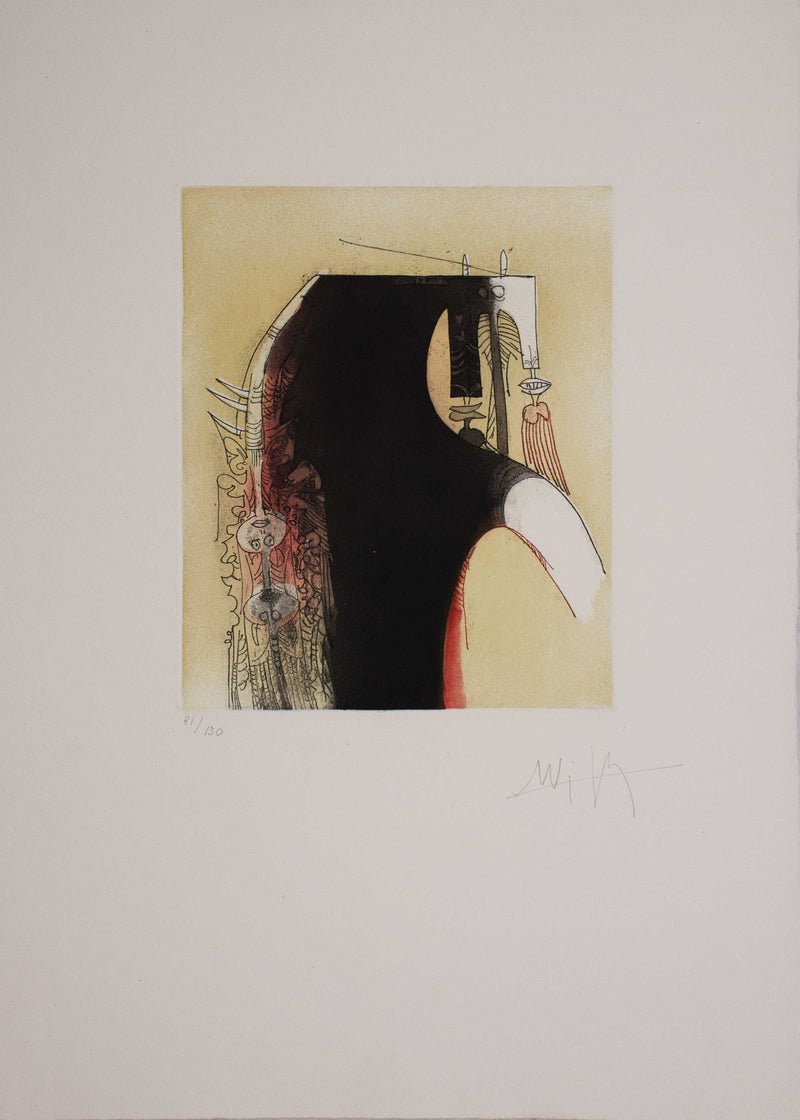
Painter, printmaker and sculptor
Wifredo Lam
Cuba, 1902–1982
Stay up to date with this artist
Leave your email to receive updates on newly available artworks and news about this artist.
Artworks by Wifredo Lam
1 artwork

Biography of Wifredo Lam
In the images of Wifredo Lam (Sagua la Grande, Cuba, 1902 – Paris, 1982), bodies may have animal features, plants may take on the appearance of human presences, and figures may transform into creatures that are difficult to classify. This universe does not arise from a simple taste for the fantastical: it takes shape through the encounter between the European avant-garde, Cuba's history, and Afro-Cuban…
Read the full biographyClose the biography
In the images of Wifredo Lam (Sagua la Grande, Cuba, 1902 – Paris, 1982), bodies may have animal features, plants may take on the appearance of human presences, and figures may transform into creatures that are difficult to classify. This universe does not arise from a simple taste for the fantastical: it takes shape through the encounter between the European avant-garde, Cuba's history, and Afro-Cuban cultural traditions. Lam developed a deeply personal language, capable of addressing colonialism, identity, and memory without turning painting into a literal illustration of ideas or rituals.
From Europe to the Return to Cuba
After his early studies in Havana, Lam moved to Spain in 1923 and pursued his artistic training on a continent undergoing major political and cultural transformations. During the Spanish Civil War, he supported the Republican cause; he later reached Paris, where he met Pablo Picasso and frequented avant-garde circles. His engagement with Cubism and Surrealism gave him new tools for breaking down the figure, altering proportions, and constructing images in which the logic of dreams coexists with a rigorous pictorial structure. But these influences alone cannot explain his oeuvre: Lam did not simply adopt a European language; he transformed it in response to his own cultural and historical experience.
Returning to Cuba in 1941, after many years abroad, marked a turning point. L’island was not merely the place where he rediscovered his roots, but a space where African heritage, Caribbean culture, and the consequences of colonial rule coexisted. Lam looked at this world without seeking a picturesque depiction of the tropics. Vegetal forms and hybrid figures became tools for making visible a complex history marked by slavery, exploitation, and cultural resistance. His painting challenges the exotic image of Cuba that an outsider might expect.
The Jungle and the Language of Metamorphosis
The painting The Jungle (The Jungle, 1943), held at the Museum of Modern Art in New York, exemplifies this exploration. The space is dense, almost devoid of traditional depth, and populated by elongated bodies, masks, limbs, and vegetal forms that overlap. The eye struggles to separate one figure from another: what seems human transforms into animal or plant, while the vegetation takes on an almost bodily presence. References to sugarcane also evoke an economic and social history that makes it impossible to read the work as a simple tropical fantasy.
Lam’s oeuvre features recurring mask-like heads, fixed eyes, horns, hooves, and composite anatomies. These elements do not make up a decorative repertoire to be deciphered through immediate equivalences; they acquire meaning through their continual transformation. The painter constructs a world in which identities are unstable and the picture’s surface becomes a site of encounter between cultures and memories. L’s oeuvre can be both seductive and unsettling, because the beauty of the forms does not erase the historical tension that runs through them.
Drawing, printmaking, and ceramics
The same energy can be found in drawing, where a quick line can bring a figure to life and immediately transform it into something else. Lam also devoted himself to original printmaking and artist’s books, developing his own imagery through processes that require a different relationship between mark, matrix, and surface. Later, he turned to ceramics in Albissola Marina, engaging with the material and the possibility of giving his forms a physical presence. These experiences do not represent a departure from painting, but extend its exploration into other mediums.
To understand one of his artworks on paper, it is necessary to distinguish between drawing, engraving, lithography, screenprint, and reproduction, checking the documentation for the specific edition. This technical variety accompanies a career that has spanned different places and cultures without losing coherence. Lam occupies a pivotal position in the history of twentieth-century art precisely because he shows that modernity is not an exclusively European story: it also arises from migration, exchange, and the ability to critically rework one’s roots.
Do you like Wifredo Lam?
Leave your email to receive updates on newly available artworks and news about this artist.
Wifredo Lam
Art that lives in your spaces
Artworks by Wifredo Lam open a window onto the imagination. In a contemporary interior, their presence invites you to pause and make room for unexpected visual encounters.
DISCOVER THE ARTIST
Frequently asked questions
Answers to common questions about Wifredo Lam, the artist’s life, artworks and value on the art market.
Who was Wifredo Lam?
Wifredo Lam (1902–1982) was an internationally renowned Cuban painter, known for a visual language that brings together European avant-garde art and Afro-Cuban cultural references. His oeuvre features hybrid figures, incisive marks and a complex imaginary world, and cannot be reduced to a single artistic movement.
What is the meaning of Wifredo Lam’s «La giungla»?
«La giungla» (1942–43), held at the Museum of Modern Art in New York, is one of the artist’s best-known artworks. The hybrid figures and dense vegetation evoke cultural and historical tensions relating to Cuba, identity and representations of the body. It is not simply a naturalistic view.
Was Wifredo Lam a Surrealist or a Cubist?
Lam engaged with both approaches but developed an independent visual language. Cubist fragmentation and Surrealist imagery provided tools that he reworked through his own history and references to Afro-Cuban culture.
Which figures and symbols appear in Wifredo Lam’s paintings?
Hybrid beings combining human, animal and plant forms, masks and biomorphic shapes appear frequently. These images may evoke Afro-Cuban traditions and cosmologies, but should be read with attention to the context of each artwork, avoiding formulaic interpretations.
Did Wifredo Lam make original lithographs and engravings?
Yes, alongside paintings and drawings, he produced prints. For collectors, it is essential to distinguish an original print made as part of the artist’s printmaking project from a later reproduction of one of his paintings, checking the technique, publisher, edition size and documentation.
Discover more artists
Explore more leading figures in modern and contemporary art


