
Painter and printmaker
Carlo Mattioli
Italian, 1911 – 1994
Stay up to date with this artist
Leave your email to receive updates on newly available works and news about this artist.
Works by Carlo Mattioli
1 work

Carlo Mattioli
Carlo Mattioli (Modena, 1911 – Parma, 1994) was an Italian painter capable of transforming simple subjects — trees, fields, landscapes, still lifes and figures — into images of great emotional intensity. His painting is recognized for its attention to matter, color and light, but above all for the way in which reality is internalized. The landscape is not a view to be described faithfully: it…
Read the full biographyClose the biography
Carlo Mattioli (Modena, 1911 – Parma, 1994) was an Italian painter capable of transforming simple subjects — trees, fields, landscapes, still lifes and figures — into images of great emotional intensity. His painting is recognized for its attention to matter, color and light, but above all for the way in which reality is internalized. The landscape is not a view to be described faithfully: it becomes memory, atmosphere, experience of time.
Training and figurative sensitivity
Linked to Parma, a fundamental city in his artistic career, Mattioli developed an independent path in the Italian panorama of the twentieth century. His research was born from a constant dialogue with the pictorial tradition, but progressively opened up to greater freedom of sign and matter. The images often retain a recognizable reference, despite moving away from the analytical representation.
The closeness to tradition did not prevent Mattioli from developing a deeply personal painting. The relationship with the masters of the past translated above all into attention to the structure of the image, to light and to the ability of color to create an atmosphere. His research does not proceed through programmatic breaks, but through progressive insights into a few motifs, observed and reinterpreted over time.
The repetition of a subject does not mean immobility. A tree painted in different seasons or with a denser material can become a completely new image. What changes is not only the natural data, but the emotional distance with which the artist observes it. This continuity allows us to recognize a coherent voice even in the transformations of the pictorial language.
This position makes it difficult to place him rigidly between figuration and abstraction. In many works the subject remains perceptible, but what matters is the relationship between the surfaces, the density of the color and the rhythm of the composition. The tree can become an isolated presence, almost a portrait; the field, an expanse of chromatic energy; still life, a silent balance between objects and space.
Trees and landscapes: nature as an internal experience
Among the motifs most loved by Mattioli are trees, often observed as organisms with their own individuality. Trunks, foliage and branches can be rendered with dense brushstrokes, energetic signs or chromatic surfaces that suggest the changing of the seasons. The subject is never just botanical: it becomes an image of resistance, fragility, growth and transformation.
Even landscapes are permeated by this sensitivity. The earth, the sky and the vegetation can be reduced to a few color relationships, while maintaining a strong evocative power. The viewer recognizes a possible place, but above all perceives a state of mind. Mattioli's painting thus demonstrates that fidelity to experience does not necessarily coincide with descriptive precision.
The landscape, in this perspective, is not limited to representing a portion of territory. The horizon line can almost disappear, the earth occupies a large part of the surface and the sky is reduced to a luminous presence. The result is not a topographic description, but a synthesis of sensations linked to place and time.
Isolated trees sometimes become monumental figures, while maintaining the fragility of living organisms. The variations in light and color can suggest the alternation of the seasons, but also the passing of memory. Nature thus offers Mattioli a repertoire that is only apparently limited: each element can be reinvented through gesture and matter.
Matter, color and light
A central element of his research is the physical quality of the pictorial surface. The color can be applied in a compact or vibrant way, allowing stratifications and variations in consistency to emerge. Light does not always come from a represented source: it often arises from the combination of shades and the way in which the material reflects or absorbs the gaze.
This attention to the surface invites us to observe the work closely, to grasp its concrete work, and from afar, to perceive its unity. The material details make sense in the overall composition. Even when the painting appears spontaneous, the relationship between solids, voids and backgrounds reveals a carefully considered construction.
In the more material works, the color seems to retain traces of the pictorial work. Accumulations, abrasions and overlapping passages build a surface that invites slow observation. Up close, individual gestures emerge; moving away, those same traces recompose into a unitary presence. The painting lives precisely on this double reading.
The relationship between figure and abstraction manifests itself here too. A field can almost appear to be an autonomous chromatic expanse, but the reference to the earth continues to orient perception. Mattioli does not erase the subject: he reduces its elements until the experience of the landscape coincides with that of color. It is a research that makes his painting recognizable without transforming it into a repetitive formula.
Drawing, illustration and graphics
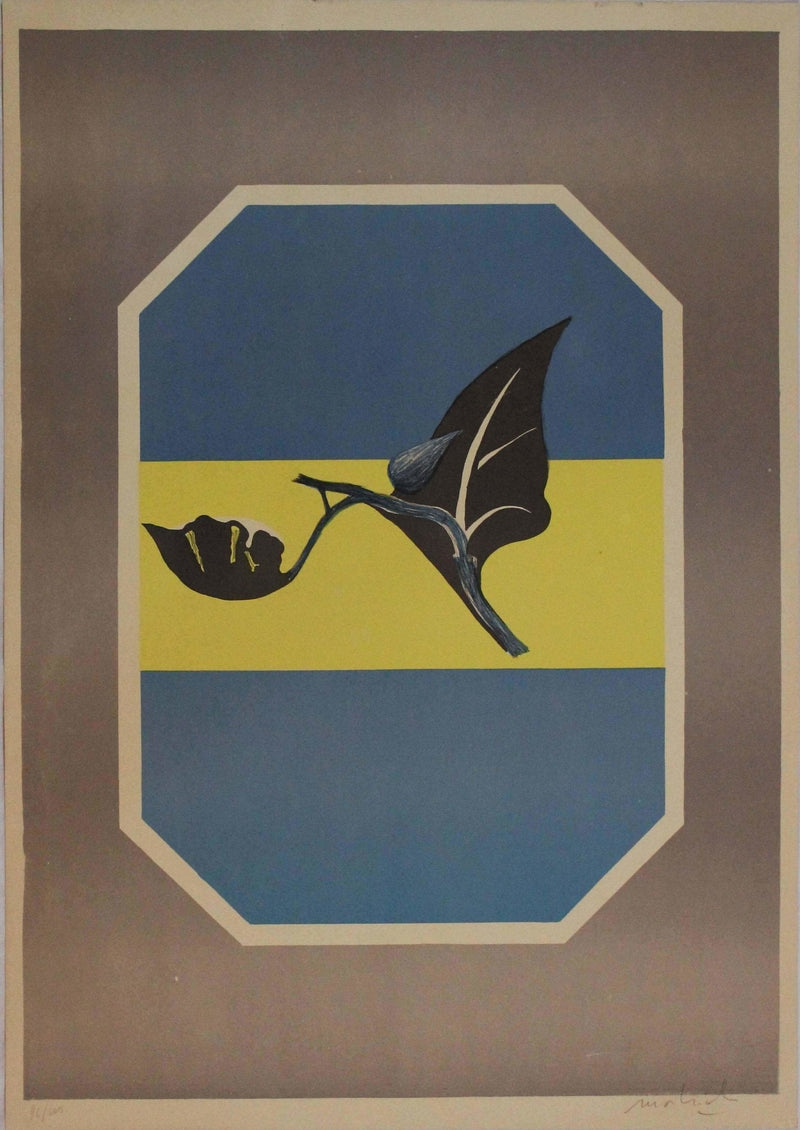
Alongside painting, Mattioli dedicated himself to drawing and production on paper, also in dialogue with the world of literature and illustration. In graphic works it is important to distinguish the original drawing from the art print and editorial reproduction. Lithography, etching and screen printing are different processes and must be indicated only when the technique of the specimen is documented.
The dialogue with literature is significant because it shows another aspect of his sensitivity. Illustrating a text does not necessarily mean describing every episode: an image can convey a tone, a pause or an atmosphere. In works on paper, the freedom of drawing allows us to explore relationships between sign and space that sometimes re-emerge in painting.
When a pictorial subject is captured in a print, it is important to check whether the image was conceived for that specific technique or whether it is a reproduction of a painting. An original lithograph implies a different printing process from a photographic reproduction; silk-screen printing requires its own matrices and steps. It is not correct to deduce the technique from the appearance of the image alone, especially when working with chromatic surfaces similar to those of painting.
For those who collect works on paper, signature, numbering, support, possible publisher and bibliographical references are relevant. Mattioli's strength lies in the ability to transform the ordinary into something essential: a tree, a field or an everyday object become places in which to recognize the depth of human experience.
The documentation of a graphic work should specify, when possible, the relationship between image and sheet, the presence of margins, the signature and any numbering. Paper also contributes to the visual experience: a more absorbent or smoother surface can change the perception of sign and color. For a painting, however, technique, support, dimensions and state of conservation are central.
Presenting these elements accurately helps to understand the variety of Mattioli's work without reducing it to a single iconographic motif. Trees, fields and still lifes thus become an opportunity to observe continuous research on the relationship between memory, light and matter, in which intensity arises from what is essential.
Do you like Carlo Mattioli?
Leave your email to receive updates on newly available works and news about this artist.
Carlo Mattioli
Art that lives in your spaces
Choosing a work by Carlo Mattioli means making room for an individual artistic language. The works gathered here suggest combinations and perspectives to bring into your own surroundings, letting art guide your gaze.

DISCOVER THE ARTIST
Frequently asked questions
Answers to common questions about Carlo Mattioli, the artist’s life, works and value on the art market.
Who was Carlo Mattioli?
Carlo Mattioli (1911–1994) was an Italian painter known for his poetic research on landscape, still life and the figure. His painting combines recognisability of the subjects and a strong attention to matter and light.
What are Carlo Mattioli's best-known subjects?
Recurring themes include trees, fields, poppies, still lifes and landscapes. Mattioli returns several times to the same subjects, modifying colour, pictorial density and atmosphere to explore new expressive possibilities.
Why are trees important in Mattioli's painting?
For Mattioli, the tree is a subject capable of uniting form, memory and perception of nature. It is not represented only in a descriptive way: it can become an isolated presence, constructed through chromatic matter and light.
How can you recognize Carlo Mattioli's style?
The works often show intense pictorial mixtures, sensitive colors and a progressive simplification of forms. Even when the subject remains recognisable, the painted surface acquires an autonomous presence.
What elements count for evaluating a work by Carlo Mattioli?
Period, subject, technique, size, provenance and documentation are relevant. A unique painting and an original lithograph have different characteristics: for both it is essential to verify authenticity and state of conservation.