
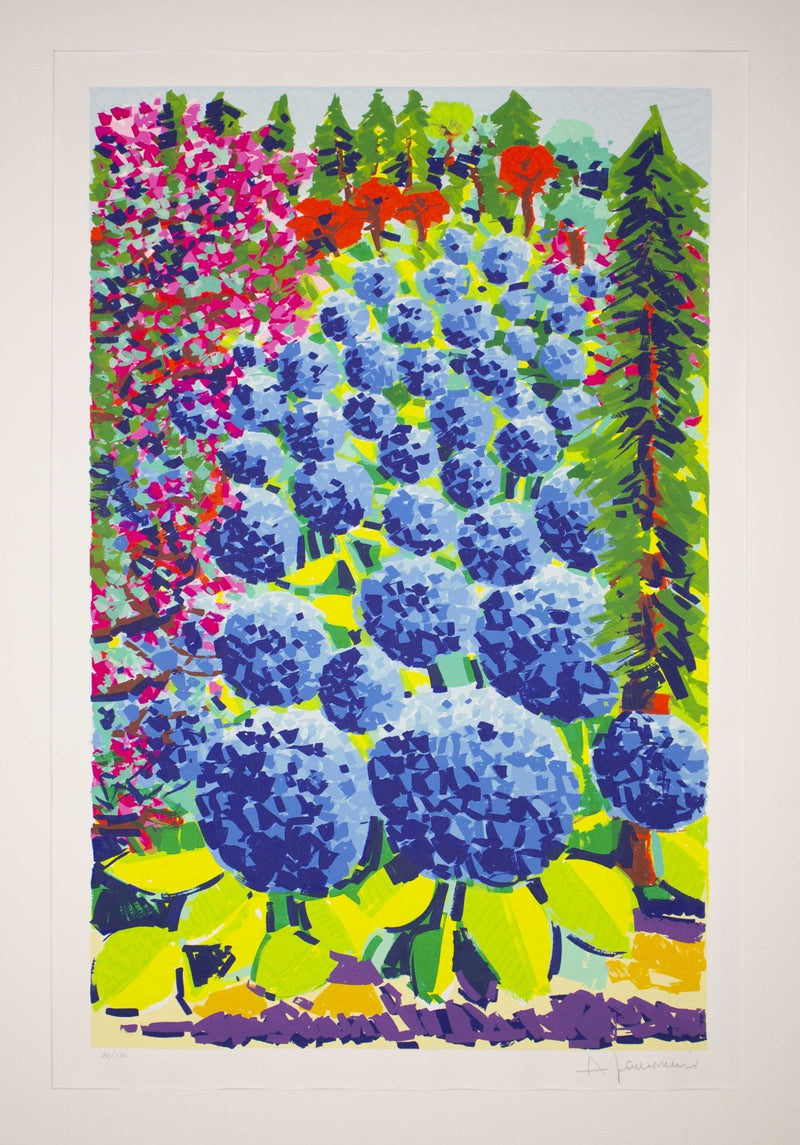
Painter
Athos Faccincani
Italiana, 1951 –
Stay up to date with this artist
Leave your email to receive updates on newly available works and news about this artist.
Works by Athos Faccincani
1 work

Athos Faccincani
Born in Peschiera del Garda on January 29, 1951, Athos Faccincani is a contemporary Italian painter known especially for the Mediterranean landscapes, flower gardens and compositions characterized by intense colors and bright atmospheres. Its production is distinguished by a vision of nature in which light plays a fundamental role, transforming real places and personal suggestions into images of great emotional immediacy. Behind the apparent serenity…
Read the full biographyClose the biography
Born in Peschiera del Garda on January 29, 1951, Athos Faccincani is a contemporary Italian painter known especially for the Mediterranean landscapes, flower gardens and compositions characterized by intense colors and bright atmospheres. Its production is distinguished by a vision of nature in which light plays a fundamental role, transforming real places and personal suggestions into images of great emotional immediacy. Behind the apparent serenity of his paintings, however, there is a complex artistic path, marked by an initial phase of intense expressive research and a subsequent transformation of the pictorial language.
Education and the first artistic experiences
Faccincani manifests since childhood a strong interest in drawing and painting. His passion initially develops in a family environment that is not in favor of artistic choice, a condition that leads him to devote himself to pictorial practice with particular determination. During his youth he frequents artists' environments and workshops, contacting figures such as Guidi, Seibezzi and Novati, from whom he learns not only technical aspects, but also the importance of discipline and continuity of work.
These experiences help to form a pictorial sensibility attentive to the relationship between observation and personal interpretation. The artist gradually understands that painting does not consist in the simple reproduction of what is seen, but requires a conscious choice of the elements to be valued. Color, composition and light become instruments through which to transform a visual impression into an image with its own identity.
After studying, Faccincani decided to devote himself fully to painting, starting a research that initially has very different characteristics than the production for which he will become more known.
The Expressionist period and a change in artistic language
Faccincani's youth works are linked to a sensibility expressionist, characterized by figures and atmospheres in which suffering, restlessness and emotional tension emerge. Painting is used as a tool to confront the most difficult aspects of human experience, through images in which color and composition contribute to building an intense psychological climate.
This phase is an important step in understanding the later evolution of the artist. The change towards a bright and colourful painting does not represent the result of purely decorative research, but an expressive choice matured through a personal path. After a period of distancing from pictorial work, Faccincani resumes painting gradually orienting his attention to nature, landscape and color ability to communicate positive sensations.
The transformation concerns both subjects and the way to organize the image. The darkest atmospheres are replaced by open compositions, in which light becomes protagonist and color acquires an intense presence. The landscape is no longer interpreted as a place of restlessness, but as a space in which to seek harmony, vitality and a more serene relationship with the world.
Light and color in Mediterranean landscapes
The most recognizable production of Faccincani is developed around the representation of Mediterranean landscapes, gardens, flowers and architectural glimpses. His works frequently evoke summer atmospheres, characterized by intense luminosity and decisive colour contrasts. The blue of the sea, the green of the vegetation, the yellow of sunlight and the bright shades of the flowers contribute to building images in which the color assumes an autonomous expressive function.
His painting presents affinity with some experiences ofImpressionism and Postimpressionism, especially for attention to light and color perception. However, Faccincani is not limited to recording a momentary impression. His compositions are often the result of a personal reprocessing, in which natural elements are organized to obtain a particular visual intensity.
The light plays a decisive role because it contributes to defining the overall atmosphere of the work. The surfaces seem to be crossed by a diffuse brightness, while the shadows are used to enhance depth and contrasts. The color does not only describe objects, but communicates a feeling of warmth and vitality that becomes an integral part of the meaning of the image.
Nature as an emotional experience
One of the most interesting aspects of Faccincani's research is the relationship between paesage and emotional dimension. Its views must not be considered necessarily topographic representations of precise places, but interpretations in which memory, observation and imagination are combined. A flowered garden or a glimpse of the sea can become opportunities to build an idealized image, in which nature appears particularly generous and bright.
This expressive choice allows the artist to develop an easily recognizable language. The compositions often favour an intense chromatic richness, with plant elements occupying an important part of the surface. Flowers and plants are not simple decorative details, but they help to define the rhythm of the image and the relationship between the first floor and depth.
The presence of architectures, terraces, paths and sea views introduces additional elements of balance. The built forms dialogue with the natural ones, creating a contrast between geometry and spontaneity. The observer is invited to ideally enter the represented space, following visual paths that cross the vegetation and lead to light openings.
The graphic techniques and the diffusion of the work
Beside painting, Faccincani also realizes original graphic works, through techniques that allow to transfer its chromatic language to different supports. Serigraphy, in particular, offers interesting possibilities for the construction of images characterized by intense sampling, overlapping and well-defined chromatic relationships.
In serigraphic works, the printing process requires careful organization of colours and matrices, allowing to obtain results in which brightness and compositional precision coexist. The graphic editions represent an important component of the diffusion of his work, making accessible the fundamental characteristics of his poetics also through formats and supports other than painting.
Throughout his career, Faccincani presents his works on numerous Italian and international exhibitions, developing a direct relationship with a public interested especially to the communicative force of his images. The recognisability of his language contributes to the diffusion of a painting in which the emotional dimension remains central.
The meaning of his research
The production of Athos Faccincani can be interpreted as a path through which color becomes a tool to transform personal experience into a bright vision of reality. The choice to represent lush gardens, Mediterranean landscapes and serene atmospheres does not necessarily entail the absence of complexity, but expresses the desire to attribute to painting a positive and vital function.
His work is distinguished by the ability to build images in which light, nature and color contribute to creating a coherent stylistic identity. Through an immediate but carefully organized painting, Faccincani proposes a vision of the landscape as a place of contemplation, memory and emotional participation, maintaining a recognizable relationship with the Italian and European figurative tradition.
Do you like Athos Faccincani?
Leave your email to receive updates on newly available works and news about this artist.
Athos Faccincani
Art that lives in your spaces
Choosing a work by Athos Faccincani means making room for an individual artistic language. The works gathered here suggest combinations and perspectives to bring into your own surroundings, letting art guide your gaze.
DISCOVER THE ARTIST
Frequently asked questions
Answers to common questions about Athos Faccincani, the artist’s life, works and value on the art market.
What does Faccincani paint?
Gardens, flowers and Mediterranean views dominate his mature work, with contrasts of light and colour.
What distinguishes his screenprints?
Layers and areas of colour retain the luminosity of his landscapes.
Which work is in the catalogue?
EmporiumArt lists La cascata delle ortensie blu (1997), a signed mixed-media screenprint.
How did his painting evolve?
His early work has an Expressionist character. Landscape and light became central in his mature work.
What does colour do in his landscapes?
Contrasts between plants, flowers and glimpses of the sea lead the eye from foreground to distance.