
Painter and printmaker
Alberico Morena
1926 – 2014
Stay up to date with this artist
Leave your email to receive updates on newly available works and news about this artist.
Works by Alberico Morena
1 work

Alberico Morena
Alberico Morena (Gubbio, 1926 – Spoleto, 2014) was an Italian printmaker, painter and teacher, best known for woodcut, which he explored with great technical refinement and narrative sensitivity. In his images, everyday life becomes a small theatre: squares, celebrations, trades, urban views and ordinary people are observed with a gaze that is both sympathetic and ironic. The artist does not seek spectacular effects, but constructs…
Read the full biographyClose the biography
Alberico Morena (Gubbio, 1926 – Spoleto, 2014) was an Italian printmaker, painter and teacher, best known for woodcut, which he explored with great technical refinement and narrative sensitivity. In his images, everyday life becomes a small theatre: squares, celebrations, trades, urban views and ordinary people are observed with a gaze that is both sympathetic and ironic. The artist does not seek spectacular effects, but constructs scenes capable of suggesting a story through gestures, distances and relationships between the figures. His work combines the rigour of the printmaking tradition with the ability to transform ordinary episodes into images suspended between realism and imagination.
The need for a documented reconstruction
Born in Gubbio, Morena trained at the Scuola del Libro in Urbino, a major centre of Italian printmaking culture. He attended the advanced course at the State Institute of Fine Arts and graduated in 1946, under Francesco Carnevali. Urbino gave him a rigorous knowledge of printing processes and a particular respect for manual work. For him, woodcut was not a quick way of multiplying images, but a practice requiring planning, control of the mark and an awareness of the relationship between printing block and paper.
One of his first significant works, La corsa dei ceri a Gubbio of 1946, already reveals his interest in collective events and the human landscape of his native region. The popular festival is not treated simply as a document: the movement of the figures and the structure of the composition transform the episode into a scene with its own rhythm. This relationship between observation and storytelling would remain central to his work, even as the subjects changed.
From 1951 to 1956, Morena taught Printing Technology at the School of Graphic Arts in Città di Castello. Having moved to Spoleto in 1956, he headed the local Art Institute from 1961 to 1977. Teaching accompanied his artistic practice and reflected its values: knowledge of materials, disciplined execution and respect for the quality of the work are integral to invention. Printmaking thus also became a body of knowledge to pass on, rather than solely an individual language.
The geography of Umbria and the Marche provided Morena with a repertoire of places and situations that recur in his works. Squares, buildings, gatherings and moments of public life are depicted with a particular sensitivity to their collective dimension. Yet these are not purely celebratory images: alongside involvement, a subtle ironic distance often emerges. Viewers can recognise a familiar episode while also perceiving a broader meaning, connected with the habits and contradictions of social life.
This narrative quality has also been recognised by critics and institutions devoted to printmaking. His works are held in Italian and international public collections. The National Gallery of Art in Washington holds, among others, woodcuts such as Sunflowers (1963) and La Grande Ruotta (1959). Their presence in a museum collection makes it possible to observe directly the technical quality of his prints and the variety of his subjects, from collective scenes to natural elements.
Technique, original works and documentation
Morena’s preferred technique was woodcut, particularly wood engraving on end-grain blocks. In this process, the image is created by working a wooden block: the areas intended to remain white are cut away, while those in relief receive the ink. Printing then transfers this relationship between solid and empty areas onto paper. With end-grain wood, the structure of the material allows particularly fine work, suited to closely spaced hatching and extremely delicate tonal variations.
Morena uses these possibilities to construct dense scenes without making them heavy. A mark may suggest the texture of a façade, the distance between figures or the atmosphere of a square; lighter areas introduce pauses and allow the eye to move. The quality of the engraving depends not simply on the number of details, but on how each stroke contributes to the legibility of the whole. In many works, technical precision coexists with a light, almost narrative tone that makes his language recognisable.
Alongside printmaking, Morena practised painting, developing related themes with different possibilities of colour. His paintings remained less well known than his wood engravings for a long time; the volume Morena pittore, edited by Nicola Micieli and published in 2001, helped document them. This relationship between different media shows the continuity of his artistic vision: everyday scenes and the human landscape retain their character even when the method of execution changes.
A full understanding of his work requires a distinction between an original print and a reproduction of a print. A woodcut printed from the block belongs to a specific artistic process; a photograph of the same image reproduced through publishing techniques is different in nature. The signature, any numbering, support, image and sheet dimensions, and provenance should be documented for each impression. The general catalogue Alberico Morena: opera xilografica 1947–2006, edited by Nicola Micieli and published in 2010, is a useful bibliographic reference for exploring his printmaking.
A particularly significant aspect is the relationship between the narrative character of the images and their technical construction. The scenes may appear spontaneous, but woodcut requires decisions in advance about which parts of the block will retain ink. The artist must therefore translate gestures and atmospheres into a system of essential marks. The precision of the process does not restrict the freedom of the story: it makes it possible. It is precisely this combination of planning and invention that distinguishes his works within the printmaking tradition of the twentieth century.
Morena’s significance lies in his ability to observe the ordinary world without trivialising it. The rigour of his craft and the delicacy of his gaze support one another: through woodcut, the artist restores a poetic dimension to everyday life, marked by irony, memory and attention to people.
Do you like Alberico Morena?
Leave your email to receive updates on newly available works and news about this artist.
Alberico Morena
Art that lives in your spaces
Choosing a work by Alberico Morena means making room for an individual artistic language. The works gathered here suggest combinations and perspectives to bring into your own surroundings, letting art guide your gaze.

DISCOVER THE ARTIST
Frequently asked questions
Answers to common questions about Alberico Morena, the artist’s life, works and value on the art market.
Who was Alberico Morena?
Alberico Morena (Gubbio, 1926 – Spoleto, 2014) was an Italian painter and engraver, known above all as a xylographer. Trained at the Urbino Book School, he developed a narrative figuration linked to daily life, popular traditions and the city of Gubbio.
What subjects appear in Alberico Morena's works?
The life of the community, the crafts, the festivals and the traditions of Gubbio recur in its production. The Festa dei Ceri is a particularly significant theme, told with personal participation. These subjects must be read in the context of the individual work, without attributing the same meaning to his entire production.
What is the characteristic technique of Alberico Morena's graphic works?
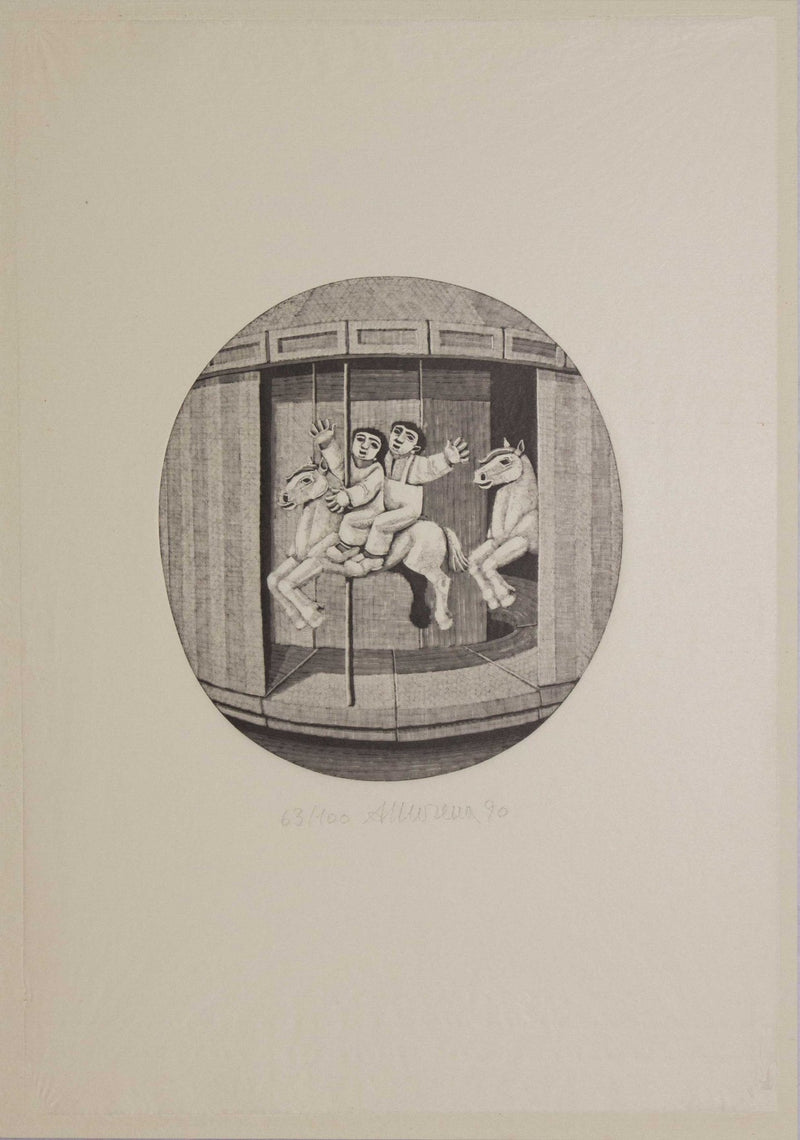
Morena is best known for xylography, a relief print obtained from an engraved wooden matrix. His work is also documented in headwood engraving. In the Emporium Art collection, the sheet for «The white horse» indicates the woodcut technique.
What do signature and edition mean on a graphic work by Morena?
The signature can attest to the artist's approval, while the numbering normally identifies an example within an edition. Both require verification: location, affixing method and consistency with the documentation are important for attribution.
What elements determine the price of a print by Alberico Morena?
Authenticity, technique, edition size, subject, size, conservation and provenance are central factors. A credible estimate requires documented comparisons with effectively comparable works, without attributing automatic values to the artist's entire production.