

Enzo Brunori biography
- ENZO BRUNORI PAINTER
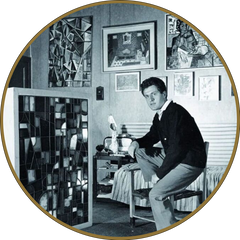
Enzo Brunori was an Italian painter, born in Perugia in 1924. It was precisely in the Umbrian cultural circles that he began, from a very young age, to take his first steps. He graduated from the Art Institute and met someone who would prove to be a key figure in his vocation for painting, Gerardo Dottori, an Italian painter of the Futurist movement, signatory of the Aeropainting manifesto. Many tried to convince him to move to Rome for a more active artistic participation, including the then minister and Roman governor Giuseppe Bottai, who was fascinated by his work during a visit to Perugia, also offering him the opportunity to continue his studies in the capital. But Brunori preferred to decline that invitation and continue his studies in his city.
It was during this period that the University for Foreigners of Perugia promoted summer courses featuring authoritative teachers such as Ungaretti, Zevi, Argan and Venturi whom he followed passionately and with whom he established a fruitful and lasting relationship.
Only later did his master Gerardo Dottori manage to convince Brunori to move to the capital where, in 1951, he held his first exhibition organized by the Art club of Enrico Prampolini at the Gallery Il Pincio. He arrived in Rome during the crucial period of the dispute between abstract and figurative art. The path to recognition was not easy for him because these were the dark post-war years, when art had no easy outlets. Thanks to tenacity and the support of many friends, particularly the backing of the art critic and teacher Lionello Venturi, he managed to make his way in the study of post-Cubist laws, drawing inspiration from nature and things while neglecting the interest in faithful reproduction of them. He went through a research period that his friend Venturi would later define as abstract-concrete, a research that culminated with a well-defined idea precisely in the 27 artworks he exhibited in the show organized at the Roman gallery Il Pincio, according to which the study of truth excludes any form of imitation. He presented works with a Cubist imprint such as Dry Flowers (1947), Tree (1949), Portrait (1948-1951) and with an artwork that most captured critics for the accurate study of Neoplasticism, Chair Coat Hat (1950). In the following years he ventured into freer paintings where color determines forms and rhythm, among these Mimosas and Mimosa Tree (1953). Between the 1950s and 1960s color took over, his coherent thought evolved towards what Crispolti calls "the poetics of color".
Equally important in those years was for Enzo Brunori the strong friendship bond with Enzo Rossi, an Italian painter who strongly supported the reasons of Cézanne's and Cubism's experience, rooted in the observation of space as the living body of the world; the same who then started an abstract experimentation based on a sense of linear and chromatic tension.
In 1953 the Abstract Art Exhibition was set up at the National Gallery of Modern Art in which Brunori participated with his artwork Painting (1952).
In 1955 he was among the artists invited to exhibit their works at the "Young Painters" exhibition at the Schneider Gallery in Rome: artists united by the non-figurative tendency. In the various works, Mimosas confirmed his emancipation of chromatic values, color assumed for the painter an autonomous expressiveness, intrinsic in all his suggestive capacity of the essence of the natural datum.
1956 marked a period of changes for the painter who was also introduced to the international art scene; in these years he exhibited in some shows abroad and participated in the twenty-eighth Venice Biennale exhibiting three canvases, After the Rain (1955), Inner Garden (1956) and The Green Tree (1956), alongside works by Burri and the abstractions of Dorazio.
He became a highly appreciated painter for his artistic coherence, admired and discussed by artists, critics, collectors, and dealers, not only Italian. In those years the "sea" became one of the elements of inspiration for Enzo Brunori who was overwhelmed by new emotional transports, bringing real stylistic changes; color took on more sensory and visceral traits in works such as Waves on the Rocks, Blue Sea and Sun on the Sea. One of his artistic inspirers was certainly Renato Birolli, an artist of the 1930s who identified with the search for a European cultural-artistic horizon and with the search for an art that was not archaizing but well rooted in the present and morally engaged.
The 1956 and 1959 Quadriennials and the 1958 Biennale proclaimed his artistic success, a success that however soon suffered a rapid halt.
The 1960s indeed determined in the artist a profound change of personal research that foreshadowed the prelude to a phase of self-exile, which he himself preferred to call a period of solitude, even refusing to participate in the Venice Biennale, openly contesting its qualitative decline. This public opposition led critics to no longer consider him at the public level.
In the following years he never stopped painting, presenting himself in 1961 with the two works Day is Reborn and The Great Mirror, capable of defining the full individuality of the artist. However, he remained distant from public exhibitions, except for rare exceptions chosen with careful accuracy.
He himself said in an interview that painting is not called to express judgments but to demonstrate quality, which requires much reflection and ways and times of work for him in contrast with the rules that art played at that time.
From 1965 he became a teacher at the Academy of Fine Arts in L'Aquila and at the same time directed the art institutes of Cortina and Civitavecchia; in 1977 he taught at the Academy of Fine Arts in Rome. His productions of the seventies and eighties, including The Blue Shaman (1976), Etching (1979) and Seagulls (1983) highlight the existential state of Brunori and the search for real elements in the use of colors.
In 1988 the city of Perugia dedicated an anthology to his artistic movement, a retrospective later repeated also in Faenza.
In 1992 he participated in the exhibition in honor of his friend Lionello Venturi "From Cézanne to Abstract Art", first set up in Verona and then in Rome.
In 1993 Enzo Brunori died due to an illness and, in the same year, the cultural association "Enzo Brunori" was established, desired and promoted in his honor by his life partner Vittoria Lippi, which collects all the artworks and the archive of the Perugian painter, remembered as the Shaman of Color.