

Visual artist
Paolo Scirpa
1934 –
Stay up to date with this artist
Leave your email to receive updates on newly available works and news about this artist.
Works by Paolo Scirpa
7 works
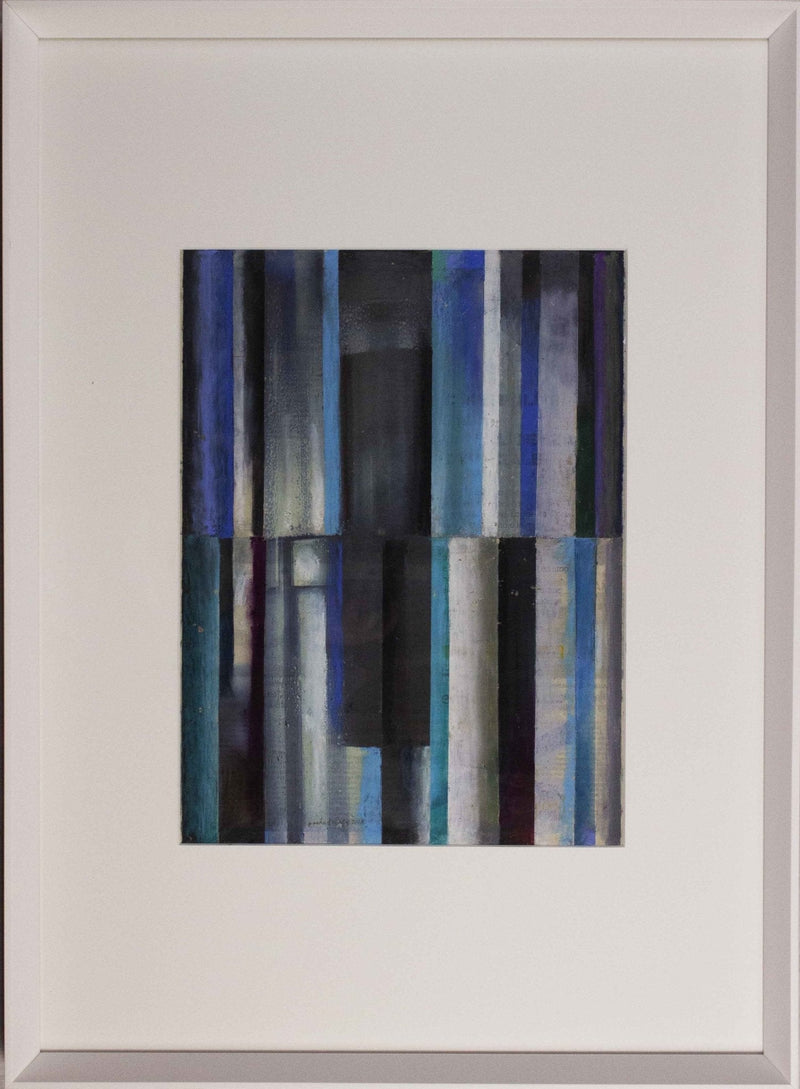
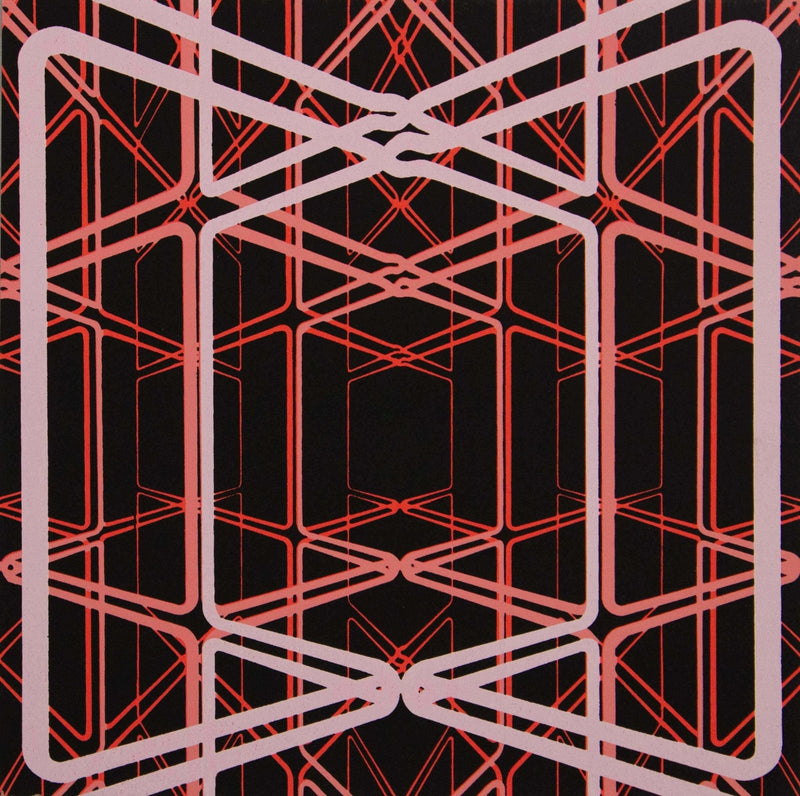

Paolo Scirpa
In the research of Paolo Scirpa (Syracuse, 1934 – Milan, 2025), light is not only what allows us to see a work: it becomes the material through which the work takes shape. Painter and experimenter of space, Scirpa has built a language in which neon, reflective surfaces, geometries and perception collaborate to suggest apparently infinite dimensions. His production crosses drawing, graphics, painting and installation, but…
Read the full biographyClose the biography
In the research of Paolo Scirpa (Syracuse, 1934 – Milan, 2025), light is not only what allows us to see a work: it becomes the material through which the work takes shape. Painter and experimenter of space, Scirpa has built a language in which neon, reflective surfaces, geometries and perception collaborate to suggest apparently infinite dimensions. His production crosses drawing, graphics, painting and installation, but maintains a constant question: to what extent does what we see coincide with real space?
From painting to experimentation with light
Trained artistically in Sicily, Scirpa deepened his knowledge of the European avant-garde in the 1960s, also frequenting the graphic circles of Salzburg. In 1965 he participated in the Rome Quadrennial and in 1968 he moved to Milan, the city in which he would develop much of his research and teach at the Brera Academy of Fine Arts. The encounter with a climate open to kinetic, optical and environmental research contributed to progressively shifting his interest from pictorial representation towards the concrete experience of the spectator.
The transition was not a simple abandonment of painting. Scirpa continued to question the surface and color, but began to consider the image as part of a more complex system, in which the position of the body, the movement of the gaze and the physical properties of light come into play. This context also includes works criticizing consumerism, such as Consumer Megalopoli from 1972, which show attention to contemporary society alongside perceptive experimentation.
The relationship with technology, in this perspective, does not coincide with an indiscriminate enthusiasm for machines. The devices make sense because they test how the body measures distance and attributes depth to what it observes. The transition from the pictorial surface to the environment does not eliminate the imaginative dimension of the painting: it makes it traversable with the gaze, without allowing the spectator to actually enter the space he thinks he sees. It is a productive contradiction, upon which Scirpa builds many of his most recognizable images. The relationship between the light on and the structure off is also significant: the object retains its materiality, but radically changes its appearance when the lighting system comes into operation.
Ludoscopes and the illusion of infinity
The most recognizable series is the Ludoscope series, developed starting in the seventies. Through the combination of light sources and mirrors, the artist creates structures that seem to open up far beyond their material limits. The device may have relatively small dimensions, but the repetition of reflections generates the sensation of an endless light tunnel. The work thus undermines an elementary certainty: the distance we perceive does not necessarily correspond to a distance that can actually be covered.
The term itself suggests a playful component, but the optical game leads to deeper questions. The luminous shapes sometimes recall an impossible architecture or a cosmic space; rigorous geometry coexists with an almost metaphysical suggestion. Scirpa doesn't just amaze with a technical effect: he uses illusion to make visible the unstable nature of our perception. In environmental projects, this research also enters into dialogue with architecture and public space.
The experience of Ludoscopes depends on the relationship between a light source, the reflection and the position of the observer. A sequence of repeated figures may appear to continue into a space that does not actually exist; by moving the point of view slightly, the alignments and the sensation of depth change. Geometric rigor is therefore not a simple ornament, but the condition that makes illusion possible. The title invites you to play, however the effect produced concerns a serious issue: the trust we place in sight. Scirpa shows that perception is a construction, continuously negotiated between physical characteristics of the object and mental interpretation. This awareness brings his work closer to optical-kinetic research, while maintaining its specific identity.
Painting, graphics and collectible works
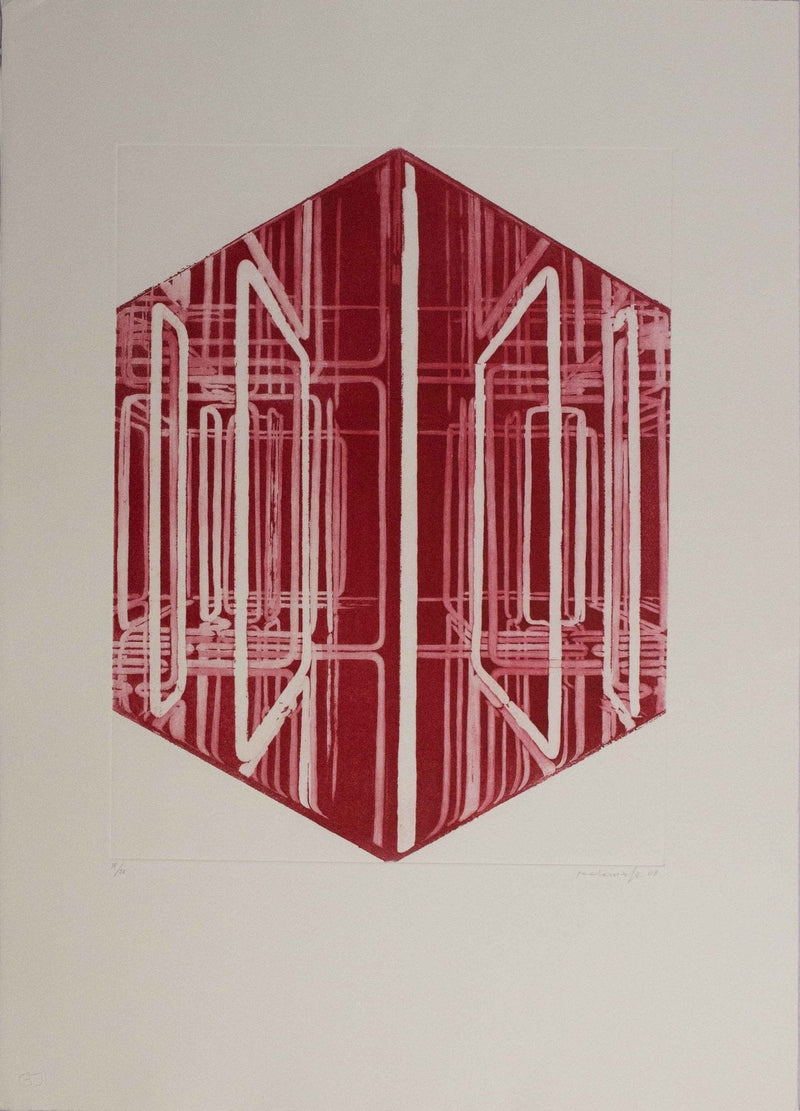
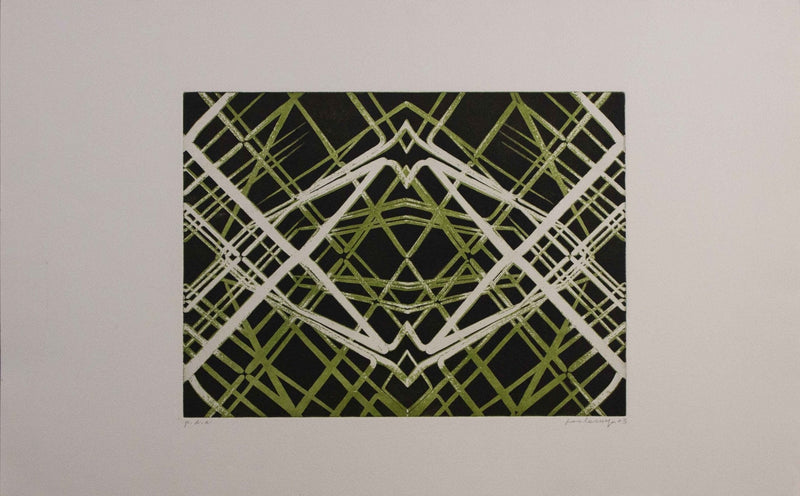
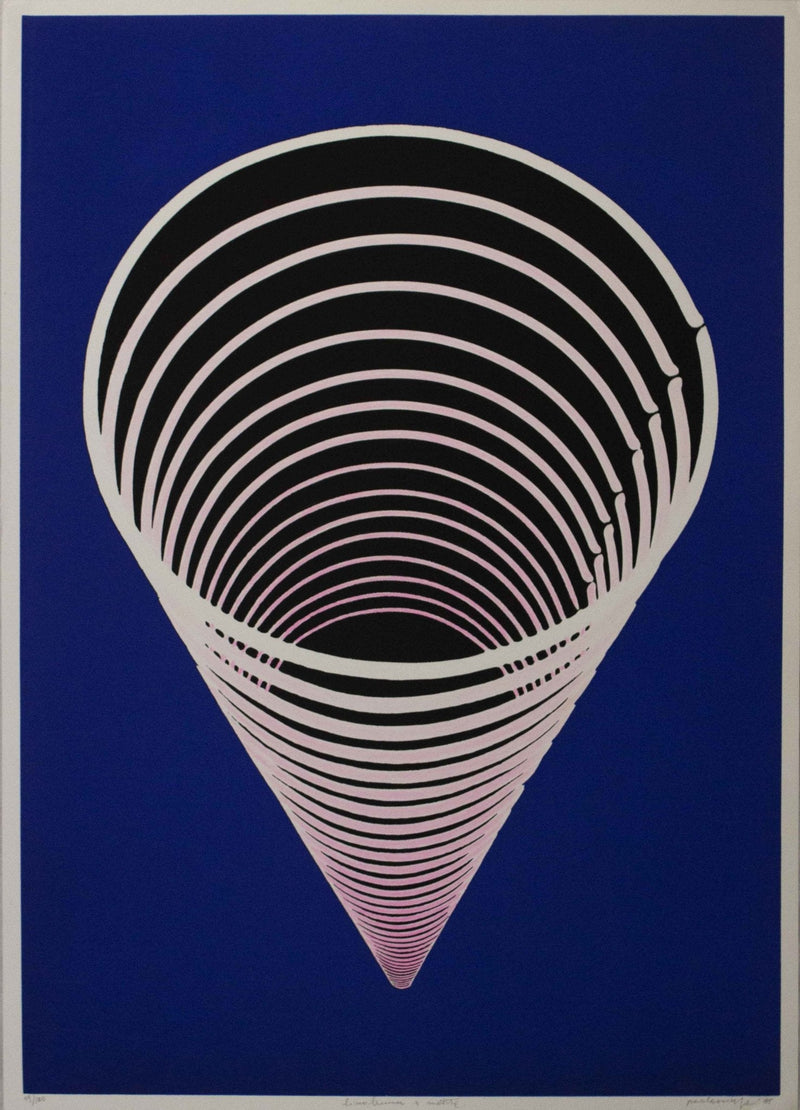
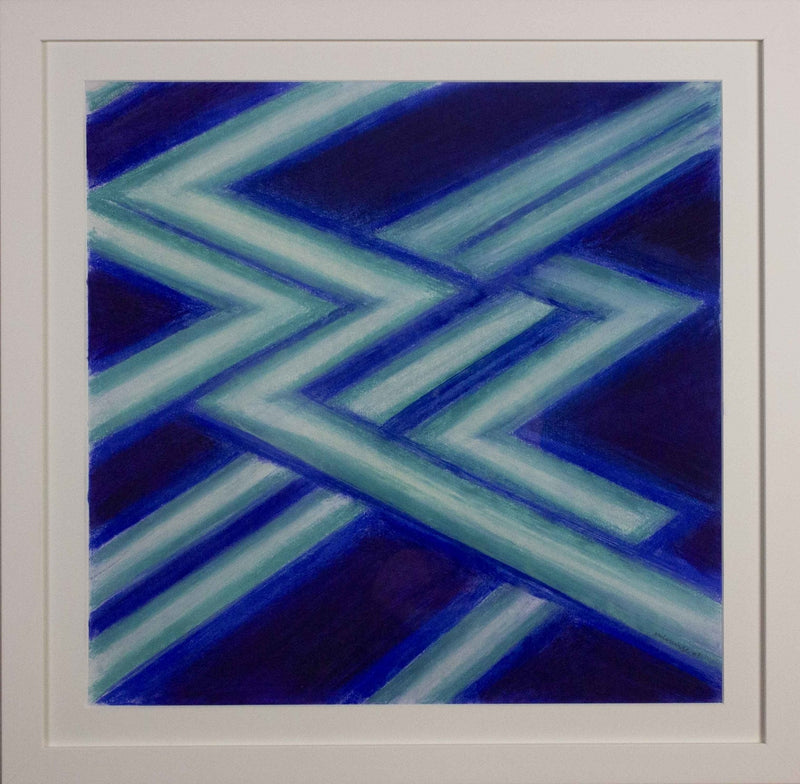
Even two-dimensional works can be read in relation to Ludoscopes. Concentric geometries, progressions and chromatic contrasts translate the idea of expansion and depth onto the surface, while the design maintains the design precision necessary for installations. In the prints, the relationship between backgrounds and lines allows us to observe how an apparently simple structure can generate visual movement.
When reading these works it is interesting to distinguish the actual depth of the support from the depth suggested by the composition. Geometric progressions, color contrasts and modular repetition can make one perceive movement even when nothing physically moves. It is a research that makes the sheet or canvas a space of autonomous experimentation, not an impoverished version of the installation. The relationship with the light devices remains evident, but the role of the observer changes: instead of finding himself in front of a lit structure, he must mentally reconstruct the movement suggested by the lines and backgrounds. Precisely this difference helps to understand the variety of Scirpa's production.
To correctly catalog a work by Scirpa it is important to distinguish between original work on paper, art print, project, multiple and light device. Materials, electrical components, technique, signature and possible print run require specific checks. His legacy lies in the ability to transform technological tools into a poetic reflection on light: what seems like an optical experiment becomes a way of imagining the infinite.
In the case of light devices, conservation presents different problems than those of a painting. The presence of mirrors, electrical power supply, light sources, any component replacements and operating methods must be documented. A photograph of the lit work only returns part of the experience, while an image of the switched off object can completely hide its perceptive quality. For graphic works, however, it is useful to check whether the geometry was conceived directly for printing or derives from another work. The distinction between original edition and reproduction does not depend on the complexity of the drawing, but on the process and documentation. This attention to materials allows us to understand how Scirpa has developed a coherent language through profoundly different supports.
Do you like Paolo Scirpa?
Leave your email to receive updates on newly available works and news about this artist.
Paolo Scirpa
Art that lives in your spaces
Choosing a work by Paolo Scirpa means making room for an individual artistic language. The works gathered here suggest combinations and perspectives to bring into your own surroundings, letting art guide your gaze.
DISCOVER THE ARTIST
Frequently asked questions
Answers to common questions about Paolo Scirpa, the artist’s life, works and value on the art market.
Who was Paolo Scirpa and what is he known for?
Paolo Scirpa (1934–2025) was an Italian artist known above all for his research on light and the perception of space. His works explore the relationship between surface, apparent depth and optical illusion, often through luminous and geometric structures.
What are Paolo Scirpa's «Ludoscopes»?
The Ludoscopes are works in which light, mirrors and geometries create the impression of a space that extends beyond the physical limits of the work. Their effect changes with the observation point, actively involving the viewer.
What is the role of light in Paolo Scirpa's art?
Light is not just a means of illuminating the image: it becomes an integral part of the work. Scirpa uses it to question the perception of depth and the boundary between real space and virtual space.
Does Paolo Scirpa belong to kinetic and programmed art?
Scirpa's research dialogues with optical-kinetic art and experiments on perception, but has a specific identity linked to the use of light and the illusion of depth. To classify a single work it is necessary to consider technique and period.
How do you recognize an original graphic by Paolo Scirpa?
It is necessary to examine the indicated technique, the possible numbering of the print run, the signature and the documentation of origin. An original artist print does not automatically coincide with a reproduction: the distinction depends on the creation process and the edition.