
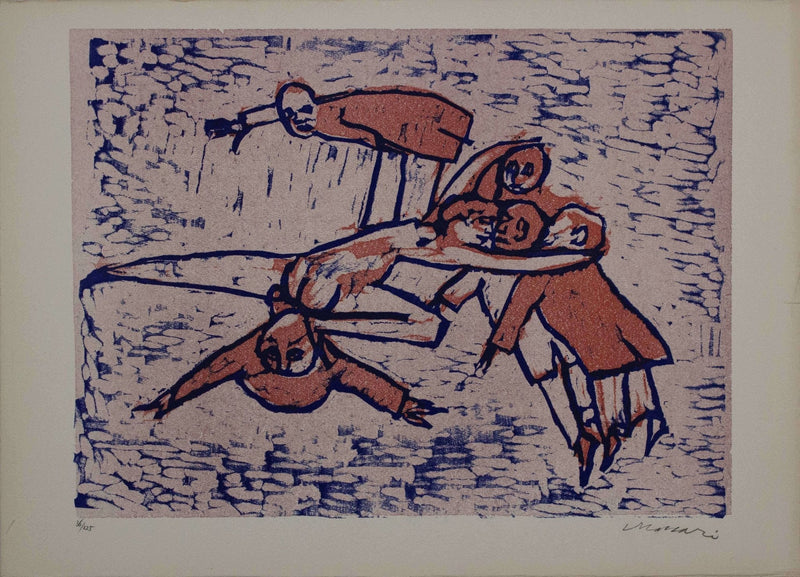

ARTISTIC TECHNIQUES
Linocut
From linoleum to paper, the strength of shapes.
A relief printing technique based on the contrast between cut-away areas and the raised surfaces that transfer ink to paper.
OUR LINOCUTS
Works to discover, choose and live with every day.
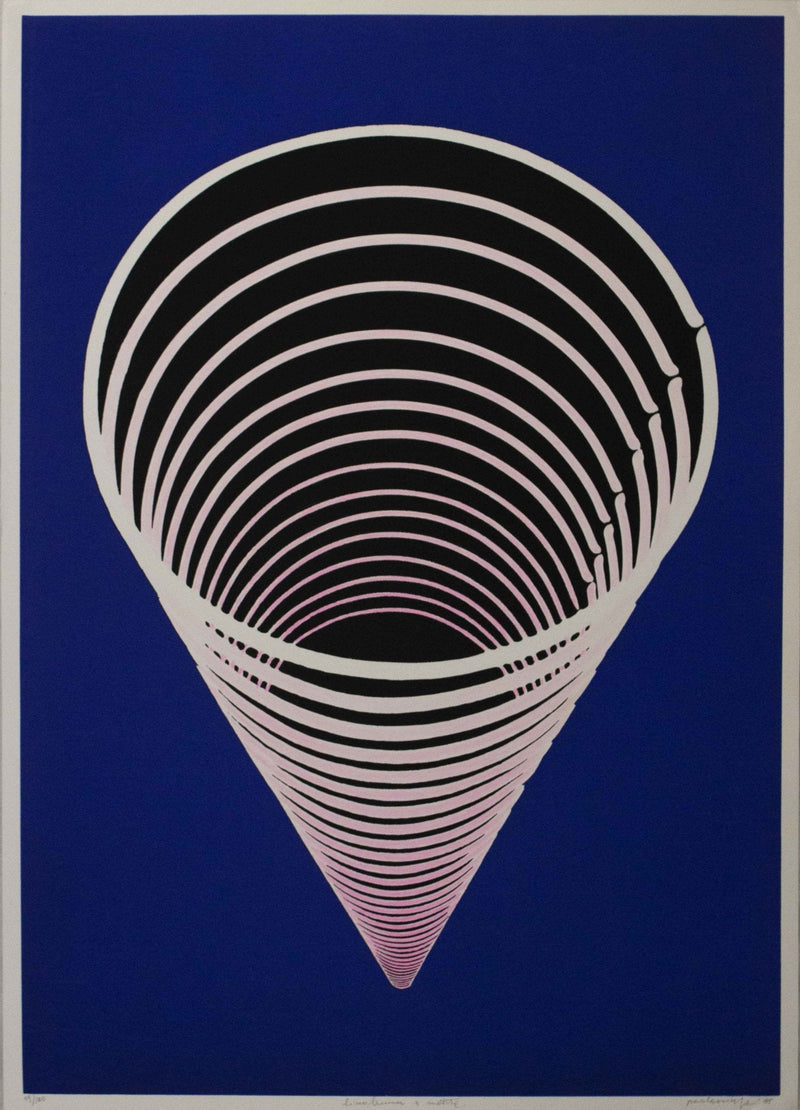
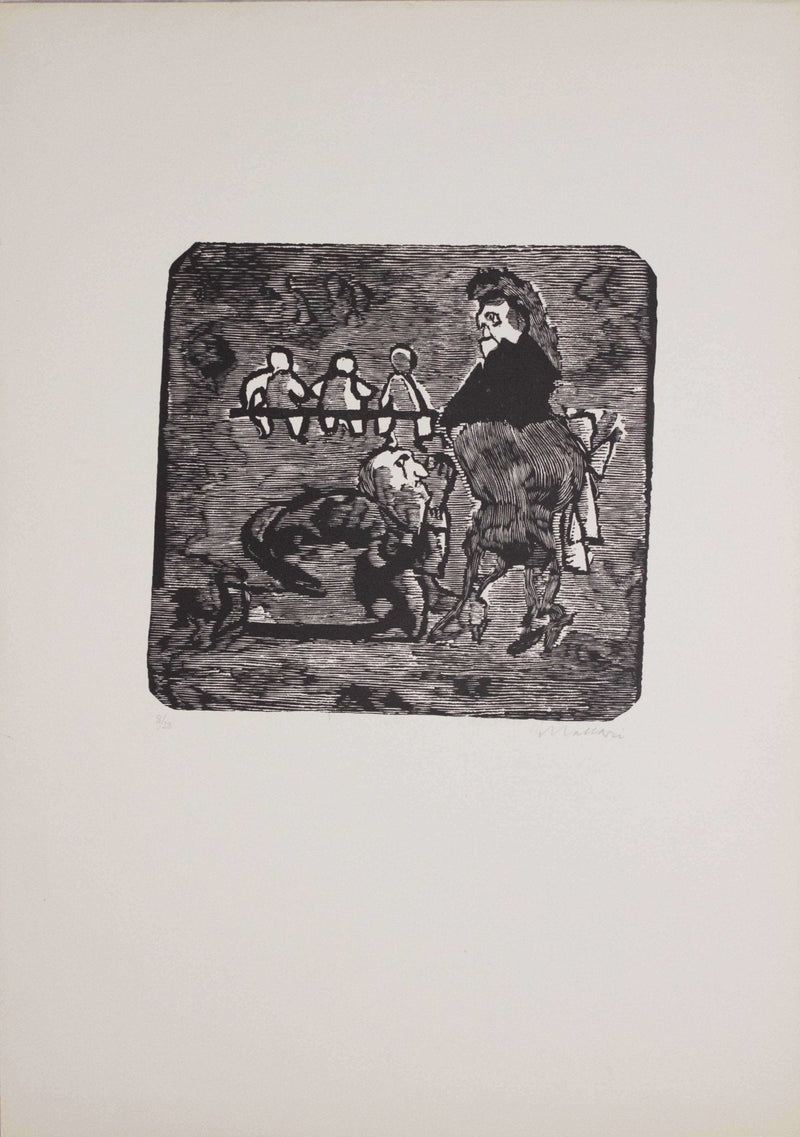

KNOWING ARTISTIC TECHNIQUES
What is linocut?
Linocut is a relief printing technique that uses a properly engraved linoleum block as a matrix. The artist removes the parts from the surface that are not intended to receive ink, leaving the shapes to be printed on paper in relief.
The process belongs to the same family as woodcut, from which it is distinguished mainly by the material used. Linoleum, free from the characteristic grain of wood, offers a relatively homogeneous surface and allows for fluid marks, clean shapes, and highly immediate compositions.
During printing, ink is applied to the raised parts and transferred to paper by pressure.
Linocut can be used for figurative images, abstract compositions, portraits, landscapes, and graphic explorations based on the relationship between full and empty spaces.
Particularly appreciated for the strength of the mark and the clarity of the shapes, this technique has found its place in modern and contemporary art, offering artists a direct, versatile expressive medium capable of producing very different results.
Origins — How and when linocut was born
Linocut is a relatively recent technique compared to woodcut and other traditional artistic printing processes.
Its spread is linked to the invention of linoleum, a material developed in the second half of the nineteenth century and initially intended mainly for the production of floor coverings.
The composition of the material, traditionally consisting of oxidized linseed oil, resins, fillers, and textile supports, made it compact enough to retain engraved shapes and soft enough to be worked with hand tools.
Between the late nineteenth and early twentieth centuries, linoleum began to be used for printing as well, first in decorative, educational, and craft contexts.
Artists gradually recognized its expressive possibilities, especially due to the ease with which it allowed for the creation of clean shapes and compositions based on the contrast between printed surfaces and white areas.
During the twentieth century, linocut acquired its own artistic identity, distinct from the mere imitation of woodcut.
An important contribution came from artists who explored relief printing as a modern language, emphasizing the simplification of shapes, the synthesis of the mark, and the energy of the compositions.
In the 1950s, Pablo Picasso developed an intense experimentation with linocut, creating works in which color and the construction of the image took center stage.
Particularly significant was his research into the progressively reduced matrix process, which allowed for multiple colors to be obtained through successive engravings and prints from the same block.
These experiments demonstrated that linoleum could be used not only for essential images but also for complex color compositions.
During the twentieth century, linocut also spread into illustration, editorial graphics, and the production of original prints, maintaining an important presence in art education.
The relative simplicity of the necessary tools encouraged its use by artists interested in directly controlling all stages of the process.
Even today, linocut is practiced both through traditional processes and in combination with contemporary techniques, retaining the allure of an image constructed through the progressive removal of material.
How it is made — From engraving the linoleum to printing
The creation of an original linocut begins with the preparation of a linoleum block intended to become the printing matrix.
The artist can draw directly on the surface or transfer a preparatory image onto it, keeping in mind that the resulting print will generally be mirrored relative to the matrix.
The drawing is then engraved using gouges and other cutting tools, which are used to remove the parts that are to remain white or not receive ink.
The areas left in relief constitute the surfaces intended for printing.
Unlike woodcut, in which the direction of the wood grain can influence the movement of the tools, linoleum has a relatively uniform structure that facilitates the creation of curves, outlines, and continuous shapes.
The artist can use gouges of different widths to obtain thin marks, wide grooves, and articulated surfaces.
Once the engraving is complete, ink is distributed over the raised parts using a roller.
The matrix is then placed in contact with a sheet of paper and subjected to pressure. The print can be made using a press suitable for relief printing or, for certain formats and processes, through carefully distributed manual pressure.
The ink transfers from the raised surfaces to the paper, while the recessed parts normally do not produce any impression.
To create multi-color images, different matrices can be used, each intended for a color component of the composition.
Another possibility is represented by the lost matrix technique, or reduction process.
In this case, the artist initially prints one color, further modifies the same matrix by removing other parts of the surface, and proceeds with the subsequent impressions.
Each new engraving progressively reduces the areas available for printing, making it impossible to return the matrix to its previous state.
The process requires careful planning of the color sequence and precise registration of the sheets.
Before the final edition, test prints can be made to check the inking, pressure, and legibility of the shapes.
The quality of the result depends on the precision of the engraving, the choice of paper, the characteristics of the ink, and the control of the various steps.
Linocut thus allows for the creation of original images in which the relationship between the engraved surface and the printed surface constitutes an essential element of the artistic language.
Characteristics — What distinguishes an original linocut
Linocut is distinguished by the strength of the contrast between the printed parts and those left white, a direct result of the relief engraving process.
The artist constructs the image by progressively removing material from the matrix, according to a logic in which empty space assumes an expressive importance equal to that of the surfaces intended to receive ink.
Linoleum allows for defined outlines, fluid lines, and uniform areas, favoring compositions in which the synthesis of shapes becomes a central element.
The absence of wood grain makes the surface particularly suitable for curvilinear marks and images constructed through continuous shapes.
This characteristic does not, however, imply that linocut must necessarily be geometric or abstract. The technique can be used for portraits, landscapes, figures, decorative compositions, and images of great complexity.
In color prints, the overlapping of impressions can generate intense color effects and particularly interesting visual relationships.
An original linocut is born from an image conceived and created through the engraving of the matrix, thus distinguishing itself from a simple photographic reproduction of a pre-existing work.
Like other original graphic techniques, it generally belongs to an edition composed of multiple copies.
The copies can be signed and numbered by the artist. A numbering such as 25/100 conventionally identifies a copy belonging to an edition of one hundred numbered copies, without necessarily indicating the chronological order of printing.
Artist's proofs, indicated with the initials P.A., and state proofs made during the process may also be present.
In the case of lost matrix linocuts, the process takes on a particular characteristic: the progressive removal of material prevents the same sequence of printing from being reproduced again from the original matrix.
This aspect contributes to defining the technical conditions of the edition, although it does not by itself constitute a guarantee of authenticity.
The signature, provenance, documentation, and information about the edition remain fundamental elements for correctly identifying the work.
The quality of the paper, the inking, and the state of conservation also affect the appearance of the individual copy.
Linocut continues to be appreciated for its expressive immediacy and for the ability to transform a relatively simple process into an artistic language of great visual strength.
For the collector, it represents an original form of fine art print, in which the gesture of engraving, the relationship between full and empty spaces, and the construction of shapes become an integral part of the work.
Art in interiors
A linocut, a thousand possibilities.
At home or in the office, the lines and contrasts of linocut bring character to your space.


FREQUENTLY ASKED QUESTIONS
Everything about linocut
Simple and clear answers to the most common questions.
What is the difference between linocut and woodcut?
Both are relief prints. Linocut uses a linoleum matrix, free from the wood grain used in woodcut.
What is a lost matrix linocut?
The artist prints one color and re-engraves the same matrix for each subsequent step. The removed material prevents the previous states from being reprinted.
How do you recognize an original linocut?
Verify the stated technique, provenance, edition data, and documentation. The signature and numbering help identify the copy.
What does 25/100 mean?
It indicates copy 25 of an edition of one hundred numbered copies. The number may differ from the printing order.
How do you preserve a linocut?
Protect the sheet from direct light and moisture. To frame it, choose conservation materials and leave a space between the paper and the glass.
Explore other art techniques
 Etching
The appeal of the etched line
 Aquatint
The nuances of intaglio
 Lithography
Freedom of line
 Screen printing
Colour takes shape
 Woodcut
The line cut into wood