

Painter
Tano Festa
Italian, 1938 – 1988
Stay up to date with this artist
Leave your email to receive updates on newly available works and news about this artist.
Works by Tano Festa
1 work

Tano Festa
A closed shutter, an unusable window, or a fragment of Michelangelo can become radically contemporary images. Tano Festa, a leading figure of the School of Piazza del Popolo, created an Italian Pop Art shaped not only by everyday objects and photographic techniques, but also by the visual memory of the Renaissance. His work transforms the familiar into something unexpected, suspended between quotation, irony, and melancholy.
Read the full biographyClose the biography
A closed shutter, an unusable window, or a fragment of Michelangelo can become radically contemporary images. Tano Festa, a leading figure of the School of Piazza del Popolo, created an Italian Pop Art shaped not only by everyday objects and photographic techniques, but also by the visual memory of the Renaissance. His work transforms the familiar into something unexpected, suspended between quotation, irony, and melancholy.
Rome and the School of Piazza del Popolo
Tano Festa was born in Rome on November 2, 1938. In 1952, he enrolled at the Institute of Art in Rome. In 1957, he earned a diploma in Artistic Photography. His photographic training would prove fundamental to his subsequent practice, particularly in his use of projected images, reproductions, and processes involving the transformation of photography. During his youth, he came into contact with Mario Schifano, Franco Angeli, and other key figures in Rome’s emerging art scene. These included Renato Mambor, Giosetta Fioroni, Cesare Tacchi, and Jannis Kounellis.
In the late 1950s, Festa joins the cultural milieu that would later be identified as the School of Piazza del Popolo. The group is not a strictly organized movement. It brings together artists united by an interest in moving beyond Informalism and exploring new visual languages. Caffè Rosati and Galleria La Tartaruga become key meeting places. Festa develops a personal approach in which objects and the memory of art play a central role.
Festa’s youthful drawings feature references to Surrealism and gestural painting. L'artist looks with interest at the artworks of Roberto Matta and certain currents in international abstraction. In 1959, he participates in a group exhibition at the Galleria La Salita in Rome, alongside Franco Angeli and Giuseppe Uncini. The participation marks his entry into the Roman art scene.
In 1960, Festa gradually abandoned informal gestural painting. He created his first monochrome paintings, characterized by surfaces dominated by a single color. Red takes on particular importance. The surface can be crossed by strips of paper or elements that alter its rhythm. L'artista develops a style of painting in which color and material structure take center stage.
In 1961, Festa introduced wooden slats into his compositions. The painted surface takes on a more object-like dimension. The painting is no longer considered merely a plane onto which color is applied. It becomes a physical structure. This transformation paves the way for his subsequent interest in everyday objects.
In 1962, Festa began using doors, windows, shutters, and wardrobes. The objects are reconstructed according to his designs, often stripped of their original functions. A window can be closed off and offer no view. A door can lose the ability to open. L'oggetto becomes an autonomous image. The transformation introduces an enigmatic dimension in which everyday meaning is suspended.
The object-based artworks bring Festa close to the movements of New Dada and Nouveau Réalisme. In 1962, he took part in the exhibition The New Realists at the Sidney Janis Gallery in New York. L'exposition brings together artists interested in transforming objects and images from contemporary life. Festa nevertheless develops a language distinct from that of American Pop Art. His repertoire includes above all objects, symbols, and references to the history of Italian art.
From Monochromes to Objects
Italian Pop Art is distinguished by its relationship with artistic and cultural heritage. Festa uses images that belong to the collective memory. Renaissance masterpieces become contemporary subjects. The quotation is not necessarily celebratory in character. It can prompt reflection on the reproduction of images and their meaning in modern society.
The relationship with Michelangelo is one of the most recognizable aspects of Festa’s work. L'artista takes details from the artworks of the Renaissance master, transforming them through color, enlargement, and simplification. The images can be projected onto the surface and subsequently reworked. The fragment takes on an autonomous meaning. The original figure is removed from its historical context and inserted into a new composition.
In 1967, during a stay in New York, Festa created artworks belonging to the series Michelangelo according to Tano Festa. The images are derived primarily from figures in the Medici Tombs. L'artist alters proportions, colors, and spatial relationships. Contemporary language thus enters into dialogue with the Renaissance tradition. Quotation becomes a creative process capable of transforming the image's meaning.
Another important element in Festa's production is the sky. Blue surfaces crossed by clouds often take on symbolic meaning. The theme is also linked to the memory of his brother, artist Francesco Lo Savio, who died in 1963. In 1967, Festa created The Sky, a monumental work dedicated to his brother. The composition transforms a material structure into an evocative image. The sky becomes a space of memory and absence.
In the 1970s, Festa continued to engage with the history of painting. He drew on references to Michelangelo, Leonardo, Manet, Cézanne, and other artists. Images may be accompanied by writing or reduced to fragments. A quotation is not the same as a faithful copy. L'artist alters the subject through his own language. The memory of art becomes part of the contemporary world.
Festa's photographic training helped shape some of his techniques. L'artist uses projected images and processes that make it possible to transfer figures onto a surface. In some artworks, he uses emulsion-coated canvases, enamels, and aniline dyes. The relationship between photography and painting allows pre-existing images to be introduced into new compositions. Technique thus plays a central role in transforming the subject.
Festa's production also includes screenprints, lithographs, and other graphic artworks. The printing techniques are consistent with his interest in reproducing and transforming images. Screenprinting makes it possible to work with areas of color and images derived from matrices. Lithography, by contrast, allows for a more direct relationship with drawing. The graphic editions may revisit recurring subjects, including Michelangelo, Renaissance figures, and symbolic motifs.
Michelangelo, photography, and memory
screenprint played a significant role in the dissemination of Festa's images. The process makes it possible to construct compositions through successive layers of color. Shapes can be simplified and arranged in defined areas of color. The printmaking technique is particularly suited to the language of Pop Art, based on the transformation of familiar images. For cataloging purposes, it is necessary to distinguish between original screenprints, reproductions, and prints produced later. The presence of a signature or numbering must be verified on each individual work.
In the 1980s, Festa developed a style of painting characterized by greater gestural freedom. The subjects include portraits, fantastical figures, and images connected with literature. L artist frequently used acrylic. Among his most distinctive works are the Confetti, compositions in which small colored elements are applied to the painted surface. Color takes on a lively, dynamic presence.
Over the course of his career, Festa took part in numerous exhibitions. He appeared at the 1964 Venice Biennale and returned to the event in subsequent editions. His artworks were exhibited in important Italian and international galleries and museums. In 1993, the Venice Biennale dedicated an exhibition to Tano Festa and his brother Francesco Lo Savio. L'exhibition helped reconstruct the relationship between two distinct protagonists of Rome's artistic scene.
Tano Festa died in Rome on January 9, 1988. His relatively brief career spanned some of the fundamental moments in the renewal of postwar Italian art. From Informalism to monochromes, from objects to the reinterpretation of Renaissance masterpieces, the artist developed an ever-changing artistic practice.
Tano Festa holds a central position in the history of Italian Pop Art. His originality lies above all in transforming the artistic heritage of the past into a repertoire of contemporary images. Through painting, objects, photography, and graphic art, he develops a language in which memory, reproduction, and invention become inseparable elements.
Do you like Tano Festa?
Leave your email to receive updates on newly available works and news about this artist.
Tano Festa
Art that lives in your spaces
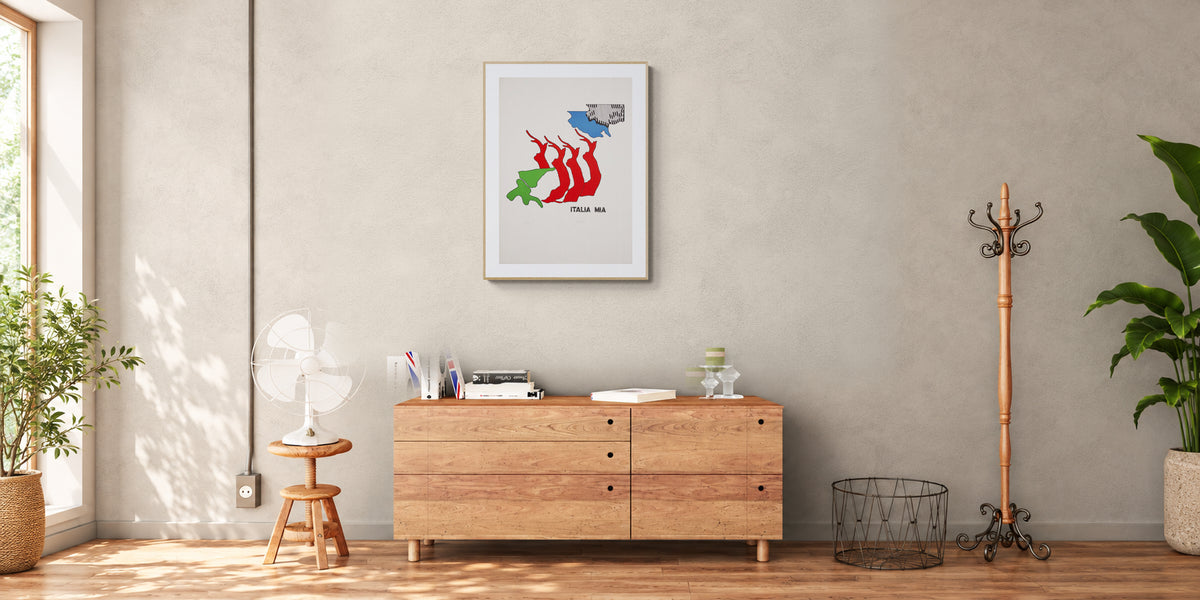
Works by Tano Festa bring the language of Pop art into everyday spaces. Paired with clean lines and contemporary furnishings, they become the starting point for a personal interior, open to colour and a dialogue with art.
DISCOVER THE ARTIST
Frequently asked questions
Answers to common questions about Tano Festa, the artist’s life, works and value on the art market.
Who was Tano Festa?
Tano Festa (1938–1988) was an Italian artist close to the so-called Piazza del Popolo School. His research reworks images from the history of art and objects from modern life, intertwining painting and mass visual culture.
Was Tano Festa part of Italian Pop Art?
He is frequently compared to Italian Pop Art, but his work maintains a specific relationship with the national artistic tradition. Quotes from Michelangelo and other historical masterpieces appear alongside contemporary images.
Why did Tano Festa take up Michelangelo's works?
Michelangelo's quotes allowed Festa to transform famous images into contemporary icons. They were not simple copies: the change in scale, color and context produced a new reflection on the way we see art.
What are the most recognizable subjects of Tano Festa?
Recurring motifs include windows, shutters, obelisks and quotes from the Sistine Chapel. To identify a specific work it is necessary to consider the period and the technique, avoiding attributions based only on the subject.
How much is a Tano Festa screen print worth?
There is no single value. Subject, edition, signature, numbering, print quality, conservation and provenance have an impact. The price asked by a seller does not necessarily coincide with the result of an actual sale.