
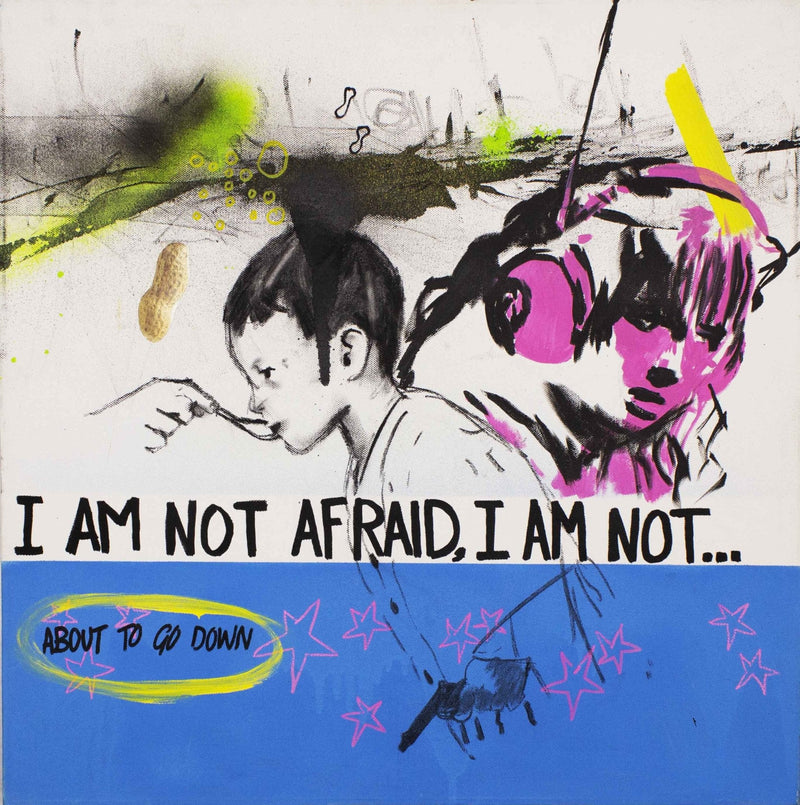
I am not afraid
i am not.., Mixed media (acrylic, charcoal, spray paint, marker and glitter)
$3,389.00
Visual artist
British, 1980 –
Leave your email to receive updates on newly available works and news about this artist.
i am not.., Mixed media (acrylic, charcoal, spray paint, marker and glitter)


Stuart Semple (Bournemouth, 1980) is a British artist whose practice intertwines painting, installation, experimental materials and public intervention. His work deals with contemporary visual culture, with the images of mass communication and with the emotional meaning of colour. Alongside the works created for galleries and exhibition spaces, Semple is known for having brought the debate on artistic materials out of specialist circles, transforming pigments and paints into tools for participation and discussion.
In Semple's painting, suggestions emerge from Pop Art, advertising language and the incessant circulation of images. Surfaces may appear seductive and luminous, but behind this immediacy there are often less reassuring themes: fragility, desire, memory, loss and the construction of identity. The artist uses an accessible visual grammar to interrogate the way society represents emotions and consumes images.
The interest in communication does not only concern individuals. The choice of intense colours, particular finishes and unconventional materials also contributes to changing the experience of the work. Painting becomes a place where the physical quality of the surface and its power of attraction are inseparable from meaning. For this reason his production cannot be traced back to a single style: the language changes, but the attention to the relationship between image and spectator remains constant.
The familiarity of the images used by Semple should not be confused with unambiguous communication. An alluring color can immediately draw attention, while the subject or context suggests the opposite feeling. It is in this distance that the artist often places his work: between what popular culture promises and what people actually experience. The reference to advertising language then becomes a critical tool, not just a repertoire of forms. Even the choice of materials with an unusual finish helps to create a physical relationship with the image. A very opaque, shiny or fluorescent surface does more than just color a composition: it changes the way light is absorbed or returned.
A well-known part of his activity concerns the creation and dissemination of artistic materials. Through initiatives related to particularly intense pigments and paints with a strong optical effect, Semple raised a simple and provocative question: who can access a color? The public confrontation around extremely black formulations, as well as the promotion of pink pigments and other materials, has transformed a technical question into a discussion on exclusivity and creative freedom.
The online circulation of these initiatives has contributed to their notoriety, because the discussion on color lends itself to immediately recognizable images and public discussions. However, the visual effect shown on a screen does not always coincide with that which can be observed in person. Performance depends on light, surface, photographic device and viewing conditions. This difference makes the project even more interesting: a material is presented through digital means that cannot fully restore its physical qualities. Semple also works on this distance between concrete experience and communication, transforming pigment into a meeting point between laboratory, image and public.
Colour, from this perspective, is not a luxury reserved for the few nor a purely commercial property. It is a tool through which anyone can experiment, imagine and produce images. The participatory dimension distinguishes these projects from traditional works: the public is not limited to observing, but can use the material and contribute to the circulation of the ideas it represents.
The debate on access to materials has taken on particular visibility through the public story linked to extremely absorbent blacks and the availability of artistic formulations. Semple responded to a topic often presented as exclusively technical with provocative initiatives and products aimed at a broad audience. It is important to distinguish the symbolic gesture from the material reality: different pigments do not necessarily have the same optical properties, the same resistance or the same conditions of use. The artistic interest of the operation also consists in making visible the system of patents, licenses, trademarks and distribution that can surround an apparently simple substance such as a color. The act of purchasing or using a pigment becomes part of a discussion about the control of creative possibilities.
Semple's practice includes paintings, works on paper, installations and projects involving unusual substances and surfaces. The experimental component does not eliminate the role of composition: the artist continues to question the relationship between form, color and perception, but often does so by highlighting the process that produces the image. The result can oscillate between irony and emotional intensity, between popular language and reflection on the art system.
This openness towards the public does not erase the difference between a participatory project and an autonomous work. In an exhibition, the meaning of a work depends on the composition, scale, layout and relationship with other objects; in the diffusion of an artistic material, however, creativity can be entrusted to people who will use it in unpredictable ways. The two dimensions coexist in Semple's practice and explain his presence both in the debate on art and in that on digital culture. For a collection it is therefore necessary to precisely describe what you own: a unique painting, a multiple conceived by the artist, a print in edition size or a commercial product. A similarity in brand or color is not enough to establish equivalence.
For works intended for collecting, it is appropriate to distinguish original paintings, editions, prints, objects and artistic products. The notoriety of a pigment or a formulation does not alone determine the status of a work: the specific project, the support, the technique, the possible print run and the documentation count. Semple's contribution consists above all in having shown that the discussion on color can concern both individual sensitivity and the social rules that define who creates and who can participate.
Leave your email to receive updates on newly available works and news about this artist.
Stuart Semple
Choosing a work by Stuart Semple means making room for an individual artistic language. The works gathered here suggest combinations and perspectives to bring into your own surroundings, letting art guide your gaze.

DISCOVER THE ARTIST
Answers to common questions about Stuart Semple, the artist’s life, works and value on the art market.
Stuart Semple is a contemporary British artist who works across painting, installation and participatory projects. His activity is also known for its reflection on colour, the accessibility of artistic materials and contemporary visual culture.
Semple attracted attention with artistic initiatives related to particularly intense pigments and colors, including pink. These projects have contributed to a public discussion on the relationship between ownership, exclusivity and the possibility of using color in art.
His works can address emotions, consumption, advertising languages and pop culture. Color is often used in a direct and recognizable way, but the meaning must be read in relation to the specific series or composition.
Some works dialogue with the imagery of Pop Art and mass communication, but defining him exclusively as a pop artist would be reductive. His practice also includes conceptual interventions and projects focused on participation.
It is useful to check whether it is an original edition, a signed print or a reproduction, as well as format, medium, number of copies and conditions. Any certification must refer precisely to the proposed work.